 Quran
Quran

| Key Takeaways |
| Learning Quran begins with Arabic letter recognition, progressing through Noorani Qaida before attempting full Quranic reading. |
| Tajweed rules govern correct pronunciation; learning them early prevents deeply ingrained mispronunciation habits in non-Arabic speakers. |
| Consistent 20–30 minute daily sessions produce faster, more durable Quran learning results than irregular longer study blocks. |
| Memorization (Hifz) becomes sustainable when paired with a structured daily revision system from the very first ayah memorized. |
| A qualified online teacher accelerates Quran learning by providing real-time correction unavailable through apps or self-study alone. |
Millions of Muslims across the English-speaking world want to read and understand the Quran but don’t know where to begin. The script is unfamiliar, the sounds are unlike English, and most available resources assume prior Arabic knowledge.
Learning Quran as a non-Arabic speaker follows a clear, teachable sequence: master the Arabic alphabet, build reading fluency through Noorani Qaida, apply Tajweed rules, then progress to memorization or deeper comprehension. Each stage builds on the last, and with the right method, any beginner can succeed.
Step 1: Learn the Arabic Alphabet to Start the Path of Reading the Quran
To learn Quran correctly, your first task is mastering the 28 Arabic letters — their shapes, sounds, and positional forms. Without this foundation, every subsequent stage becomes unnecessarily difficult.
Arabic letters change shape depending on their position in a word — initial, medial, final, or isolated. Most non-Arabic speaking beginners underestimate this. In our sessions at Buruj Academy, students who skip proper letter recognition often plateau at the reading stage because they are guessing shapes rather than reading them.
Why Does Pronunciation Accuracy Matter From Day One?
Arabic contains sounds that do not exist in English — letters like ع (ʿAyn), غ (Ghayn), ح (Ḥa), and خ (Kha) require specific throat and mouth positions. Mispronouncing these from the beginning creates habits that take months to correct later.
Our Al-Azhar-trained instructors at Buruj Academy teach these sounds using makharij al-huruf (articulation points) from the very first lesson — not as an abstract concept, but as a physical skill trained through listening and repetition.
Buruj Academy’s Online Quran Classes for Beginners provide structured letter-by-letter instruction with real-time pronunciation correction, giving non-Arabic speakers the precise foundation they need before touching a Mushaf.
Begin Learning Quran With a FREE Trial Lesson
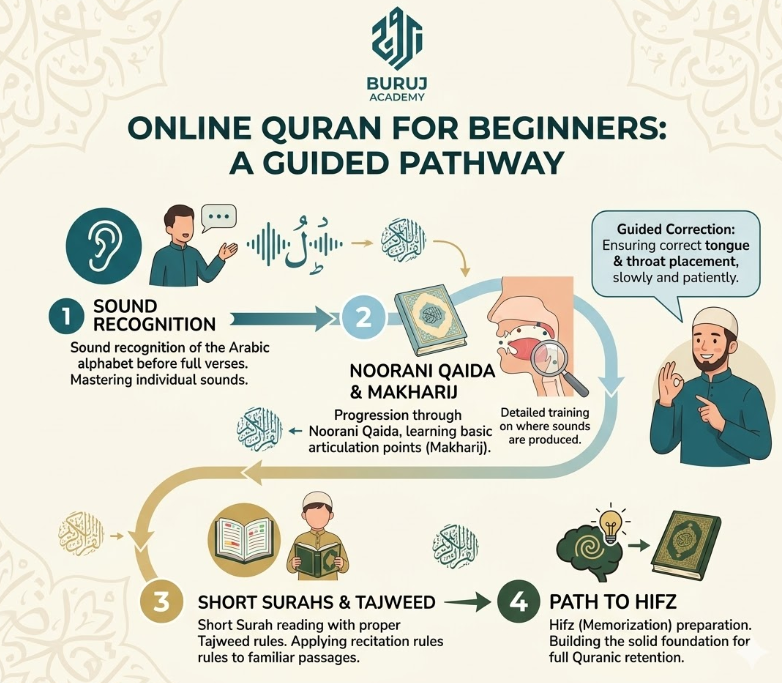
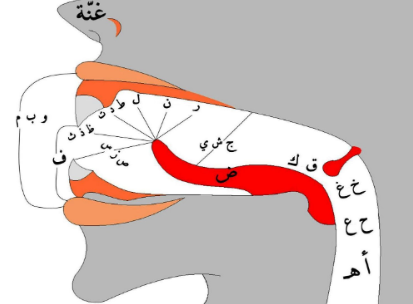
| Arabic Letter Group | Articulation Region | Common Beginner Error |
| ب، م، و | Lips (Shafawiyyah) | Confusing ب with English “b” — lacks full lip closure |
| ت، د، ط | Tip of tongue / upper teeth | Dental vs. alveolar placement confusion |
| ك، ق | Back of tongue / throat | Substituting ق with “k” sound |
| ع، ح، هـ | Throat (Halqiyyah) | Completely omitting the letter or substituting “a” |
Spend two to three weeks on letter mastery before progressing. This investment pays back in every stage that follows.
Read also: What Does the Quran Teach?
2. Work Through Noorani Qaida Systematically
Noorani Qaida is the gateway between knowing Arabic letters and actually reading Quran. It bridges isolated letter recognition and connected reading by introducing vowel marks (harakat), sukoon, tanween, shadda, and letter joining rules in a carefully sequenced progression.
Most adult beginners underestimate Noorani Qaida, assuming it is only for children. In our experience, adults who work through it properly — even in a condensed format — read Quran significantly more fluently than those who attempt to jump directly to the Mushaf.
What Noorani Qaida Actually Teaches
| Stage | Skill Developed |
| Isolated letters | Shape and sound recognition |
| Vowelled letters (harakat) | Short vowel reading: fatha, kasra, damma |
| Sukoon and joining | Reading consonant clusters |
| Tanween and shadda | Nunation and gemination sounds |
| Madd (elongation) | Long vowel identification |
| Connected words | Real Quranic word reading |
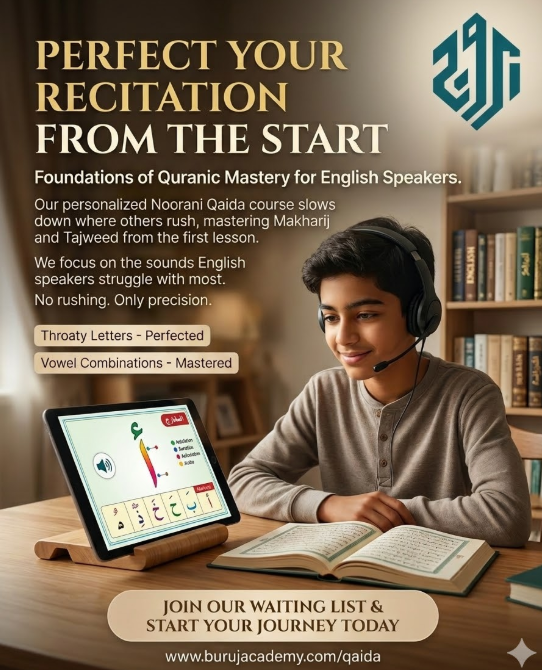
Buruj Academy’s Noorani Qaida Course integrates Noorani Qaida methodology with structured reading practice, ensuring beginners develop accurate reading reflexes before advancing to independent Quran recitation.
Book your FREE trial lesson in the Noorani Qaida course
If you are unsure where you currently stand, read our guide on reading the Quran for the first time — it walks through exactly what to expect at each early stage.
3. Begin Quran Reading With Short Surahs First
Once letter recognition and basic reading mechanics are in place, begin your actual Quran reading with Juz Amma — the 30th Juz containing the short surahs most Muslims already know from Salah. Starting here gives you immediate motivation through recognizable content.
Reading familiar surahs — Al-Fatiha, Al-Ikhlas, Al-Falaq, An-Nas — from the written page bridges the gap between hearing and reading. Students at Buruj Academy consistently report that this moment — successfully reading a surah they previously only heard — is one of the most motivating milestones in their Quran learning.
How to Structure Your First Reading Sessions
Keep early reading sessions short and focused: 15–20 minutes maximum. Read slowly, letter by letter if needed, prioritizing accuracy over speed. Speed develops naturally through repetition — accuracy does not fix itself.
Read each verse aloud. Silent reading does not train pronunciation or build the muscle memory needed for confident recitation. Always read to a teacher or use recorded recitation for immediate comparison.
Excel in Your Quranic Studies
Join Buruj Academy and master the Quran with our structured, professional curriculum.
Book Your Free Trial4. Learn Tajweed Rules to Read Quran Correctly
Tajweed is the set of rules governing correct Quran recitation — covering pronunciation, elongation (Madd), nasalization (Ghunnah), and rules governing Noon and Meem Sakinah. Learning Tajweed is not optional for those serious about reading Quran properly; it is the standard the Quran itself demands.
The most effective approach — what we call the Buruj Method’s sound-before-rules principle — is to train your ear and mouth to produce the correct sound before memorizing the rule’s Arabic name. Students who learn rule labels first without sound training can recite definitions perfectly but cannot apply them in live recitation.
Core Tajweed Rules Every Beginner Must Know
| Tajweed Rule | Trigger Condition | Practical Effect |
| Ikhfa | Noon sakinah/tanween before 15 specific letters | Nasal concealment for 2 counts |
| Idgham | Noon sakinah before ي، ن، م، و، ل، ر | Merging with or without Ghunnah |
| Iqlab | Noon sakinah before ب | Converting to Meem sound with Ghunnah |
| Izhar | Noon sakinah before throat letters | Clear, distinct pronunciation |
| Qalqalah | Letters ق، ط، ب، ج، د with sukoon | Echo/bounce release on the letter |
For a structured introduction to these rules, our guide on Tajweed for beginners explains each foundational rule with practical examples from the Quran.
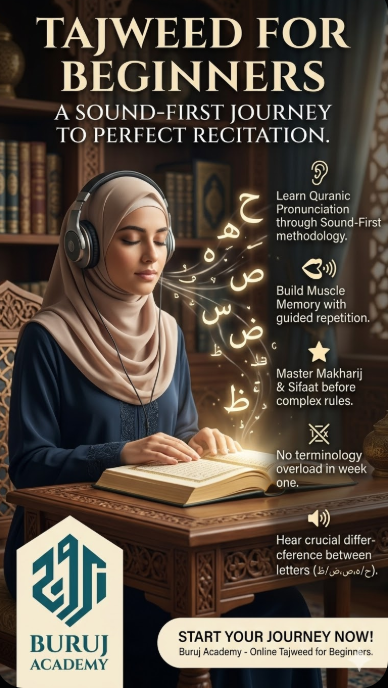
Buruj Academy’s Tajweed for Beginners course teaches these rules in sequence, with Ijazah-certified instructors providing real-time recitation correction so errors are caught immediately rather than reinforced through repetition.
Book Your FREE Trial Lesson to Begin Your Tajweed Journey
Read also: How to Get Ijazah in Quran?
5. Build a Daily Practice Habit Using a Realistic Quran Learning Schedule
Consistent daily practice is the single most decisive factor in Quran learning progress. In our instructors’ experience, a student who practices 20 minutes daily for 30 days outperforms a student who studies 3 hours on weekends by a measurable margin — both in reading fluency and in retention.
The reason is neurological: short, frequent exposure builds stronger reading pathways than infrequent intensive sessions. This is especially true for non-Arabic speakers whose brains are not wired for Arabic phonetics from childhood.
A Realistic Weekly Practice Structure for Beginners Learning Quran
| Day | Focus | Duration |
| Saturday | New lesson with teacher | 30 minutes |
| Sunday | Review and practice new lesson independently | 20 minutes |
| Monday | Reading practice — previous two lessons | 20 minutes |
| Tuesday | New lesson with teacher | 30 minutes |
| Wednesday | Review and practice new lesson independently | 20 minutes |
| Thursday | Combined review of all current week lessons | 20 minutes |
| Friday | Light revision + Recitation in Salah focus | 15 minutes |
Protect your practice time as you would any other appointment. Students who treat Quran learning as optional — fitting it in when time allows — rarely progress beyond the beginner stage.
Discover the Buruj Academy Difference
Step into our virtual classrooms and see how our expert instructors make learning Quran and Arabic intuitive and clear. We focus on overcoming the specific hurdles non-native speakers face, building your confidence and connection with the Quran.
6. Start Memorizing Quran (Hifz) With a Structured System
Memorization is within reach for every Muslim, regardless of age or prior experience. The key is starting small, starting correctly, and building a revision system from day one. Attempting to memorize without a revision plan is the most common mistake we see — students memorize new material but lose previously learned verses within weeks.
The Prophet ﷺ described the Quran as requiring constant maintenance: “Keep refreshing your knowledge of the Quran, for I swear by Him in whose Hand my soul is, it is more liable to escape than camels which are hobbled.” (Sahih al-Bukhari 5033)
A Proven Daily Memorization Framework
Start with one to three ayat per day — not more, regardless of how well the first session goes. Consistency matters more than daily volume.
Each session should follow this sequence: revise yesterday’s portion five times, revise last week’s portion twice, then learn new material. This three-tier revision system prevents the most common memorization failure: forgetting previously learned verses while learning new ones.
For a detailed memorization plan, our guide on building a Quran memorization schedule provides day-by-day frameworks you can adapt to your pace.
Buruj Academy’s Hifz Classes for Adults gives working professionals a realistic, personalized memorization pathway with Al-Azhar-trained Hifz specialists who adapt revision schedules to each student’s life demands and retention capacity.
Book Your Free Trial Lesson with Burruj’s Hifz Course for Adults

7. Learn With a Qualified Teacher, Not Apps Alone
Apps and YouTube videos are useful supplementary tools, but they cannot replace a qualified teacher for Quran learning. The reason is correction: Quran recitation errors are often invisible to the student — you cannot hear your own mispronunciation because your brain processes what you intended to say, not what you actually said.
A qualified teacher hears what you cannot. This is why the traditional method of Quran transmission has always been oral — teacher to student, with direct correction. Every Ijazah chain traces directly back to the Prophet ﷺ through this living transmission.
In our experience at Buruj Academy, students who use apps exclusively for 6–12 months often arrive with confidently wrong pronunciation patterns that require significant unlearning before real progress can resume. Early investment in qualified instruction prevents this entirely.
Buruj Academy provides 1-on-1 sessions with Ijazah-certified, Al-Azhar-trained instructors, flexible scheduling across global time zones, and personalized learning plans built around your current level — whether you are a complete beginner or returning student rebuilding after a gap.
Book a FREE trial session with one of Buruj’s Azhari Quran tutors

Excel in Your Quranic Studies
Join Buruj Academy and master the Quran with our structured, professional curriculum.
Book Your Free TrialStart Learning Quran With Buruj Academy’s Expert Instructors
Every step in this guide becomes faster and more effective with qualified guidance. Buruj Academy’s instructors are Al-Azhar University graduates and Ijazah-certified specialists with 12+ years teaching non-Arabic speakers globally.
Our Buruj Method — Sound-before-rules, Consistency-before-speed, Patience-before-performance — is designed specifically for adult and beginner learners building from zero.
- Personalized 1-on-1 sessions tailored to your level and pace
- Flexible 24/7 scheduling to fit any time zone or lifestyle
- Real-time pronunciation correction from lesson one
- Clear progression from alphabet to fluent recitation
Take the next step in your learning journey today by enrolling in one of our specialized programs:
- Online Quran Classes
- Online Quran Classes for Beginners
- Online Quran Classes for Adults
- Online Quran Classes for Ladies
- Online Quran Classes for Kids
- Quran Reading Course
- Quran Recitation Course
- Online Ijazah Course
- Online Qirat Course
Book your free trial lesson at Buruj Academy today.
Frequently Asked Questions About How to Learn Quran
What Is the Easy Way to Learn Quran by Heart for Non-Arabic Speakers?
The easiest way to learn Quran by heart is to start with short surahs from Juz Amma, memorize one to three ayat daily, and build a three-tier revision system from day one — revising yesterday’s portion, last week’s portion, and new material in every session. Pairing this with a qualified teacher prevents the mispronunciation habits that silently undermine memorization progress.
How to Learn Quran Easily When You Have No Arabic Background?
Learning Quran becomes significantly easier when you follow the correct sequence: Arabic alphabet first, then Noorani Qaida, then short surahs, then Tajweed rules. Skipping stages creates confusion that feels like inability — it is almost always a sequencing problem, not a learning problem. Our guide on what is the best way to memorize Quran breaks this sequence down further.
How to Learn Quran for Beginners?
Beginners should start with the Arabic alphabet and letter sounds — not the Mushaf itself. Once letters are recognised accurately, Noorani Qaida builds the reading mechanics needed for connected Quranic text. Most beginners who feel stuck started at the wrong point. Foundational letter and vowel mastery, taught by a qualified instructor, is the correct and only starting point.
What Are the Quran Basics Every New Learner Must Know Before Reading?
Every beginner must learn four core basics before reading Quran: the 28 Arabic letters and their positional forms, the three short vowel marks (harakat), sukoon and its effect on letter pronunciation, and the concept of Madd (elongation). These four elements, covered systematically in Noorani Qaida, give you the reading toolkit every Quranic word requires.
How to Learn Quran Quickly Without Sacrificing Accuracy?
The fastest path to Quran reading combines daily 20–30 minute practice sessions, Noorani Qaida completion before touching the Mushaf, and a qualified teacher providing real-time correction from lesson one. Students who attempt speed without accuracy consistently take longer overall — mispronunciation habits require months to reverse. Accuracy first is always the quicker route. Our guide on how to memorize Quran faster provides additional techniques.
How Can I Learn Quran Fast if I Only Have 20 Minutes a Day?
Twenty focused daily minutes is enough to make consistent, measurable progress. Use the first five minutes revising previous material, ten minutes on new learning with your teacher or structured resource, and five minutes reading aloud for fluency. This daily rhythm, maintained without gaps, produces faster results than longer sessions done irregularly. Protecting that daily window is the most important decision you will make.
How to Learn Quran at Home?
Learning Quran at home requires three things: a fixed daily practice time, a reliable structured resource such as Noorani Qaida, and at minimum two weekly 1-on-1 sessions with a qualified online teacher for pronunciation correction. Apps and recordings support practice but cannot replace live correction. Buruj Academy’s fully online 1-on-1 sessions make qualified instruction accessible from any home, in any time zone, with fully flexible scheduling.