 Arabic
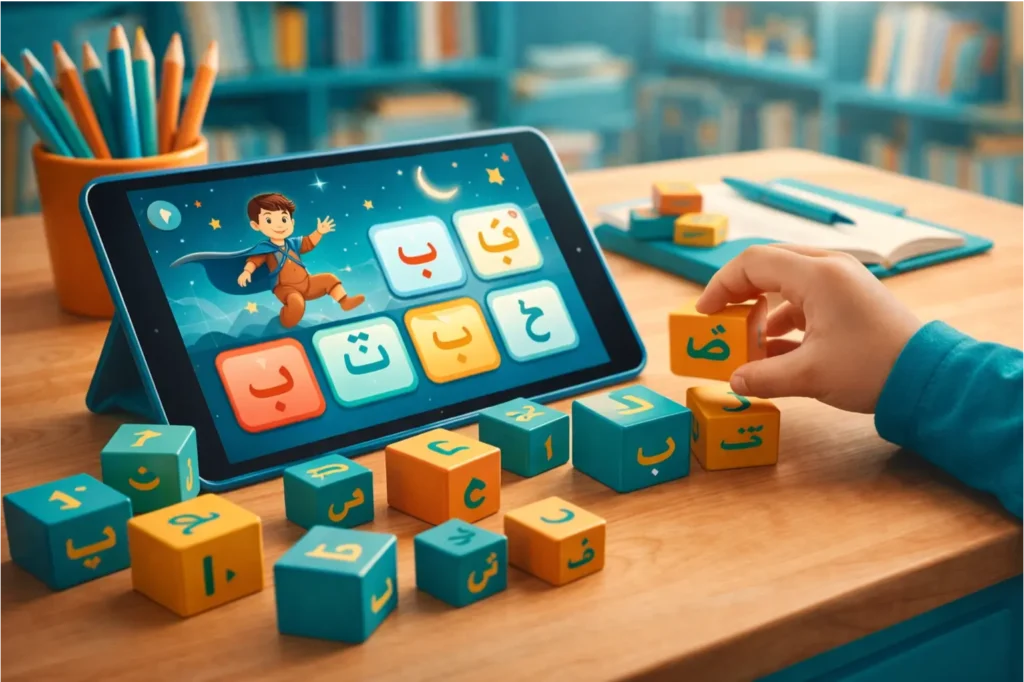
Many parents want their children to connect with Arabic but feel unsure where to begin. Watching your child struggle with unfamiliar letters and sounds while trying to stay engaged is genuinely challenging, especially without an Arabic background yourself.
Arabic learning for kids thrives on six gradual stages: joyful letter recognition, word associations, sound mastery with vowels, fluency through games, simple Quranic word reading, and short daily routines. Combined with age-based speaking practice and structured online guidance, progress becomes steady, realistic, and confidence-building.
How to Learn Arabic for Kids?
Learning Arabic for kids works best when broken into small, joyful steps. This guide walks parents through six practical, age-tested stages—from letter recognition to simple Quranic words—with realistic timelines and activities children genuinely enjoy.
Step 1 Is to Help Kids Learn Arabic Letters Through Songs and Shapes
Arabic has 28 letters, and that number alone can feel overwhelming. The key for young learners is starting with shape recognition, not memorization pressure.
Sing the Arabic alphabet to a simple tune—many are available on YouTube. Point to letters on colorful charts daily for just 5–10 minutes. Children aged 4–7 absorb letters fastest through repetition paired with movement and sound.
At Buruj Academy, our Online Arabic Classes for Kids teach each letter through stories and songs—children learn ب through بيت (house) and ت through تفاحة (apple)—making the alphabet memorable rather than mechanical.
Book your child’s free Arabic trial now!

Step 2 Is Connecting Arabic Letters to Everyday Words Kids Already Love
Once children recognize most letters, link each one to a familiar word or image. This bridges recognition with meaning, which accelerates retention significantly for young learners.
| Letter | Arabic Word | Meaning | Memory Tip for Kids |
| ب | بيت | House | “B is for Building” |
| ك | كتاب | Book | “K is for Knowledge” |
| م | ماء | Water | “M is for More water!” |
| س | سمك | Fish | “S is for Swimming fish” |
Word-picture associations like these help children aged 5–10 recall letters three times faster than drilling alone. Keep a homemade chart on the fridge for daily reference.
Step 3 Is Teaching Kids Arabic Letter Sounds Before Full Word Reading
Reading Arabic requires knowing how each letter sounds in different positions—beginning, middle, and end of words. This step is where many parents skip ahead too quickly.
Introduce short vowel sounds (fatha, kasra, damma) using colored stickers or markers. Red for fatha (_َ_), blue for kasra (_ِ_), green for damma (_ُ_). Visual color-coding helps children aged 6–9 distinguish sounds without confusion.
Practice 10-minute daily sessions reading simple two-letter combinations: بَ، بِ، بُ. Short, consistent practice beats one long weekly session for children’s developing attention spans every time.
Step 4 Is Using Arabic Games to Help Kids Build Reading Fluency Naturally
Fluency develops through repeated exposure in low-pressure settings. Games remove the anxiety that can block language acquisition in children, especially non-Arabic speakers starting from scratch.
Try “Arabic Letter Bingo” using homemade cards with letters your child knows. Call out letters, and children mark them. The winner reads aloud the letters on their card for extra practice and confidence-building.
Step 5 Is Moving Kids from Arabic Letters to Simple Quranic Words
Once children read basic letter combinations, introduce simple Quranic words. This connects Arabic skills to Islamic identity, which is deeply motivating for young Muslim learners.
قُلْ
Qul
Say
This single-syllable word appears in four short surahs children already know—Al-Ikhlas, Al-Kafirun, Al-Falaq, An-Nas. Recognizing it in writing thrills children!
Start with words from surahs your child has memorized. When a child sees اللَّهُ written and knows exactly what it means and sounds like, Arabic stops feeling foreign and starts feeling personal and sacred.
Step 6 Is Practicing Arabic for Kids Through Short Daily Routines at Home
Consistency matters more than lesson length when children learn Arabic. A daily 10-minute routine maintained all week outperforms a single 60-minute session by a wide margin for retention.
Here are simple daily routine ideas by age:
- Ages 4–7: Point to 3 letters on a wall chart, say their names and sounds together each morning
- Ages 8–12: Read 5 simple Arabic words aloud, then write them once from memory each evening
- Ages 13–15: Read one short Quranic sentence daily, identify letters and vowel marks independently
Parents don’t need to know Arabic themselves—consistency and encouragement are the real tools at home. Celebrating small wins, like “You read that whole word!” builds momentum children carry into every lesson.
Discover the Buruj Academy Difference
Step into our virtual classrooms and see how our expert instructors make learning Quran and Arabic intuitive and clear. We focus on overcoming the specific hurdles non-native speakers face, building your confidence and connection with the Quran.
How to Learn Arabic for Kids at Home?
Teaching Arabic at home feels manageable when parents break it into small, clear steps. You do not need to speak Arabic fluently yourself to support your child’s learning effectively and confidently.
1. Create a Simple Arabic Corner at Home
Dedicate one wall or shelf space to Arabic learning. Post the alphabet chart, a few picture-word cards, and your child’s recent work. Seeing Arabic daily normalizes it and keeps curiosity alive without formal lessons.
2. Use Arabic in Everyday Routines
Label household items with Arabic words — باب (baab – door), كتاب (kitaab – book), ماء (maa – water). Point to them naturally during the day. Children absorb vocabulary through environmental exposure remarkably well when it feels casual rather than forced.
3. Make Flashcard Sessions a Game
Create simple flashcard sets with the Arabic letter on one side and a picture on the other. Play matching games, “snap,” or timed challenges. Even five minutes of this daily builds recognition faster than any worksheet could.
4. Read Arabic Picture Books Together
Arabic picture books with simple vocabulary expose children to the script in a meaningful context. Reading together for just 5–10 minutes before bed makes Arabic a warm, shared activity rather than a study obligation.
At Buruj Academy, our Arabic Alphabet Learning Course gives parents a structured home-support framework alongside expert instruction, so families know exactly what to practice between sessions without guesswork.
Get your kid a free trial now in the Best Alphabet course
How to Speak Arabic for Kids?
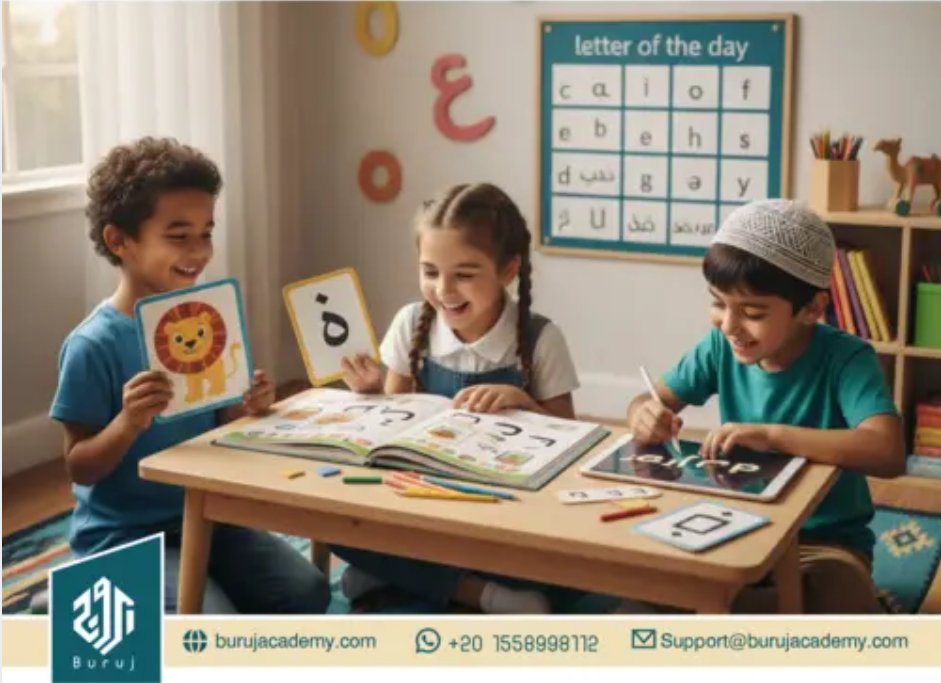
Spoken Arabic develops fastest when children hear it repeatedly in enjoyable contexts. Songs are especially powerful because melody helps the brain store language patterns more efficiently than plain repetition.
Ages 4–7: Songs and Rhymes First
At this age, children learn almost entirely through sound and rhythm. Arabic alphabet songs on YouTube, simple counting chants, and greetings like السلام عليكم (As-Salamu Alaykum) said during daily routines build comfortable familiarity with Arabic sounds naturally.
Ages 8–12: Stories and Conversation Games
Older children benefit from simple Arabic stories with pictures, basic conversation practice, and role-play games. Practice ordering food in Arabic, introducing family members, or describing colors around the house. These real-context activities build confidence quickly.
Ages 13–15: Structured Conversation Practice
Teenagers can handle short structured conversations, basic question-and-answer practice, and simple paragraph reading. Connecting Arabic to their Quran recitation or Islamic studies gives this age group meaningful motivation to persist through challenges.
Arabic spoken at home, even if just greetings and simple phrases, signals to your child that Arabic is a living, valued language in your family — not just a school subject.
Read Also: Top 10 Arabic Games for Kids
How to Learn Arabic for Kids Online?
Online Arabic learning works exceptionally well for children when sessions are short, interactive, and visually engaging. The key is choosing platforms and classes that treat children’s attention spans as a feature to work with, not a problem to fight.
Look for online Arabic classes that use visual aids, interactive whiteboards, games within lessons, and instructors who genuinely enjoy working with children. A 20-minute online session with an engaging teacher achieves far more than 60 minutes of passive video watching.
Technology offers helpful tools too: Arabic alphabet apps, interactive letter-tracing programs, and educational YouTube channels in English that teach Arabic to kids. Use these as supplements to structured instruction rather than replacements.
Buruj Academy‘s Online Arabic Classes for Kids run 20–30 minute sessions optimized for children’s focus windows, taught by Al-Azhar graduates with 12+ years of experience teaching young non-Arabic speakers in engaging, child-centered ways.
Book your child’s free Arabic trial now!

Read Also: Arabic Kids Books
How Can I Teach My Child Arabic?
Many parents ask this question with an underlying worry — “I don’t speak Arabic, can I really teach my child?” The answer is yes, with the right mindset and tools. Your role is to support, not replace, qualified instruction.
As a parent, your most powerful contributions are: creating a consistent learning environment, practicing brief daily review, celebrating every small achievement visibly, and connecting Arabic to Islamic identity in positive, meaningful ways your child genuinely values.
Realistic expectations matter enormously here. Arabic alphabet recognition typically takes 4–8 weeks of consistent practice. Basic word reading takes 2–4 months. Fluent Quran reading takes 1–2 years.
Common mistakes to avoid include: pushing too hard too soon, practicing only right before lessons, comparing your child’s progress to other children, and treating mistakes as failures rather than as a normal, healthy part of the learning process.
Read Also: Learn Arabic Alphabet for Kids
Master the Arabic Language
Develop reading, writing, speaking, and comprehension skills through interactive Arabic lessons for all levels.
Start Arabic ClassesRead Also: Arabic Sentences for Kids
Begin Your Child’s Learning Arabic Path With Buruj Academy
Consistent home practice builds a foundation, but structured teaching from qualified instructors accelerates a child’s progress significantly and ensures correct pronunciation habits from the very start.
- Instructors are Al-Azhar graduates trained specifically in child pedagogy
- Age-appropriate curriculum designed for children ages 4–15
- Gamification, stories, and interactive activities — not dry lectures
- Short 20–30 minute sessions matched to children’s focus spans
- Patient, encouraging approach building confidence at every stage
- Flexible scheduling designed to fit your family’s routine
Book your child’s free trial Arabic lesson with Buruj Academy today and see how enjoyable Arabic learning can genuinely be.
Find your child’s perfect match among Buruj’s top courses for kids:
- Arabic Classes for Kids
- Alphabet course
- Noorani Qaida Course for Kids
- Quranic Arabic Course
- Islamic Studies for Kids
- Hifz Classes for Kids
- Quran Classes for Kids
- Tajweed for Kids
Get a free trial for your child today.

FAQs
What is the easy way to learn Arabic for kids?
The easiest way combines visual letter associations with daily short sessions of 5–15 minutes and meaningful context like songs or stories. When children connect Arabic letters to pictures and familiar sounds, learning clicks quickly and sticks far longer than rote repetition.
What age should kids learn Arabic?
Children can begin Arabic exposure through songs and sounds from age 3–4, with structured letter learning from age 4–6. This early window makes correct pronunciation easier to establish. However, children at any age, including teenagers, can learn Arabic effectively with age-appropriate instruction and consistent practice.
Can a 13 year old learn Arabic?
Yes, absolutely. Teenagers often learn Arabic faster than young children because they understand grammar explanations and can sustain longer focus. The key is connecting Arabic to meaningful goals like reading the Quran directly, creating a judgment-free learning space, and celebrating every milestone to build lasting confidence.
Conclusion
Success in teaching Arabic to children rests on breaking the journey into manageable steps—letters first, then sounds, then meaningful words. Age-appropriate activities, from songs to structured conversations, ensure skills develop naturally without pressure or burnout.
Short, consistent daily routines at home reinforce formal lessons far more effectively than occasional long sessions. Labeling objects, reading picture books, and practicing simple Quranic words turn Arabic into a living language within the family environment.
With realistic timelines, patient encouragement, and qualified instruction when needed, children of any age can build strong Arabic foundations. Steady effort, joyful practice, and meaningful connection to faith transform Arabic from a challenge into a lasting achievement.


Leave a Reply