 Islamic

| Key Takeaways |
| The Prophet ﷺ promised that a struggling Quran reader earns two rewards: one for reciting and one for the difficulty itself. |
| The hadith of Al-Mahir bil-Quran is authentic, narrated in Sahih Muslim (hadith 798). |
| Struggling to read the Quran is not a spiritual deficiency — Islamic scholarship treats it as a sign of sincere effort. |
| Making mistakes in recitation while genuinely trying does not nullify the reward; intention and effort are both recognized. |
| Quitting Quran recitation because of difficulty contradicts the clear prophetic encouragement to persist despite struggle. |
Many non-Arabic speaking Muslims carry a quiet shame about their Quran recitation. They stumble over letters, hesitate at words, and wonder whether their recitation even counts when it sounds so imperfect.
The Prophet Muhammad ﷺ addressed this directly and with remarkable mercy. The authentic hadith about reading Quran with difficulty establishes that struggling readers receive double reward — making sincere effort among the most honored acts of worship in Islam.
The Hadith About Reading Quran with Difficulty
The hadith about reading Quran with difficulty is one of the most comforting prophetic statements recorded in Islamic tradition. It was narrated by Aisha (رضي الله عنها) that the Prophet ﷺ said:
“The one who is proficient in the Quran will be with the honorable and obedient scribes (angels), and the one who recites the Quran and finds it difficult, faltering or stumbling through its verses, will have a double reward.”
This hadith is recorded in Sahih Muslim, hadith 798, making it one of the most rigorously authenticated texts on Quran recitation in the entire hadith corpus.
The Arabic original uses the word “يَتَتَعْتَعُ فِيهِ” — meaning to stammer, struggle, or labor through something with visible effort. This is not careless recitation. It is the sincere effort of someone trying their absolute best despite difficulty.
At Buruj Academy, our Azhari tutors remind students of this hadith from the very first lesson. We have seen how deeply it shifts a beginner’s relationship with recitation — from anxiety to purpose.
Book a FREE trial session with one of Buruj’s Azhari Quran tutors

Al-Mahir Bil-Quran Hadith
The full hadith contains two categories of reciters, and understanding both gives the complete picture.
Al-Mahir bil-Quran (الماهر بالقرآن) refers to the proficient, fluent reciter — someone who reads smoothly with mastery. The Prophet ﷺ described this person as being “with the honorable and obedient scribes” — a reference to the angels who record deeds and carry revelation.
This is an extraordinary honor. The skilled reciter is elevated to the company of angels in the Hereafter because of their dedication to mastering the Book of Allah.
What Rank Does the Struggling Reciter Receive?
The struggling reciter — described with the word “يَتَتَعْتَعُ” — receives two rewards. Some scholars, including Ibn Hajar al-Asqalani in his commentary Fath al-Bari, note that the double reward compensates precisely because the struggle itself is an act of striving (mujahada) in the path of Allah.
| Reciter Type | Arabic Term | Description | Reward |
| Proficient | Al-Mahir | Fluent, skilled, smooth recitation | Company of honorable angels |
| Struggling | Al-Mutatati’ | Faltering, laboring, effortful | Double reward |
Neither category is described as invalid or rejected. Both are honored — at different levels, for different qualities.
Does Struggling to Read the Quran Mean Your Recitation Is Worthless?
Struggling to read the Quran does not diminish the validity or reward of recitation — the prophetic hadith explicitly assigns value to the struggle itself. The condition for the double reward is sincere effort combined with difficulty, not casual inattention.
This is a critical distinction our instructors at Buruj Academy make consistently in our Quran Reading Course. Students sometimes conflate struggling with failing. Islamically, they are entirely different states.
Book your Free trial lesson and start reading the Quran

Struggling means the student is genuinely engaged, genuinely trying, and genuinely encountering a real challenge. That is precisely the condition the Prophet ﷺ described and honored.
What Counts as “Difficulty” in the Hadith?
Islamic scholars identify several legitimate forms of difficulty covered by this hadith:
- Non-Arabic speakers learning to pronounce Arabic letters for the first time
- Students working to distinguish similar letters like ح and خ, or ذ and ز
- Beginners connecting letters and reading words slowly
- Elderly learners whose memory and pronunciation require additional effort
- Anyone whose tongue does not naturally produce Arabic sounds
What is NOT covered is deliberate carelessness — reading without attention or without any effort to improve. The reward is tied to sincere striving, not passive recitation.
Expand Your Islamic Knowledge
Join our structured online courses led by qualified instructors to deepen your understanding of the Deen.
Join a Free Trial ClassRead also: Hadith About Reading Quran
Is the Double Reward for Struggling to Read Quran Authentic?
The double reward hadith is fully authentic. It is narrated in Sahih Muslim, hadith 798 — one of the two most authoritative hadith collections in Sunni Islam. Sahih Muslim is considered the highest grade of hadith reliability after Sahih Bukhari.
This is not a weak hadith, a fabricated narration, or a scholarly dispute. The chain of transmission (sanad) goes through Aisha (رضي الله عنها), one of the most reliable narrators in hadith science, directly to the Prophet ﷺ.
We emphasize this at Buruj Academy because some students have encountered questionable or inauthentic Islamic content online. When students ask us about the reward for struggling readers, we always direct them to the verified Sahih Muslim text — not paraphrased summaries.
What Does Islam Say About Making Mistakes While Reading Quran?
Making mistakes while reading Quran in a context of genuine learning and effort is treated with mercy in Islamic scholarship. The Prophet ﷺ did not condemn the struggling reciter — he granted them a higher numerical reward than many realize.
Our instructors consistently see this question from adult beginners, particularly those reading the Quran for the first time as adults. The fear of making mistakes keeps many students from reciting at all — which is the opposite of what the Sunnah encourages.
The Difference Between Mistakes from Effort and Mistakes from Neglect
Islamic scholars draw an important line between two types of error:
| Type of Mistake | Context | Islamic Ruling |
| Tajweed error while learning | Student actively studying and improving | Forgiven; effort is rewarded |
| Mispronunciation despite genuine effort | Non-Arabic speaker sincerely trying | Covered by double reward hadith |
| Deliberate carelessness | Reciting without attention or effort to improve | Not the same as sincere struggle |
| Error after mastery | Qualified reciter making avoidable errors | Requires correction and continued practice |
The first two categories — those most common among beginners — are precisely what the hadith addresses. Imam al-Nawawi, in his commentary on Sahih Muslim, notes that the word “يَتَتَعْتَعُ” implies genuine labor, not casual negligence.
Buruj Academy’s Online Quran Classes for Beginners are specifically built around this understanding. Our Ijazah-certified instructors correct errors with patience because they understand Islamically — and pedagogically — that errors are part of the path, not a reason for shame.
Begin Learning Quran With a FREE Trial Lesson
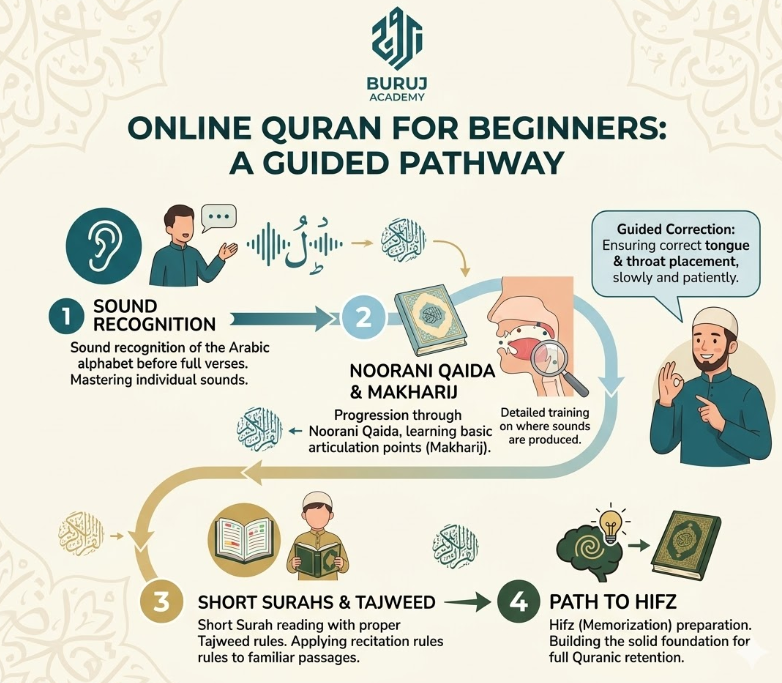
Discover the Buruj Academy Difference
Step into our virtual classrooms and see how our expert instructors make learning Quran and Arabic intuitive and clear. We focus on overcoming the specific hurdles non-native speakers face, building your confidence and connection with the Quran.
Is the Quran Hard to Read for Non-Arabic Speakers?
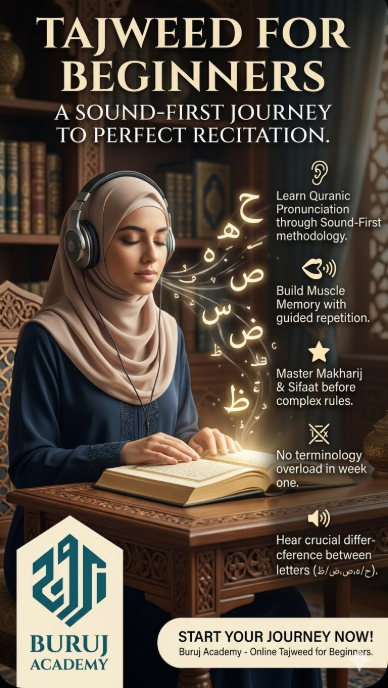
The Quran is genuinely challenging for non-Arabic speakers — not because of spiritual unworthiness, but because Arabic is a phonetically complex language with sounds that do not exist in English or most European languages. The makharij (articulation points) of letters like ع, غ, ح, خ, and ق require muscle memory that English-trained mouths have never developed.
In our experience teaching non-Arabic speakers at Buruj Academy, most adult beginners require 6–10 weeks of consistent daily practice before Arabic letter sounds feel even partially natural. This is entirely normal — and it is exactly the kind of struggle the Prophet ﷺ described in the hadith.
Why Does Arabic Pronunciation Feel Impossible at First?
Arabic uses 28 letters with 17 distinct articulation points (makhraj), several of which produce sounds from the throat, the middle of the tongue, or the lips in ways English never requires. For a native English speaker, these are genuinely new physical skills — not simply new sounds to memorize.
This is why we follow the Buruj Method’s Sound-before-Rules principle in our Tajweed Classes for Beginners. Students train their ear and tongue on correct sounds before they ever study a Tajweed rule — because rules applied to wrong sounds compound the difficulty unnecessarily.
The good news, Islamically and practically, is that the difficulty itself is the source of the reward. The harder the letter is for you to produce correctly, the more sincere your effort — and the more specifically you fit the description in the prophetic hadith.
Book Your FREE Trial Lesson to Begin Your Tajweed Journey
Read also: Is Reading Quran Fard or Sunnah? The Complete Islamic Ruling Explained
How Should a Struggling Quran Reader Respond to This Hadith?
A struggling Quran reader should respond to this hadith with renewed commitment, not passive comfort. The double reward is tied to ongoing effort — not to a permanent state of difficulty that the reader makes no attempt to improve.
The hadith is mercy for the student who is genuinely trying. It is not permission to remain at a beginner level indefinitely without seeking instruction or practice. The Prophet ﷺ praised the struggling reciter’s effort, and the spirit of that praise is active striving — not passive resignation.
Practical Steps for Struggling Readers
- Seek qualified instruction: Consistent errors uncorrected become habits. A qualified teacher catches and corrects before habits solidify.
- Recite daily, even briefly: Consistency trains muscle memory. Even five minutes of daily recitation builds more than one hour per week.
- Use the hadith as fuel, not as a ceiling: The double reward motivates continued effort — it does not replace the goal of improvement.
- Start with Tajweed fundamentals: Understanding Tajweed basics gives struggling readers a structured path rather than unguided struggle.
Expand Your Islamic Knowledge
Join our structured online courses led by qualified instructors to deepen your understanding of the Deen.
Join a Free Trial ClassStart Reciting with Confidence Through Buruj Academy’s Expert Guidance
Every struggling reader deserves both the prophetic reward and the practical tools to improve. The hadith promises the reward — a qualified teacher provides the path forward.
Buruj Academy’s Online Quran Recitation Course connects students with Al-Azhar University graduates and Ijazah-certified instructors who specialize in teaching non-Arabic speakers — with 12+ years of dedicated experience.
Our approach combines prophetic encouragement with the Buruj Method: patient, structured, personalized instruction in 1-on-1 online sessions with flexible scheduling. Whether you are reading your first letter or refining your recitation, our instructors meet you exactly where you are.
Join a global community of learners and find the path that best supports your spiritual and intellectual growth:
- Online Studies Islamic Classes (General & Flexible)
- Islamic Studies Course for Beginners (Foundational Knowledge)
- Islamic Studies Classes for Kids (Engaging & Values-Based)
- Islamic Studies Classes for Adults (In-Depth Theological Discussion)
- Islamic Studies Classes for Ladies (Sisterhood & Specialized Learning)
- Islamic Studies Classes for New Muslims (Guided Support & Essentials)
- Tafseer Al Quran Course (Unlocking Divine Meanings)
- Quranic Sciences (Uloom Al Quran) Course (Advanced Linguistic & Historical Context)
Book your free trial lesson today and begin your recitation with an instructor who understands both the Islamic spirit and the practical path to beautiful, accurate Quran reading.
Frequently Asked Questions About the Hadith on Reading Quran with Difficulty
Is the Hadith About Double Reward for Struggling Readers Authentic?
Yes. The hadith is recorded in Sahih Muslim, hadith 798, narrated by Aisha (رضي الله عنها). It is fully authenticated with a strong chain of transmission. Sahih Muslim is among the two highest-graded hadith collections in Sunni Islam, making this narration one of the most reliable on Quran recitation.
Does the Double Reward Apply to Someone Who Never Tries to Improve?
No. The double reward is tied to genuine effort and sincere striving — described in the hadith by the word “يَتَتَعْتَعُ”, which implies active labor. Islamic scholars, including Imam al-Nawawi, clarify that the reward applies to those who are sincerely trying, not those who recite carelessly without any effort to improve.
Should I Stop Reciting Quran Until My Pronunciation Is Perfect?
Never. Stopping recitation entirely because of imperfect pronunciation contradicts the direct prophetic encouragement in this hadith. The Prophet ﷺ honored the struggling reciter — which means struggle during recitation is a valid and rewarded state. Seek instruction to improve, but never stop reciting while you do.
What Is the Meaning of Al-Mahir Bil-Quran in the Hadith?
Al-Mahir bil-Quran (الماهر بالقرآن) means the one who is proficient, skilled, and fluent in Quran recitation. The Prophet ﷺ described this person as being with the noble and obedient angels in the Hereafter. Reaching this level requires consistent study and Tajweed mastery — something achievable with structured guidance.
How Can I Reduce the Difficulty of Reading Quran Over Time?
The most effective path is consistent daily practice with a qualified teacher who corrects errors in real time. Beginning with Tajweed fundamentals — particularly correct letter pronunciation (makharij) — removes the root cause of most recitation difficulty for non-Arabic speakers within weeks of focused practice.