 Islamic

Many Muslims wonder whether they can combine everyday activities like eating with Quran recitation — especially when time feels limited. It is a genuinely common question we hear from students at Buruj Academy, particularly those trying to maximize their Quran time throughout a busy day.
The short answer: eating while reading Quran is not haram, but it is disliked (makruh) according to the majority of scholars. However, if food is in the mouth during recitation, the ruling shifts — it becomes impermissible, because it directly corrupts the pronunciation of Quranic letters.
Can You Eat While Reading the Quran?
Yes, eating while reading Quran is permissible in Islamic law, as no explicit Quranic verse or authentic hadith prohibits it. Scholars classify it as makruh (disliked) rather than haram, based on the principle that actions diminishing the reverence due to Allah’s words are discouraged. The permissibility increases when there is genuine need, but the ideal is to give the Quran undivided attention.
The reasoning behind this classification connects to two fundamental values in Islam: the sanctity of the Quran and the flexibility of Islamic law. No Muslim is sinful for eating while listening to or reciting the Quran, particularly in cases of necessity.
Yet scholars consistently remind believers that the Quran deserves a higher level of engagement than multitasking allows.
| Scenario | Ruling | Reason |
| Eating while reading Quran (mouth empty when reciting) | Permissible but Makruh | No direct prohibition; disliked for lack of reverence |
| Reciting with food actively in the mouth | Not Permissible | Distorts makharij al-huruf |
| Eating while listening to Quran (not reciting) | Permissible | Listening does not require letter articulation |
| Pausing recitation during chewing, then resuming | Permissible and recommended | Preserves both reverence and pronunciation accuracy |
If you want to build a structured Quran recitation habit with proper guidance, Buruj Academy’s Quran Recitation Course provides personalized 1-on-1 sessions with Ijazah-certified instructors who help students develop sustainable routines alongside correct recitation technique.
Book your first FREE recitation lesson
Why Is Reciting Quran with Food in the Mouth Not Allowed?
Reciting Quran with food in the mouth is not permissible because it prevents the correct articulation of letters from their proper points of origin (makharij al-huruf).
Proper Tajweed requires that each letter emerge from its precise makhraj with its correct attributes (sifat). Food obstructs this, making the recitation invalid as a correct rendering of Allah’s words.
This is not a minor stylistic concern — it is a matter of Tajweed integrity. The Quran was revealed with precise phonetic structure, and every letter carries weight.
What Did Sheikh Ibn Uthaymeen Say About Reciting Quran with Food in the Mouth?
Sheikh Ibn Uthaymeen — rahimahullah — was asked specifically about a man reciting Quran while chewing gum. His ruling was clear: he did not believe the person could establish the letters correctly while chewing, because the articulation points are occupied by the movement of chewing.
He stated explicitly that a person must not recite Quran unless they can produce their letters properly according to their ability. His advice: if you want to recite, put down the gum.
This ruling applies equally to any food or substance that interferes with free movement of the tongue, lips, and articulation tract during recitation. The principle is consistent across classical Tajweed scholarship.
How Does Chewing Affect Makharij al-Huruf?
The Arabic letters of the Quran emerge from seventeen primary articulation zones, ranging from the deepest part of the throat (aqsal-halq) to the lips (shafatayn). When the mouth is occupied with chewing, multiple zones are compromised simultaneously — the tongue cannot freely reach its tip positions, the lips cannot form their proper closure, and the jaw movement disrupts the precision required for letters like ض, ظ, ر, and ل.
In our Tajweed sessions at Buruj Academy, we observe this directly. Students who try to review aloud immediately after eating — even just a sip of water — often notice their pronunciation of emphatic letters (huruf al-isti’la) becomes noticeably less precise. The mouth requires freedom to perform Tajweed correctly.
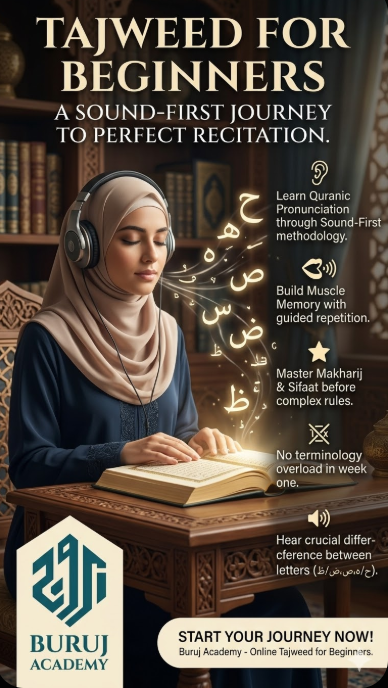
If you want to develop a strong foundation in this area, Buruj Academy’s Tajweed for Beginners course teaches makharij recognition from the ground up, so students understand why these physical requirements matter — not just that they do.
Book Your FREE Trial Lesson to Begin Your Tajweed Journey
Expand Your Islamic Knowledge
Join our structured online courses led by qualified instructors to deepen your understanding of the Deen.
Join a Free Trial ClassRead also: Can I Drink Coffee While Reading Quran?
What Do Scholars Say About Reverence for the Quran During Recitation?
Scholars of Islamic etiquette (adab al-Quran) consistently emphasize that the Quran deserves the highest level of presence and attention when being recited or studied. Eating during recitation, even if permissible, contradicts the spirit of ta’dhim (exaltation) due to Allah’s words.
Classical scholars of Tajweed and Quranic sciences noted that the ideal conditions for recitation include cleanliness, a settled body, a calm mind, and a mouth free from food or drink. These are not legal requirements in most cases, but they represent the elevated standard a believer should aspire to.
| Level of Engagement | Description | Recommended Practice |
| Wajib (Obligatory) | Correct pronunciation of letters | Never recite with food in mouth |
| Mustahabb (Recommended) | Full focus, no distractions | Stop eating before reciting |
| Adab (Etiquette) | Seated, calm, facing Qiblah if possible | Set aside dedicated recitation time |
| Mubah (Permissible) | Eating nearby without active recitation | Acceptable, avoid making it habitual |
This framework helps students understand that Islamic rulings on Quran recitation operate on a spectrum — from what is strictly required to what represents the highest aspiration.
Discover the Buruj Academy Difference
Step into our virtual classrooms and see how our expert instructors make learning Quran and Arabic intuitive and clear. We focus on overcoming the specific hurdles non-native speakers face, building your confidence and connection with the Quran.
Practical Guidelines for Reading Quran Around Mealtimes
The most practical approach is to treat mealtimes and recitation time as separate. This is not burdensome — it actually improves both the quality of your eating and the quality of your recitation. Here are clear guidelines based on Islamic scholarship and practical teaching experience:
Before eating: Complete your recitation portion, close the Mushaf respectfully, then begin your meal.
During eating: You may listen to Quran recitation, but avoid reciting aloud with food in the mouth at any point.
After eating: Wait until the mouth is fully clear and rinsed if needed before resuming recitation.
If necessary mid-session: Pause recitation completely during chewing or swallowing. Resume only when the mouth is clear and you can produce letters correctly.
In our experience at Buruj Academy, students who establish a dedicated pre-meal recitation habit — even fifteen minutes before breakfast or dinner — make significantly more consistent progress than those who try to combine Quran time with other activities.
For memorization students specifically, our Online Hifz Program incorporates structured daily schedules that respect the need for dedicated recitation time — separate from distractions.
Start Hifz today with a FREE trial session
Read also: Can the Quran Be Read in English?
How to Maximise the Blessing and Quality of Your Quran Recitation
Protecting the quality of your recitation is an act of worship in itself. The Prophet ﷺ said, as recorded in Sahih al-Bukhari (5027): “The one who is proficient in reciting the Quran will be with the noble, dutiful angels.” This hadith establishes that the quality of recitation — its correctness and precision — carries immense spiritual reward.
Practically, this means treating every session of recitation as an intentional act. Remove distractions, ensure the mouth is free, sit in a clean state, and focus on producing each letter from its correct makhraj.
Students at Buruj Academy working through our reading the Quran for the first time resources or progressing through formal Tajweed study consistently report that when they treat their recitation as dedicated time — not background activity — both their pronunciation and their connection to the Quran improve markedly.
Understanding Tajweed rules more deeply, including how letters are formed, also reinforces why conditions like a food-free mouth matter. Our blog on Tajweed for beginners is a strong starting point for students who want to understand the foundational principles behind these rulings.
Expand Your Islamic Knowledge
Join our structured online courses led by qualified instructors to deepen your understanding of the Deen.
Join a Free Trial ClassStart Your Quran Recitation Journey with Buruj Academy’s Expert Instructors
Understanding the etiquette and rulings around Quran recitation is the first step — consistent, correctly guided practice is what builds lasting skill and spiritual connection.
Buruj Academy offers:
- Ijazah-certified instructors and Al-Azhar University graduates with 12+ years teaching non-Arabic speakers
- The Buruj Method: Sound-before-rules in Tajweed, ensuring correct makharij from day one
- Personalized 1-on-1 online sessions with flexible 24/7 scheduling
- Real-time pronunciation correction and individualized learning plans
- Programs for all levels — beginner to advanced, children to adults
Join a global community of learners and find the path that best supports your spiritual and intellectual growth:
- Online Studies Islamic Classes (General & Flexible)
- Islamic Studies Course for Beginners (Foundational Knowledge)
- Islamic Studies Classes for Kids (Engaging & Values-Based)
- Islamic Studies Classes for Adults (In-Depth Theological Discussion)
- Islamic Studies Classes for Ladies (Sisterhood & Specialized Learning)
- Islamic Studies Classes for New Muslims (Guided Support & Essentials)
- Tafseer Al Quran Course (Unlocking Divine Meanings)
- Quranic Sciences (Uloom Al Quran) Course (Advanced Linguistic & Historical Context)
Book your free trial lesson today and experience expert Quran instruction built on authentic Islamic scholarship.
Frequently Asked Questions About Eating While Reading Quran
Is It Haram to Eat While Reading Quran?
Eating while reading Quran is not haram according to the majority of scholars. It is classified as makruh (disliked) because it diminishes the reverence owed to Allah’s words. The act becomes impermissible specifically when food is in the mouth during active recitation, as this directly corrupts the correct articulation of Quranic letters.
Can I Listen to Quran While Eating?
Listening to Quran while eating is permissible, as listening does not involve producing letters and therefore does not carry the Tajweed concern. However, scholars recommend attentive listening as a mark of respect. If possible, eat in a state of calm and avoid loud conversation or distraction while Quran is being recited around you.
What Should I Do If I Want to Recite During Meals?
The correct practice is to pause recitation completely during chewing or swallowing. Resume only when the mouth is fully clear. Better still, complete your recitation before the meal begins or after it ends. This protects both the correctness of your pronunciation and the reverence due to the Quran.