Reading the Quran in English is reading a translation of its meanings — not the Quran itself, which is exclusively the Arabic text.
English Quran translations are permitted and encouraged outside of prayer for understanding, reflection, and learning Quranic meanings.
Salah (prayer) is invalid if recited in English — Arabic recitation of Al-Fatihah is an obligatory condition for every Muslim.
The reward for reading an Arabic letter of the Quran is multiplied tenfold; translations carry separate reward for seeking knowledge.
Non-Arabic speakers should use English translations as a bridge toward learning the original Arabic — not as a permanent replacement.
Every Muslim who picks up an English Quran translation is doing something genuinely praiseworthy.
The desire to understand Allah’s words is itself an act of worship, and English translations have opened the Quran’s guidance to millions who grew up speaking no Arabic.
Can the Quran Be Read in English?
No, the Quran is the Arabic word of Allah as revealed to the Prophet Muhammad ﷺ, and an English translation — however accurate — is an explanation of its meanings, not the Quran itself.
Is Reading the Quran in English the Same as Reading It in Arabic?
Reading the Quran in English is not the same as reading it in Arabic, and Islamic scholars are unanimous on this point. The Quran — Al-Qur’an al-Kareem — refers specifically to the Arabic text as revealed. An English version is a Tafsir (explanation) rendered in another language, carrying its own reward but occupying a different category entirely.
This distinction is not a technicality meant to discourage English speakers. It is a recognition of something profound: the Quran’s linguistic miracle (I’jaz) is inseparable from its Arabic form. The rhythm, the phonetic precision, the layered meanings of each word — none of these transfer completely into any translation.
Why Scholars Define the Quran as Arabic Exclusively?
Classical and contemporary scholars, including those at Al-Azhar University, consistently define the Quran as“the Arabic speech of Allah, revealed to Muhammad ﷺ, transmitted by mass-narration (Tawatur), whose recitation is an act of worship.”Every element of this definition anchors the Quran to its Arabic text.
When you read Pickthall, Sahih International, or any other English rendering, you are reading a scholar’s best effort to convey meaning. That effort is valuable — but it is the scholar’s human work, not the preserved divine text.
Does Reading the Quran in English Count as Quran Recitation?
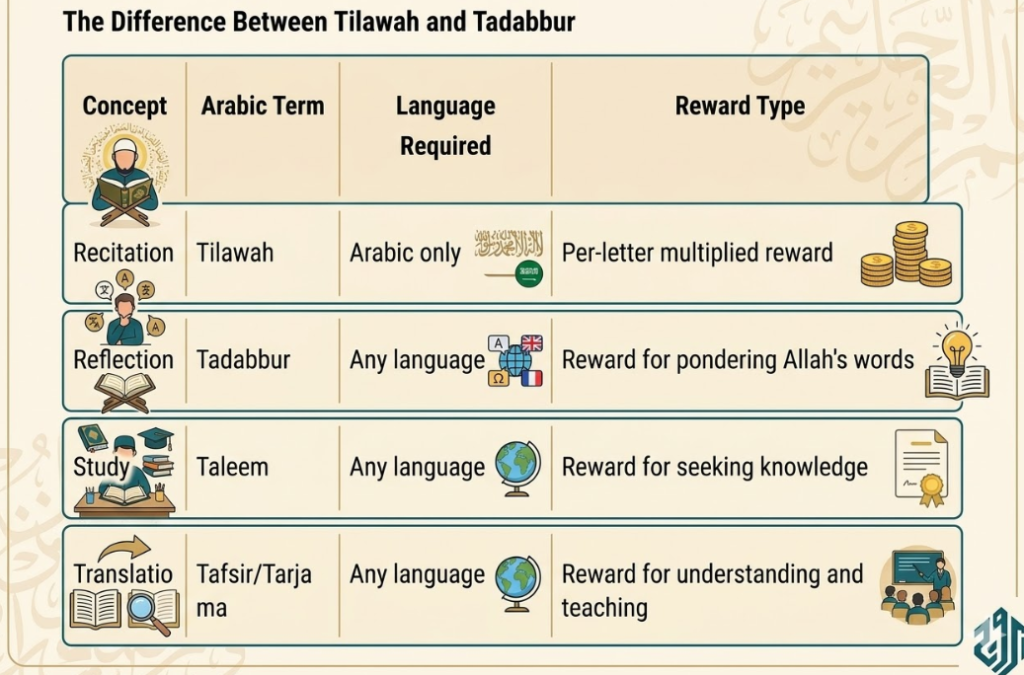
Reading the Quran in English does not count as Quranic recitation (Tilawah) in the technical Islamic sense. Tilawah specifically refers to reciting the Arabic text, and its distinct rewards are tied to that Arabic recitation.
The Prophet ﷺ said: “Whoever reads a letter from the Book of Allah will receive a reward, and the reward will be multiplied by ten.”This hadith, recorded in Jami’ at-Tirmidhi (2910), refers to Arabic letters of the Quran. Reading “Alif Lam Meem” earns reward for three letters — this applies to the Arabic, not to reading “A.L.M.” in an English footnote.
Reading an English translation earns its own reward — the reward of seeking knowledge, of Tafakkur (reflection), and of striving to understand Allah’s guidance. But these are distinct categories of worship.
Excel in Your Quranic Studies
Join Buruj Academy and master the Quran with our structured, professional curriculum.
Reading the meanings of the Quran in English is not haram. It is not only permitted but actively encouraged for those who need it to understand Allah’s message. The purpose of the Quran is guidance (Huda), and guidance requires comprehension.
“A blessed Book which We have revealed to you, so that they might reflect upon its verses.” (Sad 38:29)
Reflection (Tadabbur) is a Quranic command — and reflection requires understanding. For a non-Arabic speaker, an English translation is the gateway to fulfilling that command.
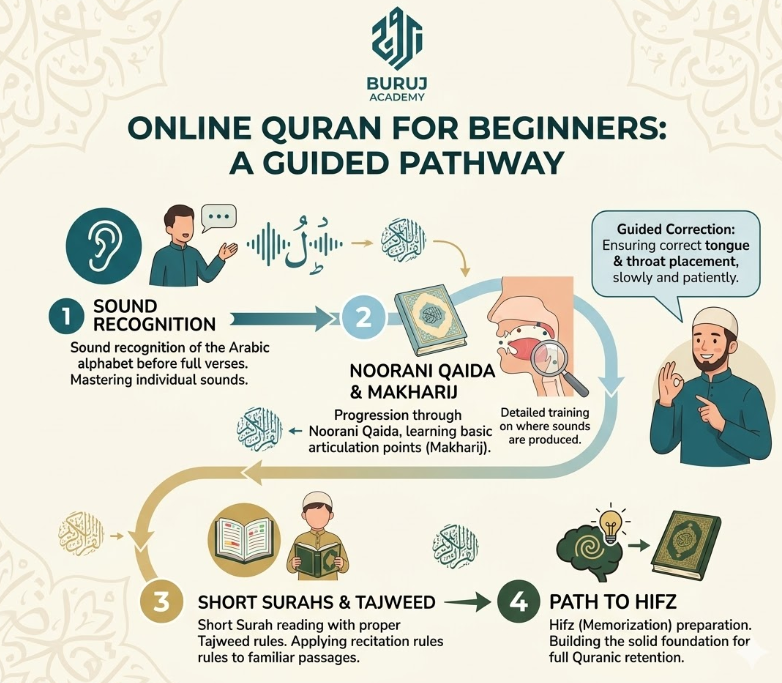
At Buruj Academy, our Online Quran Classes for Beginners are specifically designed for students who start their Quran relationship through English — then progressively build the Arabic reading skills to access the original text directly.
Can You Recite the Quran in English During Prayer?
You cannot recite the Quran in English during Salah. The scholars agree that recitation in prayer must be in Arabic. Salah recited with only English is invalid (Batil) according to the majority position.
The obligation to recite Surah Al-Fatihah in Arabic is established by the hadith of the Prophet ﷺ: “There is no prayer for the one who does not recite the Opening of the Book.” Recorded in Sahih al-Bukhari (756), this establishes Al-Fatihah — in Arabic — as a condition (Shart) of valid prayer.
In our sessions at Buruj Academy, we regularly work with new Muslims and adult beginners who have never heard Arabic before. Within three to four weeks of consistent daily practice, most students can recite Al-Fatihah with proper pronunciation — a milestone that removes a significant religious concern and builds genuine confidence.
What Is the Reward for Reading the Quran in English?
Reading the Quran in English carries real and meaningful reward — it simply falls under a different category than Tilawah. A Muslim who reads an English translation seeking to understand Allah’s commands, reflect on His guidance, or strengthen their faith is engaging in acts rewarded by Allah.
The rewards attach to: sincere intention (Niyyah) to understand Allah’s words, the act of Tadabbur (reflection and pondering), applying what is learned to one’s life and worship, and teaching others the meanings of the Quran.
What is absent from English reading alone is the specific per-letter Tilawah reward referenced in the Tirmidhi hadith above. This is not a penalty for those who cannot yet read Arabic — it is simply a recognition that Arabic recitation is its own distinct act of worship with its own distinct reward structure.
Buruj Academy’sQuran Reading Course bridges this gap directly, moving students from English-only engagement with the Quran into confident Arabic recitation — combining both the understanding that translations provide and the Tilawah reward that Arabic reading unlocks.
You should ultimately read the Quran in Arabic — while using English translation as a tool to understand what you are reading. These are not competing choices; they work best together.
A student who reads the Arabic and understands nothing has fulfilled the form of Tilawah and earns its reward. A student who reads only English understands the meaning but misses the Tilawah reward. The ideal — and the standard Islamic scholars encourage — is to pursue both: recite in Arabic and study the meaning through translation.
Study Quranic Arabic grammar for direct comprehension
Quranic Arabic courses
This progression — which reflects the Buruj Method’s consistency-before-speed principle — ensures that English reading serves its proper purpose: a bridge, not a destination.
Discover the Buruj Academy Difference
Step into our virtual classrooms and see how our expert instructors make learning Quran and Arabic intuitive and clear. We focus on overcoming the specific hurdles non-native speakers face, building your confidence and connection with the Quran.
Is It Better to Read the Quran in Arabic or English?
For a Muslim who can read both, Arabic recitation is unambiguously superior in terms of Islamic merit. The question is most meaningful for those still learning — and for them, both have their place.
Arabic recitation is better when: you want Tilawah reward, you are performing or preparing for Salah, you are following the Sunnah of the Prophet ﷺ and the companions (Sahabah), and you are seeking the spiritual experience of the Quran’s phonetic miracle.
English reading serves better when: you are studying specific rulings or stories to act on them, you are new to Islam and building foundational understanding, you are reading to a non-Muslim who needs context, and you are doing Tadabbur alongside your Arabic recitation.
The Prophet ﷺ and his companions memorized and recited in Arabic — and the Quran itself emphasizes its Arabic nature: “Indeed, We have sent it down as an Arabic Quran so that you might understand.” (Yusuf 12:2)
Our article on how to memorize the Quran faster explores how regular Arabic engagement — even for those still learning — accelerates both memorization and comprehension simultaneously.
Excel in Your Quranic Studies
Join Buruj Academy and master the Quran with our structured, professional curriculum.
Start Reading the Quran in Arabic with Buruj Academy’s Expert Instructors
Understanding the ruling is the first step — building the Arabic reading skill is the next. Whether you are a complete beginner who has never read a single Arabic letter, or a student who can read but wants to recite with proper Tajweed, Buruj Academy has a structured pathway for you.
Our instructors are Al-Azhar University graduates and Ijazah-certified specialists with 12+ years of experience teaching non-Arabic speakers worldwide. Through personalized 1-on-1 online sessions, flexible scheduling, and the Buruj Method — sound before rules, consistency before speed — students move from zero to confident Arabic recitation at a realistic, sustainable pace.
Join a global community of learners and find the path that best supports your spiritual and intellectual growth:
Book your free trial lesson today and begin the Arabic Quran reading that earns Tilawah reward, fulfills your Salah correctly, and connects you directly to Allah’s preserved words.
Frequently Asked Questions About Reading the Quran in English
Does Reading the Quran in English Count as Recitation?
Reading the Quran in English does not count as Tilawah (Quranic recitation) in the Islamic technical sense. Tilawah applies specifically to the Arabic text. English reading earns reward for seeking knowledge and reflection (Tadabbur) but is a distinct category of worship from Arabic recitation with its per-letter multiplied reward.
Is It Haram to Only Read an English Translation of the Quran?
Reading only an English translation is not haram, especially for those who do not yet read Arabic. It is encouraged for understanding. However, every Muslim is obligated to at least learn Surah Al-Fatihah in Arabic for the validity of their daily prayers, making Arabic learning an ongoing obligation — not an optional goal.
Can a New Muslim Pray Using an English Translation?
A new Muslim cannot use an English translation as a substitute for Arabic recitation in Salah. The obligation is to learn Al-Fatihah in Arabic as quickly as possible. During the learning period, scholars advise reciting what Arabic one knows and filling the rest with Arabic Dhikr, while actively working to complete Al-Fatihah.
Unlock Your Potential at Buruj Academy: Enroll Today and Elevate Your Knowledge!
Join Buruj Academy and embark on a transformative learning journey designed to expand your skills and understanding. Experience expert guidance, interactive courses, and a supportive community that empowers you to achieve academic excellence and personal growth. Start your path to success today!
 Islamic