 Quran
Quran

| Key Takeaways |
| Fajr time — after the pre-dawn prayer — is widely considered the strongest memorization window due to mental clarity and minimal distraction. |
| The average time to memorize the full Quran ranges from 3 to 5 years for consistent adult learners dedicating 30–60 minutes daily. |
| Short, repeated daily sessions outperform long, irregular ones — consistency is the single most reliable predictor of memorization success. |
| New memorization should always be scheduled in the morning; revision sessions work best in the evening before Isha or after Asr. |
| Children typically memorize faster than adults, but adults who use structured revision systems close the retention gap significantly. |
Choosing when to sit with the Quran is not a minor scheduling detail — it directly shapes how much your brain retains and how deeply the words settle into memory.
Timing affects concentration, retention, and even the spiritual quality of the connection you build with the words of Allah.
What is the Best Time to Memorize the Quran?
The best time to memorize Quran is after Fajr prayer, when the mind is rested, distractions are minimal, and the brain’s memory consolidation is at its peak.
Evening sessions after Asr or before Isha are ideal for daily revision.
A consistent daily routine — even 30 minutes — produces stronger long-term retention than occasional long sessions.
Why Fajr Is the Best Time to Memorize Quran
After Fajr prayer, the mind enters one of its most receptive states of the entire day. Sleep has cleared cognitive fatigue, short-term memory buffers are fresh, and the absence of digital noise, family demands, or work obligations creates an environment the brain rarely experiences at any other hour.
This is not simply a traditional preference. Sleep science confirms that memory consolidation — the process by which the brain transfers short-term information into long-term storage — happens most completely during the final stages of sleep, just before waking.
Sitting with new Quranic verses immediately after this process completes means the material enters a highly receptive cognitive window.
Excel in Your Quranic Studies
Join Buruj Academy and master the Quran with our structured, professional curriculum.
Book Your Free TrialWhat the Quran and Sunnah Say About the Morning Hour
Allah (SWT) Himself takes an oath by the morning in Surah Ad-Duha (93:1), indicating a special sanctity to this time.
More directly relevant to Hifz, the Prophet ﷺ made a specific du’a for barakah in the early morning hours, as recorded in Sunan Abi Dawud 2606:“O Allah, bless my Ummah in their early morning.”
In our experience at Buruj Academy, students who commit to a post-Fajr memorization window consistently outperform those who rely on midday or late-night sessions — even when total daily time invested is identical.
The difference in retention after one week is noticeable enough that our Al-Azhar-trained Hifz specialists make Fajr timing one of the first non-negotiable habits they establish with every new student.
Book a FREE trial session with one of Buruj’s Azhari Quran tutors

Why Night Memorization Is a Strong Second Option
For students whose Fajr window is genuinely unavailable — due to shift work, young children, or health circumstances — the late-night period after Tahajjud or before Fajr itself provides similar cognitive and spiritual advantages.
The world is quiet, the nafs is humbled, and the absence of daytime mental clutter allows deep focus.
| Time Slot | Memorization Suitability | Revision Suitability | Notes |
| After Fajr | ★★★★★ | ★★★★ | Peak window for new memorization |
| After Asr | ★★★ | ★★★★★ | Best dedicated revision slot |
| After Isha | ★★★ | ★★★★ | Good if sleep follows soon after |
| Tahajjud / Pre-Fajr | ★★★★ | ★★★★ | Excellent for spiritually motivated students |
| Midday / Dhuhr | ★★ | ★★★ | Mental fatigue reduces retention |
Read also: Best Age to Memorize Quran
What Is the Average Time to Memorize Quran?
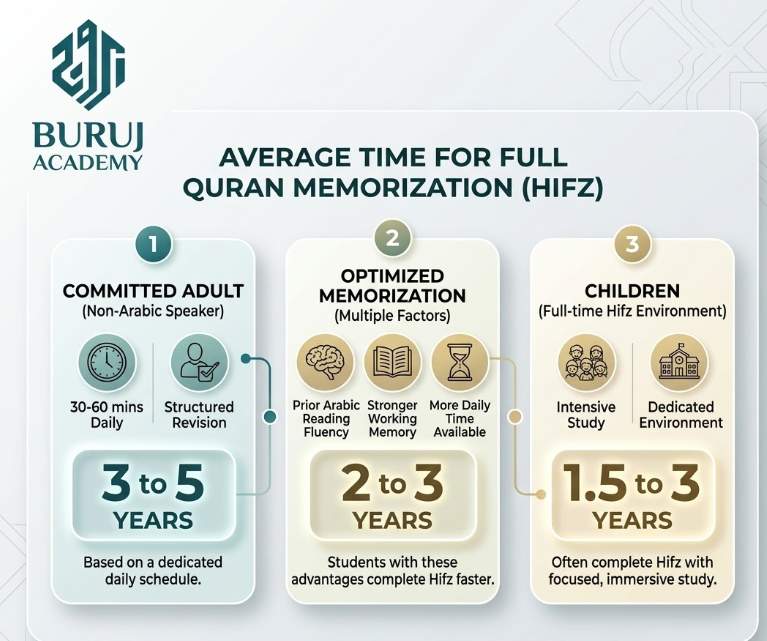
The average time to memorize the full Quran for a committed adult non-Arabic speaker — dedicating 30 to 60 minutes daily with structured revision — ranges from 3 to 5 years. Students with prior Arabic reading fluency, stronger working memory, or more daily time available can complete memorization in 2 to 3 years. Children in a full-time Hifz environment often complete it in 1.5 to 3 years.
These are honest estimates, not marketing figures. The Quran contains approximately 6,236 verses across 114 surahs, with significant variation in verse length and phonetic complexity. No two memorization timelines are identical.
Factors That Directly Affect Your Memorization Timeline
Several variables determine whether someone memorizes in two years or seven. Understanding them helps students set realistic expectations and design effective systems.
| Factor | Accelerates Timeline | Slows Timeline |
| Daily session length | 45–60 minutes focused | Under 20 minutes fragmented |
| Arabic reading fluency | Strong Tajweed foundation | Struggling with basic reading |
| Revision consistency | Daily structured review | Irregular or skipped revision |
| Teacher accountability | 1-on-1 instructor sessions | Solo self-study only |
| Memorization age | Under 15 (neuroplasticity) | Over 40 (requires stronger systems) |
| Distraction environment | Quiet, scheduled space | Noisy or unpredictable schedule |
Buruj Academy’s Hifz Classes for Adults addresses all six of these factors through personalized learning plans, structured revision schedules, and 1-on-1 sessions with Al-Azhar-trained Hifz specialists who have guided hundreds of adult students through realistic, sustainable memorization timelines.
Book Your Free Trial Lesson with Burruj’s Hifz Course for Adults

What Is the Fastest Time to Memorize Quran?
The fastest verified completions of full Quran memorization range from 1 to 1.5 years for exceptional young students in intensive full-time programs. For adults in part-time study, the realistic fastest timeline with genuine retention — not surface-level memorization — is approximately 18 months to 2 years, requiring 1.5 to 2 hours of daily focused work.
It is important to be honest here: speed without retention is not Hifz.
We at Buruj Academy regularly see students who rush through memorization only to lose vast portions within months because revision was neglected. Authentic Hifz requires that what is memorized stays memorized — and that standard demands time.
How to Memorize Quran Faster Without Sacrificing Retention?
Accelerating memorization responsibly requires a smarter system, not simply more hours. The most effective acceleration strategies are:
1. New verses in the morning.
Allocate the Fajr window exclusively to new memorization. Never mix new memorization with revision in the same mental session — they compete for the same cognitive resources.
2. Spaced repetition for revision
Review a new verse on day 1, day 3, day 7, and day 14. After passing all four reviews, it is ready for weekly maintenance. This is the evidence-backed spacing pattern our instructors implement in Buruj Academy’s Online Hifz Program.
3. Read before you memorize
Never attempt to memorize a verse you cannot read fluently. Students who skip this step waste memorization time fighting pronunciation errors simultaneously. Our guide on how to memorize Quran faster covers this in greater detail.
Discover the Buruj Academy Difference
Step into our virtual classrooms and see how our expert instructors make learning Quran and Arabic intuitive and clear. We focus on overcoming the specific hurdles non-native speakers face, building your confidence and connection with the Quran.
How Much Time Does It Take to Memorize Quran for Different Learners?
The time required differs meaningfully by life stage, available daily time, and learning environment. Rather than one universal answer, honest guidance requires acknowledging these differences directly.
| Learner Profile | Daily Time | Estimated Full Quran Timeline |
| Child (full-time Hifz school) | 4–6 hours | 1.5–3 years |
| Child (part-time, 1 hr/day) | 1 hour | 4–6 years |
| Teen (structured, 45 min/day) | 45 minutes | 4–5 years |
| Adult (30 min/day, consistent) | 30 minutes | 5–7 years |
| Adult (60 min/day, consistent) | 60 minutes | 3–4 years |
| Adult (intensive, 90 min/day) | 90 minutes | 2–3 years |
These timelines assume consistent daily memorization with structured revision and teacher accountability. Without revision, new memorization is lost within days regardless of time invested.
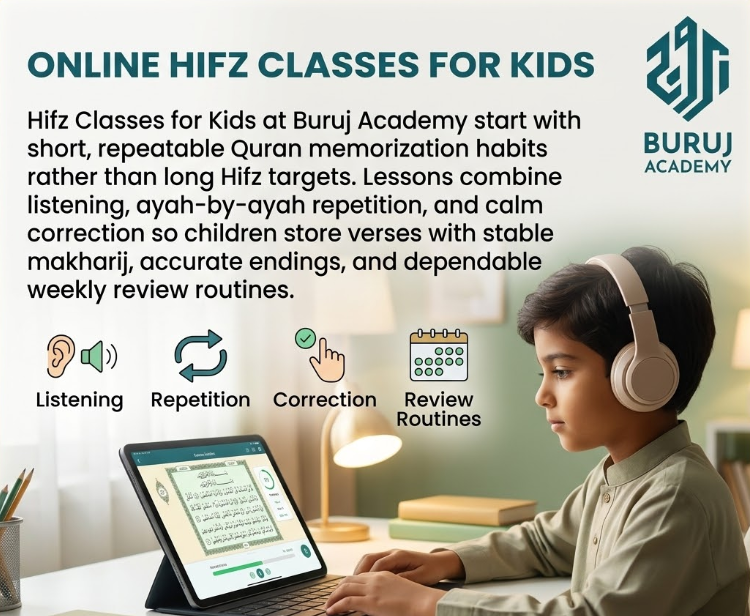
For families exploring options for their children, Buruj Academy’s Hifz Classes for Kids uses age-appropriate techniques — shorter focused sessions, positive reinforcement, and gamified review — to build memorization habits that sustain over years rather than weeks.
Start your child’s Hifz classes for free session
Read also: How to Find Quran Memorization Partners Online?
How to Build a Daily Memorization Schedule?
A workable Hifz schedule is built around your real life, not an idealized version of it. The most effective structure we have seen across hundreds of students at Buruj Academy follows a two-session daily model: new memorization in the morning, revision in the evening.
1. Morning Session: New Memorization (20–30 Minutes After Fajr)
Begin with reciting what was memorized the previous day — just once, to prime the memory. Then move to the new portion. Read the new verses aloud at least 10 times before attempting to recite from memory. Once you can recite without looking, repeat an additional 5 times with eyes closed to strengthen the neural trace.
2. Evening Session: Revision (15–20 Minutes After Asr or Before Isha)
Evening revision is not optional — it is the mechanism that converts short-term memorization into permanent retention. Review the current week’s memorization plus one older section. Keep the session short and focused rather than long and fatigued.
For a fully structured weekly breakdown, our Quran memorization schedule guide provides a ready-to-use template adaptable to any daily availability.
Should You Start with Juz Amma Before Full Hifz?
Beginning with Juz 30 — the 30th and final portion of the Quran containing the shorter surahs most frequently recited in Salah — is the recommended starting point for the overwhelming majority of adult beginners. It provides early wins, immediately practical memorization for daily prayer, and a manageable entry into the Hifz commitment.
Juz 30 contains 37 surahs of varying length. Most adult students with 30 minutes daily can complete it in 4 to 8 months with proper revision. This timeline serves as a reliable indicator of how long full Quran memorization will realistically take for that individual.
Buruj Academy’s Juz 30 Memorization Course guides students through all 37 surahs with Tajweed correction embedded throughout — because memorizing with correct pronunciation from the start prevents the costly work of unlearning errors later.
For more on the spiritual and practical rewards of this commitment, our article on benefits of memorizing Quran is worth reading before beginning.
Excel in Your Quranic Studies
Join Buruj Academy and master the Quran with our structured, professional curriculum.
Book Your Free TrialEmbark on Your Journey to Becoming a Hafiz
Carry the words of the Divine in your heart and transform your life through the noble pursuit of Hifz. At Buruj Academy, we provide a structured, supportive, and highly personalized environment to help you achieve your memorization goals, whether you are starting with the final chapters or aspiring to complete the entire Quran.
Our experienced tutors employ proven techniques to ensure long-term retention (Mutqin) and spiritual growth, making the path to memorization accessible for every member of the family.
Take the first step toward this lifelong blessing by enrolling in a program tailored to your pace:
- Online Hifz Program (Comprehensive Quran Memorization)
- Juz 30 Memorization Course (Perfect for focused starts)
- Hifz Classes for Kids (Engaging and interactive)
- Hifz Classes for Adults (Flexible scheduling for busy lives)
- Hifz Classes for Sisters (Private, supportive learning)
- Short Surah Memorization Course (Ideal for daily prayers)
- Hifz Ijazah Course (For advanced students seeking certification)
Don’t let another day pass without moving closer to your goal. Join Buruj Academy today and schedule your free trial session to begin your Hifz journey!
Frequently Asked Questions About the Best Time to Memorize Quran
Is After Fajr Really the Best Time to Memorize Quran for Everyone?
After Fajr is the strongest memorization window for most people due to mental freshness and spiritual focus following prayer. However, shift workers, mothers of newborns, or those with health constraints may find late-night or post-Asr sessions equally effective. The best time is ultimately the one you can protect and maintain consistently every day.
What Is a Realistic Daily Time Commitment for Quran Memorization?
A realistic and sustainable daily commitment for adult part-time learners is 30 to 45 minutes — split between new memorization in the morning and revision in the evening. Students who attempt two-hour sessions without prior conditioning typically burn out within weeks. Building to longer sessions gradually produces far stronger long-term results.
How Much Time Does It Take to Memorize Quran If You Start as an Adult?
Adults dedicating 30 minutes daily can expect full Quran memorization in approximately 5 to 7 years. At 60 minutes daily with structured revision, this reduces to 3 to 4 years. Adults who begin with strong Tajweed foundations and teacher accountability consistently outperform self-study timelines by a significant margin.
Can You Memorize Quran Without a Teacher?
Memorizing without a teacher is possible but significantly less efficient and carries real risk of establishing pronunciation errors that corrupt memorization. A teacher provides Tajweed correction, accountability, revision oversight, and motivational continuity through the inevitable plateau phases. For most adult learners, teacher guidance is the single variable that most reliably separates completion from abandonment.
What Is the Best Way to Start Quran Memorization as a Complete Beginner?
Begin with Noorani Qaida and Arabic reading fluency before any memorization attempt. Then start with the short surahs of Juz 30, establishing a two-session daily habit before increasing the memorization load. Read our detailed guide on what is the best way to memorize Quran for a full step-by-step approach.