 Islamic
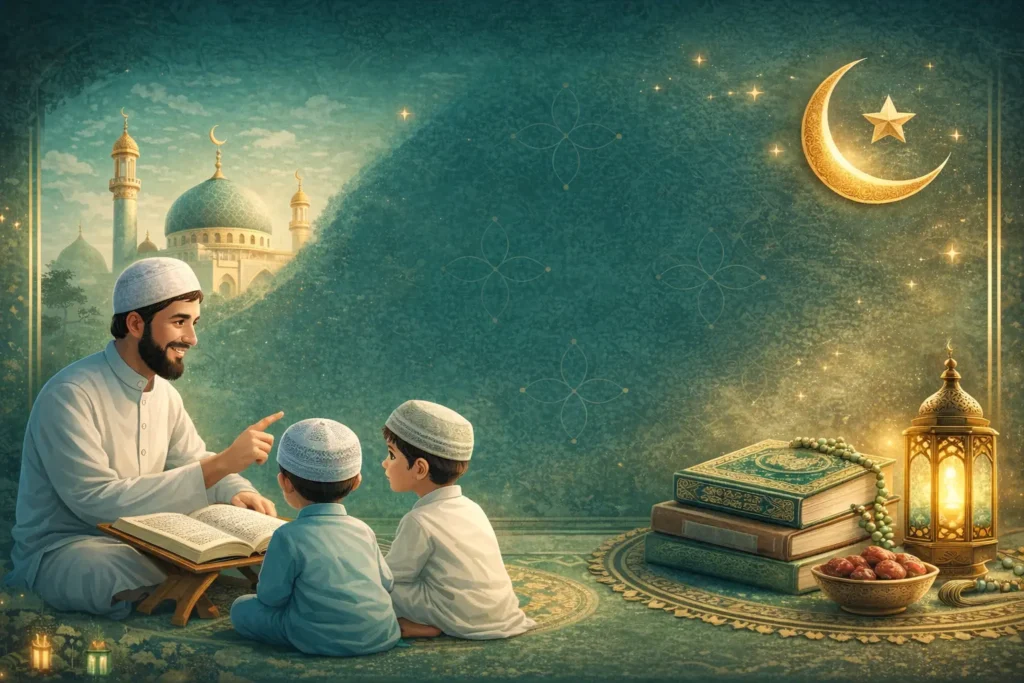
Many parents feel unsure where to start when teaching their children about Islam — especially when English is the home language and Islamic knowledge wasn’t passed down in structured ways. The good news is that children absorb faith naturally when it’s introduced simply and consistently.
Teaching the basics of Islam for kids doesn’t require a religious school or formal curriculum right away. This guide covers the core beliefs, practices, and values children need to know, with practical ways to introduce each one at home across different age groups.
1. Knowing Allah Comes Before Everything Else
Before prayers, before fasting, before any ritual — children need to understand who Allah is. This is the foundation everything else builds upon, and it can be taught beautifully through simple conversations.
Start by explaining that Allah created everything a child can see: the sun, animals, water, and people. Young children connect deeply to creation stories, so using the world around them makes this concept real and personal rather than abstract.
Ages 4-7: Ask your child, “Who made the trees? Who made you?” Then answer together: “Allah did — because He loves us.” Keep it short, warm, and repeated daily in natural moments.
Ages 8-12: Introduce the 99 Names of Allah gradually. Start with Ar-Rahman (The Most Merciful) and Al-Khaliq (The Creator). Help children connect each name to something they’ve experienced.
Ages 13-15: Discuss the concept of Tawheed — the oneness of Allah — in more depth. Teenagers can explore why believing in one God is the central pillar that all other Islamic beliefs connect back to.
Buruj Academy’s Islamic Studies Classes for Kids introduce Allah’s attributes through age-appropriate stories and discussions, helping children build genuine love for Allah rather than just memorizing names.
The first session is free in our Islamic Studies for Kids
2. The Five Pillars Give Children a Clear Islamic Framework
The Five Pillars are the practical framework of Islam, and children can begin learning them one by one from a young age. Knowing all five gives kids a sense of what “being Muslim” looks like in everyday life.
Here’s a simple overview parents can use to introduce the Five Pillars:
| Pillar | Arabic Name | Simple Meaning for Kids |
| Declaration of Faith | Shahada | “I believe Allah is One and Muhammad ﷺ is His messenger” |
| Prayer | Salah | Talking to Allah five times every day |
| Giving | Zakat | Sharing money to help people who need it |
| Fasting | Sawm | Not eating or drinking during Ramadan to remember Allah |
| Pilgrimage | Hajj | Visiting Makkah once in a lifetime if you’re able |
The table above gives parents a ready reference to explain each pillar without overcomplicating it. Children remember better when each pillar is tied to a story or real-life example they’ve seen at home or in the community.
3. The Shahada Forms the Foundation of All Muslim Belief
This short statement contains everything. Teaching children to say it with understanding — not just memorization — is the most foundational Islamic lesson you’ll ever give.
لَا إِلَٰهَ إِلَّا ٱللَّٰهُ مُحَمَّدٌ رَسُولُ ٱللَّٰهِ
La ilaha illallah, Muhammadun Rasulullah
“There is no god except Allah, and Muhammad is the messenger of Allah.”
Explain to children that the Shahada has two parts: believing in Allah alone, and believing in Prophet Muhammad ﷺ as the one who taught us how to live. Both parts work together.
Young children can memorize the words quickly, but parents should regularly ask: “What does it mean?” Revisiting the meaning keeps faith alive rather than mechanical.
Discover the Buruj Academy Difference
Step into our virtual classrooms and see how our expert instructors make learning Quran and Arabic intuitive and clear. We focus on overcoming the specific hurdles non-native speakers face, building your confidence and connection with the Quran.
4. Learning Salah Is One of the Most Important Basics of Islam for Kids
Prayer is the pillar children can see, practice, and experience every single day. Introducing Salah early — even by just watching parents pray — builds a natural connection before formal instruction begins.
Children don’t need to pray all five prayers correctly at age five. What matters first is familiarity: knowing that Muslims speak to Allah throughout the day, learning the physical movements, and hearing the Arabic words often.
Ages 4-7: Let children stand beside you during prayer. They’ll copy movements naturally. Praise every attempt warmly — “Masha’Allah, you made sujood just like Mama!”
Ages 8-12: Begin teaching the short surahs needed for Salah. Start with Al-Fatiha, then add Al-Ikhlas, Al-Falaq, and An-Nas. Short, daily practice works far better than long weekly sessions.
Ages 13-15: Work toward consistent, independent prayer. Discuss the meaning behind what’s recited in Salah — understanding Arabic phrases deepens connection and makes prayer feel purposeful rather than routine.
Through Buruj Academy’s Online Quran Classes for Kids, children learn the surahs needed for Salah with proper pronunciation, guided by patient instructors trained specifically in working with young learners aged 4-15.
Help your child start reading the Quran with a Free trial
5. Stories of the Prophet Muhammad ﷺ Bring Islamic Values to Life
Prophet Muhammad ﷺ is the model every Muslim child should know and love. Stories about his life bring Islamic values to life in ways that abstract explanations simply cannot reach.
Start with stories children can relate to emotionally: his kindness to animals, how he played with children, how he always told the truth even when it was difficult. These human moments make the Prophet ﷺ real and admirable to young minds.
Ages 4-7: Tell one short prophet story per day at bedtime. Keep it under five minutes and focus on one value — kindness, honesty, or generosity. Children at this age love repetition.
Ages 8-12: Use a children’s Seerah book. Read chapters together and ask: “What would the Prophet ﷺ do in your situation at school?” Applying his example to daily life makes learning meaningful.
Ages 13-15: Explore the historical context of his life — the early years in Makkah, the migration to Madinah, and how Islam grew. Teenagers appreciate context and cause-and-effect narratives.
6. Islamic Values Matter as Much as Rituals and Practices
Islam isn’t only prayers and fasting — it’s a complete way of treating people. Teaching children Islamic values alongside practices ensures their faith becomes a lived reality, not just scheduled acts.
The core values children should internalize early include honesty, respect for parents, kindness to neighbors, caring for animals, and sharing with others. Each value has clear examples from the Quran and Sunnah.
Here’s a practical framework for integrating values into daily family routines:
| Value | Daily Opportunity | What to Say to Your Child |
| Honesty | When they make a mistake | “Allah loves people who tell the truth, even when it’s hard” |
| Kindness | When playing with siblings | “How would you want to be treated? Do the same for them.” |
| Gratitude | At mealtimes | “Say Alhamdulillah — Allah gave us this food.” |
| Generosity | Before donating old toys | “Giving makes Allah happy and makes others feel loved.” |
| Respect | When speaking to adults | “Lower your voice and listen — that’s how we honor people.” |
Using real daily moments as teaching opportunities is far more effective than formal lectures. Children absorb values through consistent, repeated gentle reminders in context.
7. Angels and the Afterlife Deepen a Child’s Core Belief
Beyond the Five Pillars, children benefit from learning the six articles of Islamic faith (Iman). Angels and the afterlife are two concepts that children often ask about naturally — and simple, truthful answers build genuine belief.
Explain angels as beings made of light who never disobey Allah. Children find this fascinating. You can mention that two angels — Kiraman Katibin — record our deeds, which helps kids connect their daily behavior to accountability in a gentle way.
The concept of Jannah (Paradise) is particularly motivating for children. Describe it using the Prophet’s ﷺ descriptions: rivers, gardens, anything the heart desires. This gives children something beautiful to work toward rather than fear.
8. Every Child Can Begin Building a Relationship with Quran
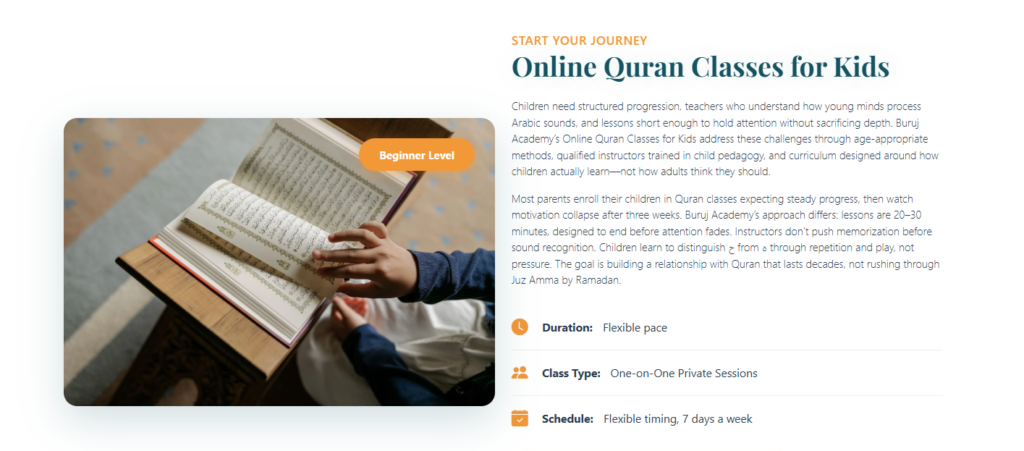
The Quran is Islam’s direct word from Allah, and every Muslim child should develop a relationship with it from early life. This doesn’t mean children must read fluently at age four — it means regular, loving exposure from the very beginning.
Babies and toddlers benefit from hearing Quran recitation daily. Playing soft recitation during quiet time or before sleep builds familiarity with the sound and rhythm of Arabic even before formal learning begins.
Ages 4-7: Begin with the Arabic alphabet using a Noorani Qaida. Short, five-minute daily sessions with colorful visuals work well at this stage. Celebrate every letter learned — progress should always feel like an achievement.
Ages 8-12: Move toward reading short surahs independently. Regular reading — even just five minutes after Maghrib — builds fluency gradually without overwhelming children or creating negative associations with Quran time.
Buruj Academy’s Noorani Qaida for Kids introduces Arabic letters through visual aids, games, and 20-25 minute sessions designed specifically for children’s attention spans, making the path to Quran reading smooth and enjoyable.
Sign up your son for a free Noorani Qaida lesson.

9. Fasting and Giving Become Meaningful Through Early Involvement
Fasting and giving charity are two pillars children can begin connecting with long before they’re required to practice them. Early familiarity makes the transition natural rather than sudden.
During Ramadan, involve children in the spirit of fasting even if they’re too young to fast fully. Let them “fast” from sunrise to Dhuhr time, participate in suhoor, and help prepare iftar. These experiences build genuine love for Ramadan.
For Zakat and Sadaqah, give children their own small amount of money to donate. When a child personally drops coins into a charity box or helps choose a family to support, generosity becomes part of their identity, not just an obligation they’ll learn about later.
| Age Group | Ramadan Involvement | Giving Practice |
| Ages 4-7 | Short fast until Dhuhr, help set iftar table | Drop coins in charity box themselves |
| Ages 8-12 | Full or half-day fast with parent guidance | Choose which cause to give to and why |
| Ages 13-15 | Complete fast, lead family in some prayers | Calculate Zakat amounts, understand obligation |
Starting small and building gradually ensures that Ramadan and giving feel like joyful, meaningful experiences as children grow.
Deepen Your Islamic Knowledge
Study Aqeedah, Fiqh, Seerah, and essential Islamic teachings with experienced instructors in a structured online program.
Try Islamic StudiesBuild Your Child’s Strong Islamic Foundation with Buruj Academy’s Islamic Studies Classes
Home conversations plant seeds, but structured learning helps those seeds grow with clarity and confidence. Children benefit deeply from guided Islamic education alongside what they learn at home.
Buruj Academy’s Islamic Studies Classes for Kids offer:
- Al-Azhar graduates with 12+ years teaching non-Arabic speaking children
- Age-appropriate curriculum designed for children aged 4-15
- Stories, games, and discussions — never dry lectures
- Short 20-30 minute sessions that match children’s attention spans
- Patient, encouraging instructors who build confidence, not pressure
- Flexible scheduling that works around your family routine
Book your child’s free trial lesson today and see the difference child-focused Islamic education makes.
Find your child’s perfect match among Buruj’s top courses for kids:
- Arabic Classes for Kids
- Alphabet course
- Noorani Qaida Course for Kids
- Quranic Arabic Course
- Islamic Studies for Kids
- Hifz Classes for Kids
- Quran Classes for Kids
- Tajweed for Kids
Get a free trial for your child today.
Conclusion
Basic knowledge of Islam for kids rests on knowing Allah, loving the Prophet ﷺ, and practicing the Five Pillars with understanding. When children learn each element in age-appropriate ways, their faith grows naturally alongside them.
Values like honesty, generosity, and kindness aren’t separate from Islamic rituals — they are Islam expressed through daily behavior. Teaching both together gives children a complete picture of what living as a Muslim means.
Starting early, keeping sessions short, and making learning enjoyable are the three habits that create lifelong connection to Islam. Every family’s pace looks different, and that’s perfectly fine — consistency matters far more than speed, Insha’Allah.

Leave a Reply