 Arabic
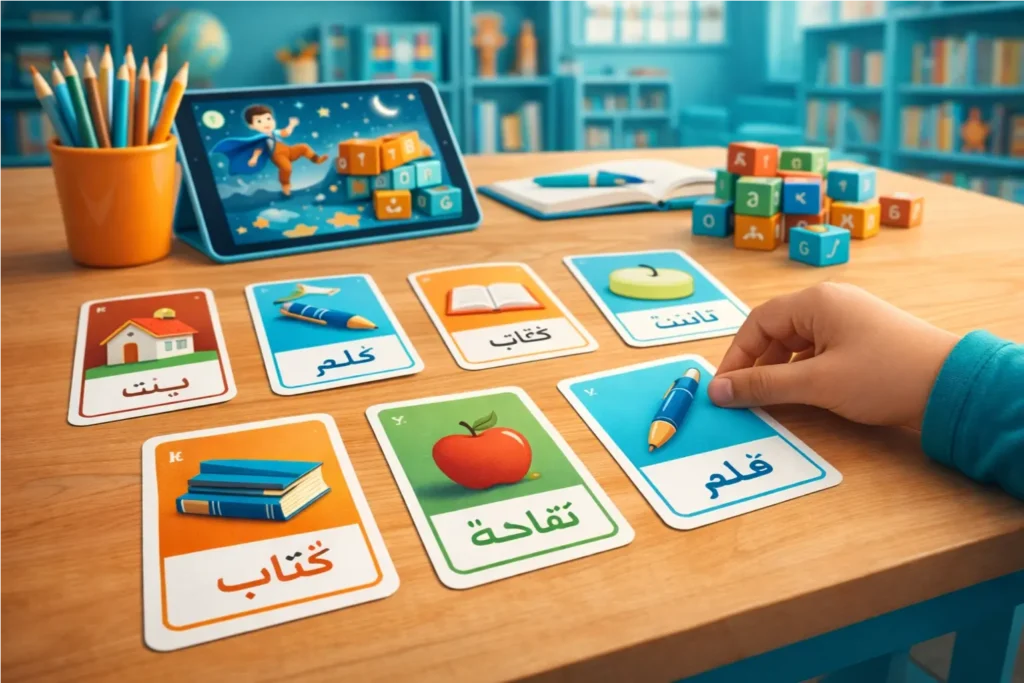
Children absorb languages naturally when surrounded by words that connect to their daily world. A child who hears “Alhamdulillah” at breakfast and “Yallah, let’s go” on the school run already has a head start in Arabic sentence building.
Teaching kids real Arabic sentences—not just isolated vocabulary—helps them communicate meaningfully from the very first lesson. This guide provides age-specific sentence lists, practical classroom and home activities, and proven teaching strategies that make Arabic sentences for kids genuinely memorable.
Why Full Arabic Sentences for Kids Work Better Than Single Words Alone?
Teaching single vocabulary words is a common starting point, but children retain language more effectively when they experience whole sentences in real context.
When a child says “أنا أحب التفاح” (Ana uhibbu at-tuffah — “I love apples”), they practice grammar, vocabulary, and pronunciation simultaneously.
Sentences also give children a sense of accomplishment. Saying something complete feels like real communication, and that feeling motivates continued learning far more than memorizing lists.
At Buruj Academy, our Online Arabic Classes for Kids are built around this exact principle—children speak in sentences from lesson one, guided by instructors with 12+ years experience teaching non-Arabic speaking families.
Book your child’s free Arabic trial now!

The Best Simple Arabic Sentences for Kids to Learn First
Not every sentence suits every child. Matching complexity to developmental stage makes Arabic feel natural rather than forced. The table below shows a fuller range of starter sentences across all three age groups:
| Arabic Sentence | Transliteration | English Meaning |
| أنا مسلم | Ana Muslim | I am a Muslim |
| بسم الله | Bismillah | In the name of Allah |
| ماما، أنا جائع | Mama, ana ja’i’ | Mum, I am hungry |
| هذا كلب | Hatha kalb | This is a dog |
| أنا أحب بابا | Ana uhibbu baba | I love Dad |
| أنا أذهب إلى المدرسة | Ana athabu ila al-madrasa | I go to school |
| هل يمكنني اللعب؟ | Hal yumkinuni al-la’ib? | Can I play? |
| أريد أن أشرب ماء | Ureedu an ashrab ma’ | I want to drink water |
| أنا أحب القرآن | Ana uhibbu al-Quran | I love the Quran |
| أين كتابي؟ | Ayna kitabi? | Where is my book? |
| أريد أن أتعلم العربية | Ureedu an ata’allama al-Arabiyyah | I want to learn Arabic |
| ما رأيك في هذا؟ | Ma ra’yuka fi hatha? | What do you think about this? |
| أعتقد أن هذا صحيح | A’taqidu anna hatha sahih | I think this is correct |
| كيف حالك اليوم؟ | Kayfa haluka al-yawm? | How are you today? |
| جزاك الله خيراً | Jazakallahu Khayran | May Allah reward you with good |
The sentences in each group are intentionally different in structure and purpose — not just vocabulary difficulty. Here is what to focus on within each age range.
Young children learn best through daily household Arabic sentences
Children at this stage need sentences that mirror their immediate world — family, food, animals, and feelings. A four-year-old cannot grasp abstract religious meaning, but they absolutely understand “ماما، أنا جائع” (Mama, ana ja’i’ — “Mum, I am hungry”) because they say it every single day.
The goal here is not grammar — it is sound familiarity. Sentences like “هذا كلب” (Hadha kalb — “This is a dog”) work because children can point at something real while saying them.
Pointing, touching, and seeing while speaking burns the sentence into memory far faster than any worksheet or repetition drill ever could.
Islamic phrases like “بسم الله” and “الحمد لله” belong here too, but treat them as daily ritual rather than formal learning. Say them together before meals, before bed, before car journeys.
Within weeks, your child will say them without prompting — that is genuine Arabic sentence acquisition happening naturally.
Discover the Buruj Academy Difference
Step into our virtual classrooms and see how our expert instructors make learning Quran and Arabic intuitive and clear. We focus on overcoming the specific hurdles non-native speakers face, building your confidence and connection with the Quran.
Middle childhood learners need sentences for daily requests
Children this age are ready for sentences that function — ones they can actually use to ask questions, make requests, and describe actions happening around them. “هل يمكنني اللعب؟” (Hal yumkinuni al-la’ib? — “Can I play?”) is perfect because it contains a real question structure children use constantly at home and at school.
At this stage, parents can introduce the idea that Arabic sentences follow a pattern: subject, then verb, then object. “أنا أذهب إلى المدرسة” (Ana athabu ila al-madrasa — “I go to school”) demonstrates this structure clearly without needing to explain it formally. Children this age absorb grammar through repeated exposure to well-chosen examples.
Sentences with question words — أين (ayna — where), ما (ma — what), هل (hal — does/is) — are particularly valuable. Questions force children to listen for a response, which creates genuine two-way communication practice rather than passive repetition.
Try asking your child “أين كتابك؟” (Ayna kitabuka? — “Where is your book?”) every morning before school.
Teens thrive when learning complex and respectful phrases
Teenagers need sentences that respect their intelligence and social awareness. At this age, the fastest way to disengage a young learner is to give them baby-level phrases. “ما رأيك في هذا؟” (Ma ra’yuka fi hatha? — “What do you think about this?”) treats them as capable thinkers who have opinions worth expressing in Arabic.
This age group also benefits from sentences that carry emotional and Islamic weight they can genuinely connect with. “أعتقد أن هذا صحيح” (A’taqidu anna hatha sahih — “I think this is correct”) introduces the important connector word أن (anna — that), which appears constantly in Quranic Arabic and in everyday speech. Learning it inside a useful sentence is far more effective than studying it as an isolated grammar rule.
Encourage teenagers to use “جزاك الله خيراً” and “كيف حالك اليوم؟” in real exchanges — with siblings, with parents, or in online Arabic classes.
When a sentence earns a real response, motivation to learn more sentences grows organically. That authentic communication loop is what separates teenagers who progress rapidly from those who plateau early.
Read Also: Learn Arabic Alphabet for Kids
How to Teach Arabic Sentences for Kids Through Daily Routines at Home?
The most effective Arabic teaching happens outside of formal lessons, woven into moments children already experience every day. Parents don’t need to be fluent—they just need consistency.
Consider this simple daily routine that takes under five minutes total:
Morning: Say “صباح الخير” (Sabah al-khayr — “Good morning”) when waking your child up. Ask them to repeat it back before getting out of bed.
Meals: Use “بسم الله” before eating and “الحمد لله” after every meal. These two sentences alone build powerful daily Arabic habit over weeks.
Bedtime: End the day with “بارك الله فيك” (Barakallahu fik — “May Allah bless you”). Children associate warmth with these words, making retention effortless.
Through Buruj Academy’s Arabic Alphabet Learning Course, children build on these home routines with structured sentence patterns taught through games and storytelling, matching exactly how young minds acquire language naturally.
Get your kid a free trial now in the Best Alphabet course
Read Also: Arabic Kids Books
Fun Games That Help Kids Practice Arabic Sentences Without Feeling Like Studying
Children learn fastest when they don’t realize they’re learning. Games create the low-pressure repetition that makes Arabic sentences stick in memory without boring drilling.
Learning Arabic Sentences Ball Game
Materials: A soft ball, a list of 5 target sentences.
Setup: Stand in a circle with your child or several children. Each person holds the ball for three seconds before passing.
How to play: The person holding the ball must say the target Arabic sentence before passing. Whoever fumbles or forgets starts again from sentence one.
Learning outcome: Repeated exposure in a playful setting. Children say each sentence dozens of times without noticing.
Learning Arabic Sentences Flashcard Race
Materials: 10 flashcards with Arabic sentences (Arabic on one side, English on the other).
Setup: Spread cards face-down across a table or floor.
How to play: Set a timer for 60 seconds. Children flip cards and say the Arabic sentence aloud before flipping the next. Parents count correct sentences.
Learning outcome: Speed-building with accuracy, perfect for ages 8–12.
Read Also: The Arabic Alphabet for Kids
Common Mistakes Parents Make When Teaching Arabic Sentences for Kids
Even well-intentioned parents sometimes approach Arabic teaching in ways that slow their child’s progress. Recognizing these patterns early saves months of frustration.
Correcting pronunciation too aggressively is the most common issue. When children fear making mistakes, they stop speaking altogether. Encourage first, gently model the correct pronunciation second.
Skipping sentences and jumping to grammar is another pitfall. Children don’t need to understand why “أنا” comes first—they need to hear and repeat it until it feels natural. Grammar awareness develops later, organically.
Inconsistency is perhaps the biggest challenge for busy families. Three minutes daily beats thirty minutes once a week significantly. Short, consistent exposure builds the neural pathways for language retention.
The table below shows what to do versus what to avoid:
| Common Mistake | Better Approach |
| Correcting every error immediately | Praise effort, model correct form gently |
| Long irregular sessions (30+ min) | 5–10 minutes daily, consistently |
| Teaching words without context | Use full sentences in real situations |
| Expecting fluency too quickly | Celebrate small wins: one new sentence per week |
| Avoiding Arabic because “I’m not fluent” | Learn alongside your child — it’s bonding |
Recognizing these patterns early makes a meaningful difference in your child’s confidence and progress.
Master the Arabic Language
Develop reading, writing, speaking, and comprehension skills through interactive Arabic lessons for all levels.
Start Arabic ClassesRead Also: How to Learn Arabic for Kids?
Expert Guidance at Buruj Academy Accelerates Your Child’s Language Development
Building confidence with Arabic sentences requires structured, expert-led instruction that goes beyond what home practice alone can achieve. Buruj Academy’s Online Arabic Classes for Kids provide exactly that foundation.
- Instructors trained in child pedagogy AND Islamic education
- Age-appropriate curriculum for children aged 4–15
- Gamification, songs, and interactive sentence-building activities
- Short 20–30 minute sessions matching children’s attention spans
- Patient, encouraging approach that builds confidence without pressure
- Flexible scheduling to fit your family’s routine
- Personalized pacing based on each child’s learning speed
- Al-Azhar graduates with 12+ years teaching non-Arabic speaking children
Book your child’s free trial lesson today and see the difference expert, child-focused instruction makes.
Find your child’s perfect match among Buruj’s top courses for kids:
- Arabic Classes for Kids
- Alphabet course
- Noorani Qaida Course for Kids
- Quranic Arabic Course
- Islamic Studies for Kids
- Hifz Classes for Kids
- Quran Classes for Kids
- Tajweed for Kids
Get a free trial for your child today.

Conclusion
Daily exposure to real Arabic sentences for kids—connected to routines like meals, mornings, and bedtimes—builds language habits that formal study alone rarely achieves. Consistency in small moments matters more than occasional long sessions.
Age-appropriate sentence selection for kids makes the difference between a child who feels capable and one who feels overwhelmed. Matching sentence complexity to your child’s developmental stage keeps motivation high and progress steady.
Games, positive reinforcement, and avoiding over-correction create the low-pressure environment where language naturally flourishes. Insha’Allah, with patience and the right approach, your child will speak Arabic sentences with genuine confidence.


Leave a Reply