 Quran
Quran
| Key Takeaways |
| The Quran mentions over 35 animals, many featured in stories that teach children moral lessons about obedience, gratitude, and trust in Allah. |
| The story of the elephant in Surah Al-Fil teaches children that Allah protects His sacred places using the smallest of His creatures. |
| The story of the cow in Surah Al-Baqarah teaches children the importance of obeying Allah’s commands without excessive questioning or delay. |
| The hoopoe bird in Surah An-Naml shows children that even small creatures can carry great responsibility when serving Allah’s purpose. |
| Prophet Sulayman’s ability to understand animal speech demonstrates to children that all living creatures glorify and communicate with Allah. |
Children connect deeply with animals, and across dozens of surahs, Allah uses animals as vessels for some of the most vivid, memorable lessons in the entire Book.
These animal stories from the Quran for kids are not fairy tales — they are true accounts filled with wisdom, wonder, and real guidance. Each one plants a seed of faith in a child’s heart through a creature they can picture, name, and remember.
1. The Story of the Elephant in the Quran
Long ago, in the year the Prophet Muhammad ﷺ was born, a powerful and proud king named Abraha ruled over Yemen.
Abraha had built a grand, jeweled church and wanted everyone in Arabia to visit it instead of the Kaaba in Makkah.
When the Arabs refused, he grew furious. He gathered the largest army anyone had ever seen — and at the front of that army stood enormous, thundering war elephants. The greatest of them was called Mahmud.
The people of Makkah were terrified. They had no army, no weapons, no walls. The city’s leader, Abdul Muttalib — the Prophet’s own grandfather — simply said: “The Kaaba belongs to Allah. He will protect it.” He took his family into the mountains and left the city in Allah’s hands.
Abraha’s army marched closer. The lead elephant, Mahmud, reached the edge of Makkah — and stopped. He refused to move forward. Soldiers beat him with iron rods. He would not budge. They turned him toward Yemen — he ran eagerly. They turned him back toward the Kaaba — he sat down and refused again. Even the elephant knew.
Then the sky darkened.
From the direction of the sea came enormous flocks of small birds — birds unlike any seen before, called Ababil. Each bird carried three tiny stones: one in its beak, one in each claw. The birds swept over the army in waves and released their stones. Each stone found its mark.
The mighty soldiers — with their elephants and armor and spears — crumbled like dried leaves. Abraha himself was struck and fled, falling apart piece by piece on the road back to Yemen until he died.
The Kaaba stood untouched. Not a single stone was disturbed.
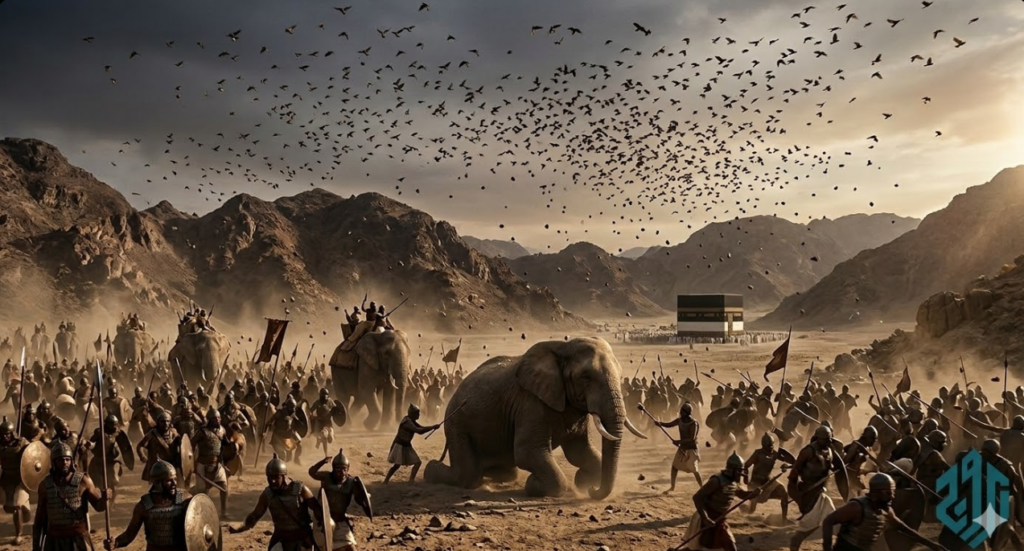
This story appears in Surah Al-Fil (Chapter 105), one of the shortest yet most powerful surahs in the Quran.
The lesson for children is immediate and clear: no matter how powerful an enemy appears, Allah’s protection is greater. Even the smallest bird, carrying the smallest stone, becomes mighty when Allah commands it.
What to tell your child: “Allah doesn’t need armies or weapons to protect what He loves. He used tiny birds with tiny stones to destroy the most powerful army of the time. If Allah is protecting something — nothing in the world can touch it.”
| Story Element | Detail | Lesson for Kids |
| The army | Abraha’s forces with war elephants | Human power has limits |
| The birds | Ababil — small, swift birds | Allah uses small things for big purposes |
| The stones | Tiny clay pellets | Allah’s permission makes the smallest thing powerful |
| The outcome | Army destroyed, Kaaba protected | Allah always protects what He loves |
We regularly find that this story is the one children ask to hear again and again in our sessions at Buruj Academy. The image of birds carrying stones stays with them for years — and so does the lesson.
Book Your Kid a Free Trial Lesson With One of Buruj’s Quran Tutors for Children

Excel in Your Quranic Studies
Join Buruj Academy and master the Quran with our structured, professional curriculum.
Book Your Free TrialRead also: Bird Story in Quran for Kids
2. The Story of the Cow in the Quran
This story of the cow in the Quran begins with a mystery and a command. Among the Children of Israel — the people of Prophet Musa (peace be upon him) — a man was found murdered. No one knew who had killed him. Arguments broke out. Families accused each other. The truth seemed impossible to find.
Allah revealed a solution to Prophet Musa: slaughter a cow, and strike the dead man with part of it. By Allah’s power, the man would come back to life just long enough to name his killer.
Simple enough — but the people did not obey simply.
“What kind of cow?” they asked.
Musa replied that Allah said: any cow — not too old, not too young, somewhere in between.
“Ask your Lord to describe its color,” they pressed again.
Musa asked, and the answer came: a bright yellow cow, so vivid it dazzles the eyes of those who see it.
“Ask your Lord to make it clearer — all cows look alike to us,” they continued.
Musa replied with patience, but the answer this time was precise: a cow that has never been used for plowing or watering fields — one that is completely sound, without a single blemish, without any mark of color other than its pure yellow.
“Now you have told us the truth,” they said — as if Musa had been hiding the answer all along.
They searched and searched. A cow matching this exact description belonged to one young man — an exceptionally righteous young man who had inherited it from his father, who had buried it as a trust for his son before he died. The people had to pay a fortune to purchase it.
They slaughtered the cow. The dead man was struck and came back to life. He named his killer. The truth was revealed.
This story gives the second and longest surah in the Quran its name: Al-Baqarah — The Cow. Allah uses it to teach one of the most enduring lessons in the Book.
What to tell your child: “When Allah gives us a command — to pray, to be kind, to tell the truth — we shouldn’t keep asking ‘why’ to avoid obeying. The Children of Israel made something easy very hard by asking too many questions. A simple ‘yes, Allah’ is always the best answer.”
| Stage | Their Response | Outcome |
| First command | “Tell us what type of cow” | Command became more specific |
| Second question | “Tell us what color” | Even more detailed requirement |
| Third question | “Tell us which cow exactly” | Very rare, expensive cow required |
| Final obedience | They slaughtered it | Truth was revealed |
We love using this story in our Islamic Studies for Kids at Buruj Academy because it sparks the best discussions.
The first session is free in Buruj’s Islamic Studies Classes for Kids

Read also: The Story of Maryam in the Quran for Kids
3. The Story of the Hoopoe Bird (Hudhud) in Surah An-Naml
Prophet Sulayman (peace be upon him) was one of the greatest kings who ever lived. Allah gave him a kingdom unlike any other — he commanded humans, jinn, winds, and animals. His armies were vast. His court was magnificent.
And every morning, every bird in the land would fly to its assigned place in his formation.
One day, Prophet Sulayman looked across his assembled forces — and noticed an empty space. The hoopoe bird, Hudhud, was missing.
Sulayman was not pleased. “Where is Hudhud?” he demanded. “If he does not come with a clear excuse, I will punish him severely.”
Before long, Hudhud arrived — small, striped, with its crown of feathers — and landed before the prophet-king with a remarkable report.
“I have seen something you have not seen,” Hudhud said. “I have come from Saba — a land of great wealth, ruled by a queen of immense power. But, O Prophet of Allah — she and her people are worshipping the sun. They bow to it instead of bowing to Allah.”
أَلَّا يَسْجُدُوا لِلَّهِ الَّذِي يُخْرِجُ الْخَبْءَ فِي السَّمَاوَاتِ وَالْأَرْضِ
Allā yasjudū lillāhil-ladhī yukhriju al-khab’a fis-samāwāti wal-arḍ
“[And] so they do not prostrate to Allah, who brings forth what is hidden within the heavens and the earth” (An-Naml 27:25)
Prophet Sulayman was moved. He composed a letter — a letter calling the Queen of Saba to leave her sun-worship and submit to the Lord of all worlds. Then he folded it, sealed it, and handed it to the tiny bird.
“Take this letter and deliver it to them,” he said. “Then wait nearby and see what they do.”
Hudhud flew across deserts and mountains and delivered the letter to the queen. She consulted her advisors. She thought deeply.
And eventually — after a series of extraordinary events — the Queen of Saba, Bilqis, came to Sulayman and accepted Islam.
All of it began with one small bird taking its mission seriously.
What to tell your child: “Hudhud was not a lion or an eagle. He was a small, ordinary-looking bird. But he paid attention, he told the truth, and he carried out his mission faithfully. Allah can give great responsibilities to anyone — big or small — who is sincere and reliable.”
Discover the Buruj Academy Difference
Step into our virtual classrooms and see how our expert instructors make learning Quran and Arabic intuitive and clear. We focus on overcoming the specific hurdles non-native speakers face, building your confidence and connection with the Quran.
4. The Story of Prophet Yunus and the Whale
Perhaps the most universally loved of all animal stories from the Quran for kids is the story of Prophet Yunus (peace be upon him) and the great whale.
Yunus left his people before Allah’s permission, boarded a ship, and when lots were drawn, was thrown into the sea.
A massive whale swallowed him — yet, miraculously, he remained alive inside.
In the belly of the whale, in complete darkness, Prophet Yunus called out to Allah with sincere repentance:
لَّا إِلَٰهَ إِلَّا أَنتَ سُبْحَانَكَ إِنِّي كُنتُ مِنَ الظَّالِمِينَ
Lā ilāha illā anta subḥānaka innī kuntu minaẓ-ẓālimīn
“There is no deity except You; exalted are You. Indeed, I have been of the wrongdoers.” (Al-Anbiya 21:87)
Allah accepted his repentance and commanded the whale to release him safely onto the shore. For a full retelling suited for younger readers, our Prophet Yunus story for kids covers every detail beautifully.
What to tell your child: “Even in the darkest, scariest place imaginable — inside a whale, in the bottom of the ocean, in the middle of the night — Allah heard Yunus. Allah always hears us. No matter where we are, no matter how scared we feel, we can always call on Him.”
5. The Story of Prophet Sulayman and the Ants
One of the most tender moments in the entire Quran involves not a mighty beast — but a single ant.
Prophet Sulayman (peace be upon him) was leading his enormous army across the land — humans, jinn, and birds all marching together in a formation so grand the earth itself trembled beneath their feet. As they approached a valley, an ant spotted the approaching army from a distance.
She called out urgently to her community:
يَا أَيُّهَا النَّمْلُ ادْخُلُوا مَسَاكِنَكُمْ لَا يَحْطِمَنَّكُمْ سُلَيْمَانُ وَجُنُودُهُ
Yā ayyuhan-namlu udkhulū masākinakum lā yaḥṭimannakum Sulaimānu wa junūduh
“O ants, enter your dwellings so that Sulayman and his soldiers do not crush you.” (An-Naml 27:18)
Then she added something remarkable — something that shows her faith: “while they do not perceive” — meaning, she knew Sulayman was a prophet of Allah, and that he would never harm them on purpose. She was not afraid of his cruelty. She was simply being careful.
Prophet Sulayman heard her voice — because Allah had given him the gift of understanding all creatures. He smiled broadly, his heart full of gratitude. He stopped his entire army. He raised his hands and thanked Allah for this gift — the ability to hear the concern of one tiny ant for her community.
What to tell your child: “The ant was so small, but she was responsible. She warned her neighbors. She thought of others before herself. And she still had good thoughts about Prophet Sulayman — she knew he was a good man. Allah noticed that little ant and put her words in His Book forever.”
6. The Story of the Dog of the People of the Cave
A group of young men — true believers in Allah — lived in a city where the king demanded that everyone worship idols. These young men refused. They knew in their hearts that there was only one God, and they would not bow to stone.
Fearing for their lives, they fled the city and took shelter in a cool, dark cave in the mountains. With them went their faithful dog, who lay down at the entrance — paws stretched forward — as if standing guard.
Allah caused them to fall into a deep, miraculous sleep. Not an ordinary sleep — but one that lasted 309 years. While they slept, their bodies were preserved. Allah turned them, gently, from side to side so their bodies would not be harmed. Anyone who looked at them from the entrance felt a sudden fear and turned away — Allah protected them even in their sleep.
Their dog stayed. Three centuries passed — and the dog remained at the cave entrance, faithful and still.
When they finally woke, they thought they had slept for a day, or perhaps half a day. They were hungry and sent one of their companions into the city to buy food quietly. But the city had changed entirely — the tyrant king was long dead, the people were different, and the coins the young man carried were ancient currency from three hundred years ago.
The people of the city gathered in amazement. The young men of the cave became a sign — living proof of the resurrection, of Allah’s power over time and death.
And their loyal dog? Allah mentioned him in the Quran not once, but several times. His faithfulness was worthy of the eternal Book.
What to tell your child: “Those young men were brave enough to say ‘no’ to a powerful king because they loved Allah more than they feared any human being. And they were not alone — even their dog stayed loyal to them. When we stand up for what is right, Allah takes care of us in ways we cannot even imagine.”
We love using this story in our Online Quran Classes for Kids at Buruj Academy because it sparks the best discussions. Children immediately ask: “Why did Allah mention the dog?” — and that question alone teaches them to think deeply about the Quran’s details.
Help your child start reading the Quran with a Free trial

For more wonderful stories structured for young learners, explore our collection of Quran stories for kids and Islamic stories for kids.
7. The Story of Prophet Salih and the She-Camel
Allah sent Prophet Salih (peace be upon him) to the people of Thamud with a miraculous she-camel as a sign of His power. This was no ordinary animal — she appeared miraculously from a rock and was a direct test for the people.
Allah gave one clear command: let the camel graze freely and drink from the water, and harm her not.
The people of Thamud killed the she-camel in defiance. This act of deliberate disobedience sealed their fate, and Allah’s punishment followed swiftly.
Key lesson for kids: Allah tests us with commands that may seem small. Disrespecting Allah’s signs — no matter what form they take — has real consequences. Obedience is not just about prayer; it includes everything Allah commands.
| The Test | The Command | Their Choice | The Consequence |
| The she-camel | Let her graze freely | They killed her | Destroyed within three days |
This story pairs powerfully with the broader theme of prophets and their peoples — which children can explore further in our Prophet Ibrahim story for kids for additional context on how Allah tested communities throughout history.
Excel in Your Quranic Studies
Join Buruj Academy and master the Quran with our structured, professional curriculum.
Book Your Free TrialGive Your Child a Bright Future with Inspiring Quranic Learning
Spark a lifelong love for the Quran and the Arabic language in your child’s heart. At Buruj Academy, we specialize in making sacred knowledge accessible, engaging, and fun for young learners.
Our expert tutors use child-friendly teaching methods—including interactive tools and personalized pacing—to ensure your little ones build a strong spiritual foundation while developing a deep connection to their faith and heritage.
Whether they are taking their very first steps in the alphabet or beginning the noble journey of memorization, we provide a safe and supportive environment where every child can thrive.
Enroll your child in one of our specialized, kid-friendly tracks today:
- Online Quran Classes for Kids
- Tajweed Classes for Kids
- Hifz Classes for Kids
- Online Arabic Classes for Kids
- Quranic Arabic Course for Kids
- Noorani Qaida Course for Kids
- Islamic Studies Classes for Kids
Ready to watch your child grow in knowledge and character? Join the Buruj Academy family and book a free trial session for your child today!
Frequently Asked Questions About Animal Stories from the Quran for Kids
How many animals are mentioned in the Quran?
Scholars have identified over 27 animals mentioned across the Quran, ranging from elephants and whales to ants and bees. Some animals give their names to entire surahs — Al-Baqarah (The Cow), An-Naml (The Ants), An-Nahl (The Bees), Al-Fil (The Elephant) — showing how significantly Allah uses the natural world to teach human beings.
What is the most famous animal story in the Quran for children?
The story of Prophet Yunus and the whale is consistently the most beloved among children. Its vivid imagery — a man alive inside a whale, praying in complete darkness — combined with its message of repentance and rescue makes it instantly memorable and emotionally impactful for young learners of all ages.
Are the animal stories in the Quran true stories?
Yes — The Quran is the literal word of Allah, and the events described within it are real historical occurrences. These are not parables or fables but actual events that happened to real prophets and real communities, preserved in the Quran as signs and lessons for all of humanity.
At what age can children start learning Quran stories?
Children as young as 3–4 years old can begin engaging with simplified Quran stories through storytelling and discussion. Formal Quran reading typically begins around ages 4–6. The stories themselves — especially animal stories — are accessible even to very young children because the concrete imagery makes abstract lessons tangible and memorable.
What lessons do animal stories from the Quran teach children?
These stories teach obedience (the cow), trust in Allah (the elephant and birds), sincere repentance (the whale), loyalty (the cave dog), responsibility (the hoopoe), and the consequences of defiance (the she-camel). Each animal story delivers a moral lesson through a living, relatable creature — making the guidance stick far longer than abstract instruction alone.