Madd Munfasil: Definition, Ruling, Divisions, and Examples from the Quran
Key Takeaways
Madd munfasil occurs when a madd letter ends one word and a hamzah begins the next word immediately after.
Its ruling is permissibility (jawaz), as scholars differ — some recite it with two counts, others extend it to four or five.
Madd munfasil divides into two types: haqiqi (real) where both words are written separately, and hukmi (implied) where the madd letter is absent from the script.
When stopping on madd munfasil haqiqi, the extension disappears and the recitation returns to the natural madd (two counts).
Madd muttasil differs from madd munfasil by requiring the madd letter and hamzah to occur within a single word, making its extension obligatory.
Knowing where to extend your voice and where to hold back is the difference between recitation that merely reads the Quran and recitation that honors it. Among the rules that most students encounter early — and find genuinely confusing — is madd munfasil.
Madd munfasil is a separated elongation that occurs across two words: the madd letter closes the first word, and a hamzah opens the second. Its ruling, its two divisions, and its contrast with madd muttasil are all essential knowledge for any student pursuing accurate Tajweed.
Table of Contents:
What Is Madd Munfasil and Why Does It Occur Across Two Words?
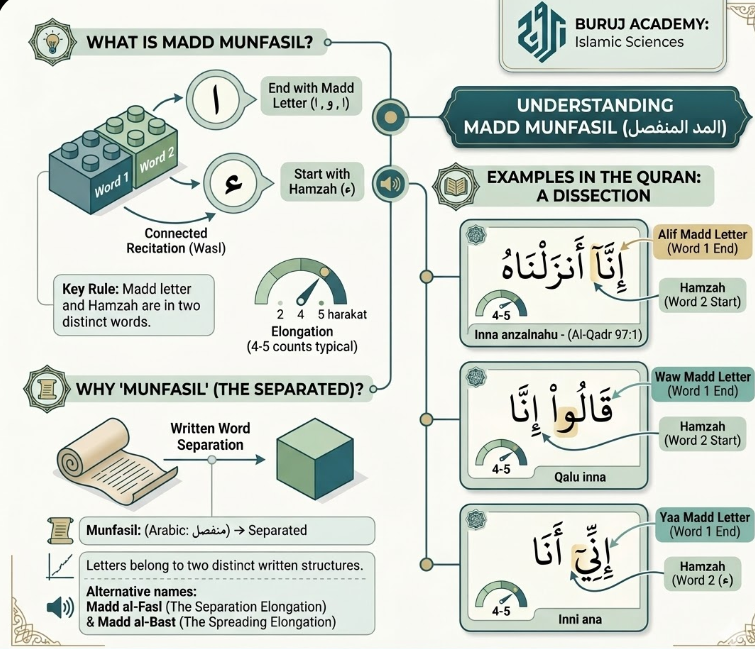
Madd munfasil is the elongation that takes place when a madd letter — و, ا, or ي — appears at the end of one word, and a hamzah (ء) immediately follows at the beginning of the next word. The two letters belong to two separate words, yet the hamzah still affects the madd letter’s duration during connected recitation (wasl).
The name “munfasil” means “separated,” referring to the fact that the madd letter and the hamzah are written in two distinct words.
Classical scholars also called it madd al-fasl (the separating elongation) and madd al-bast (the spreading elongation), since it stretches the voice across the boundary between two words.
Examples appear throughout the Quran. In إِنَّا أَنزَلْنَاهُ (Inna anzalnahu — Al-Qadr 97:1), the alif of إنَّا is the madd letter and the hamzah of أَنزَلْنَاهُ immediately follows it. Similarly, قَالُوا إِنَّا contains a waw madd followed by a hamzah opening the next word, and إِنِّي أَنَا presents a ya madd in the same configuration.
At Buruj Academy, our Online Tajweed Classes treat madd munfasil as one of the first real test points for students — because identifying the madd-then-hamzah pattern across word boundaries requires trained listening, not just rule memorization.
The ruling on madd munfasil is jawaz — permissibility — meaning scholars of recitation hold legitimate, transmitted disagreement about its length. This distinguishes it immediately from madd muttasil, whose extension is obligatory for all reciters.
Scholars who recited with qasr (two counts, the natural madd length) did so because the hamzah that triggers the extension belongs to a separate word.
Since the word could be stopped upon — removing the hamzah entirely — some reciters did not treat it as a firm cause for extension.
This is the transmitted recitation of Ibn Kathir, Abu Ja’far, Ya’qub, and al-Susi from Abu ‘Amr. It is also narrated from Qalun, and from Hafs by an alternative path through Tariq Tayibat al-Nashr.
Scholars who extended beyond two counts did so because the hamzah is present and heard during connected recitation, and the voice naturally requires space to transition from the madd letter into the hamzah.
The extension for this group ranges from slightly above two counts (fuwayq al-qasr) through tawassut (four counts) to tul (five or six counts) depending on the specific recitation.
For students learning Hafs ‘an ‘Asim through the Shatibiyyah pathway — which is the most widely taught recitation globally — the standard applied length is four or five counts, with four counts being the most commonly practiced.
Madd munfasil divides into two categories based on whether the madd letter appears visibly in the written script or is absent from it yet present in pronunciation.
1. Madd Munfasil Haqiqi: The Real Separated Elongation
Madd munfasil haqiqi occurs when the madd letter is written explicitly in the Uthmani script and the hamzah follows it in the next word. This is the standard, most frequently encountered form.
Example
Madd Letter
Source
إِنَّا أَنزَلْنَاهُ
Alif (ا)
Al-Qadr 97:1
قَالُوا إِنَّا
Waw (و)
Multiple surahs
إِنِّي أَنَا
Ya (ي)
Multiple surahs
When stopping on the first word during haqiqi recitation, the hamzah disappears and the madd returns to its natural two-count length. The extension only activates during connected recitation (wasl).
2. Madd Munfasil Hukmi: The Implied Separated Elongation
Madd munfasil hukmi occurs when the madd letter is absent from the written script but present in pronunciation, and a hamzah follows in the next word. The word is treated as if it contains a madd letter for recitation purposes, even though the script does not show it.
Examples include the ya of address (ya al-nida’) in يإبراهيم (Ghafir 40:65) followed by a hamzah, and the ha of attention (ها) in هَأَنتُمْ (Aal Imran 3:66).
The connection of haa al-kinayah (pronoun ha) to a following hamzah — such as أَن لَّمْ يَرَهُ أَحَدٌ (Al-Balad 90:7) — also falls here when the ha carries a connecting vowel before the hamzah.
Both divisions carry the same ruling and the same extension length during connected recitation.
The distinction matters practically: in haqiqi, stopping is possible and removes the extension; in hukmi, stopping is often not possible on the madd letter itself since it is not written.
Excel in Your Quranic Studies
Join Buruj Academy and master the Quran with our structured, professional curriculum.
Madd Munfasil vs Madd Muttasil: What Is the Key Difference?
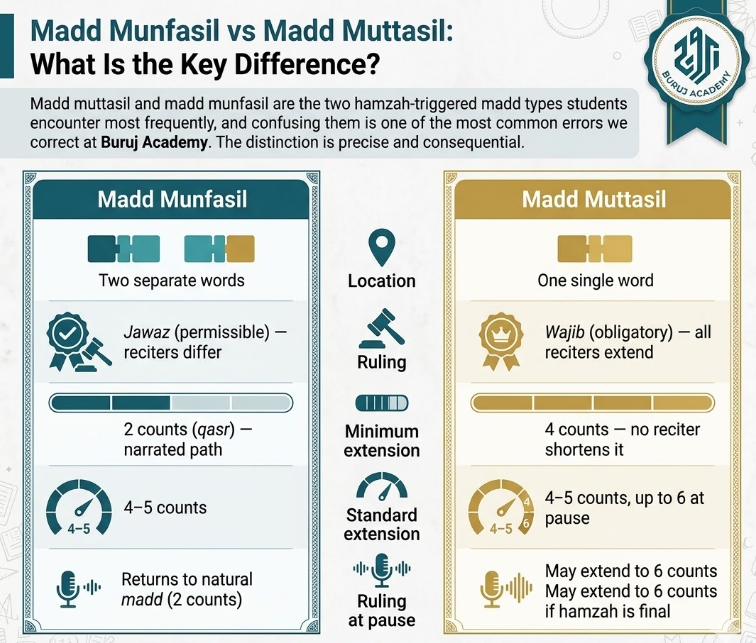
Madd muttasil and madd munfasil are the two hamzah-triggered madd types students encounter most frequently, and confusing them is one of the most common errors we correct at Buruj Academy. The distinction is precise and consequential.
Feature
Madd Munfasil
Madd Muttasil
Location of madd and hamzah
Two separate words
One single word
Ruling
Jawaz (permissible) — reciters differ
Wajib (obligatory) — all reciters extend
Minimum extension (Hafs/Shatibiyyah)
2 counts (qasr) — narrated path
4 counts — no reciter shortens it
Standard extension (Hafs/Shatibiyyah)
4–5 counts
4–5 counts, up to 6 at pause
Ruling at pause
Returns to natural madd (2 counts)
May extend to 6 counts if hamzah is final
The name “muttasil” means “connected” — the madd letter and hamzah share one word. Examples include السَّمَاءُ (al-sama’u), جَاءَتْ (ja’at), أَوْلِيَاءَ (awliya’a), and سِيءَ (si’a). In every case, the madd letter and hamzah are inseparable within a single word structure.
If you are building a strong Tajweed foundation, our Tajweed for Beginners course addresses both madd types systematically — ear-training comes before rule memorization, so students learn to hear the difference before naming it.
Recognizing madd munfasil in real Quranic text is where rule knowledge becomes practical. Below are verified examples drawn from the Quran, covering all three madd letters.
1. Examples with Alif Madd
إِنَّا أَنزَلْنَاهُ فِي لَيْلَةِ الْقَدْرِ Inna anzalnahu fi laylati l-qadr “Indeed, We sent the Quran down during the Night of Decree.” (Al-Qadr 97:1)
(The alif of إنَّا is the madd letter; the hamzah of أَنزَلْنَاهُ triggers the extension.)
يَا أَيُّهَا النَّاسُ اتَّقُوا رَبَّكُمْ Ya ayyuha l-nasu ittaqu rabbakum “O mankind, fear your Lord.” (An-Nisa 4:1)
(The ya of address is absent from the script — this is madd munfasil hukmi.)
2. Examples with Waw Madd
قَالُوا إِنَّا مَعَكُمْ Qalu inna ma’akum “They said: Indeed, we are with you.” (Al-Baqarah 2:14)
(The waw of قَالُوا is the madd letter; the hamzah of إنَّا follows from the next word.)
3. Examples with Ya Madd
إِنِّي أَنَا اللَّهُ Inni ana Allahu “Indeed, I am Allah.” (Ta-Ha 20:14)
(The ya of إنِّي is the madd letter; the hamzah of أَنَا begins the next word.)
Discover the Buruj Academy Difference
Step into our virtual classrooms and see how our expert instructors make learning Quran and Arabic intuitive and clear. We focus on overcoming the specific hurdles non-native speakers face, building your confidence and connection with the Quran.
How Does Madd Munfasil Behave During Pausing and Stopping?
The behavior of madd munfasil at pause (waqf) depends entirely on which of its two divisions you are reciting.
For madd munfasil haqiqi, stopping on the first word removes the cause of extension entirely. The hamzah belongs to the following word — when you stop before reaching it, the madd returns to its natural two-count length. This is the ruling for all reciters regardless of how much they extend during wasl.
For madd munfasil hukmi, the situation differs by sub-type. The ya of address (يأيها) cannot be stopped upon in isolation since it is not a complete word; the waqf ruling does not apply to it independently. For haa al-kinayah and meem al-jam’ with connecting vowels, the connecting vowel itself disappears at pause — removing both the madd and its cause simultaneously.
This pause-and-resume dynamic is something our Al-Azhar-trained instructors address explicitly in live sessions, because students who only learn the wasl rule often apply the extended length incorrectly when they pause mid-recitation and resume.
Master Tajweed with Buruj Academy’s Certified Instructors
Madd munfasil is one rule — but accurate recitation requires each rule to connect to every other. Understanding where the madd letters fall, when a hamzah activates them, and how stopping changes the ruling takes guided practice, not just reading.
At Buruj Academy, our Online Tajweed Classes are taught by Ijazah-certified instructors and Al-Azhar University graduates with 12+ years of experience teaching non-Arabic speakers worldwide. We use the Buruj Method — sound before rules, ear before notation — so you internalize madd distinctions through live recitation, not abstract memorization.
Every session is 1-on-1, flexible, and built around your level. Book your free trial lesson today and recite with precision from your very first session.
Join a supportive learning environment tailored to your pace and lifestyle. Start your journey toward excellence by enrolling in one of our specialized tracks:
Ready to transform your recitation? book your free assessment and start your path to Tajweed mastery today!
Frequently Asked Questions About Madd Munfasil
What Is Madd Munfasil in Simple Terms?
Madd munfasil is the elongation that occurs when a madd letter ends one word and a hamzah begins the next word immediately in connected recitation. The two letters are in separate words — which is what “munfasil” (separated) means. Its standard length for Hafs ‘an ‘Asim is four to five counts during wasl.
What Is the Difference Between Madd Munfasil and Madd Muttasil?
Madd muttasil has its madd letter and hamzah inside one single word, making its extension obligatory for all reciters. Madd munfasil has them in two separate words, giving reciters the permissibility to shorten or extend. Both share the same typical count range of four to five, but their rulings and minimum lengths differ.
Can Madd Munfasil Be Recited with Only Two Counts?
Yes — reciting madd munfasil with qasr (two counts, the natural madd length) is a valid, transmitted recitation path. It is the established reading of Ibn Kathir, Abu Ja’far, Ya’qub, and al-Susi from Abu ‘Amr, and is narrated from Hafs through an alternative chain. Students learning Hafs via the Shatibiyyah pathway typically apply four counts as the standard.
What Are the Two Types of Madd Munfasil?
Madd munfasil haqiqi occurs when the madd letter is written explicitly in the script and a hamzah follows in the next word. Madd munfasil hukmi occurs when the madd letter is absent from the script but present in pronunciation — such as the ya of address or the connecting vowel of haa al-kinayah — followed by a hamzah in the next word.
Does Madd Munfasil Apply When Stopping Mid-Recitation?
No. For madd munfasil haqiqi, stopping on the first word removes the hamzah’s influence and the extension returns to two counts. The elongation only activates during connected recitation (wasl) when the hamzah of the following word is actually pronounced.
Unlock Your Potential at Buruj Academy: Enroll Today and Elevate Your Knowledge!
Join Buruj Academy and embark on a transformative learning journey designed to expand your skills and understanding. Experience expert guidance, interactive courses, and a supportive community that empowers you to achieve academic excellence and personal growth. Start your path to success today!
 Tajweed