 Quran
Quran
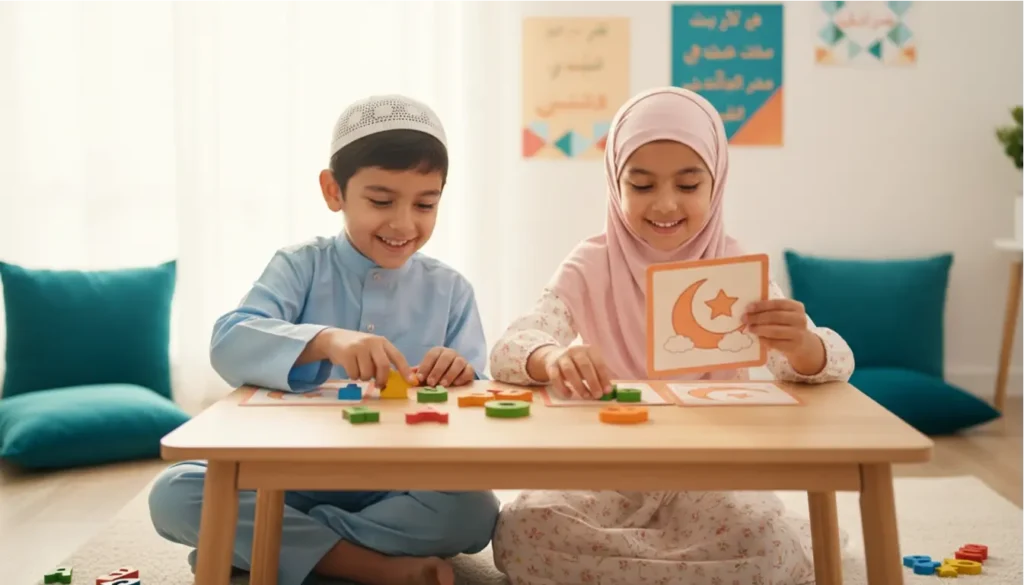
Children remember what they enjoy. When Quran learning becomes something kids look forward to rather than endure, memorization deepens, pronunciation improves, and love for Allah’s words grows naturally over time.
Choosing the right Quran activities for kids makes all the difference between a child who engages willingly and one who resists every session. These ten practical activities work across different ages and learning styles, giving parents real tools they can use today.
Table of Contents:
1. Quran Coloring and Art Activities Help Young Kids Connect with Quranic Verses
Young children aged 4-7 learn best when their hands are busy. Printing simple Quranic verses in large Arabic text and letting children trace or color the letters turns passive exposure into active engagement with the words of Allah.
Parents can print سورة الإخلاص (Surah Al-Ikhlas) in large font, let children decorate each letter with their favorite colors, then read the verse together afterward. The physical activity anchors the memory beautifully.
This activity requires only paper and colored pencils. Keep sessions to 10-15 minutes for ages 4-6, and up to 20 minutes for ages 7-8. Display finished artwork on the fridge to reinforce pride and ownership of their Quran learning journey.
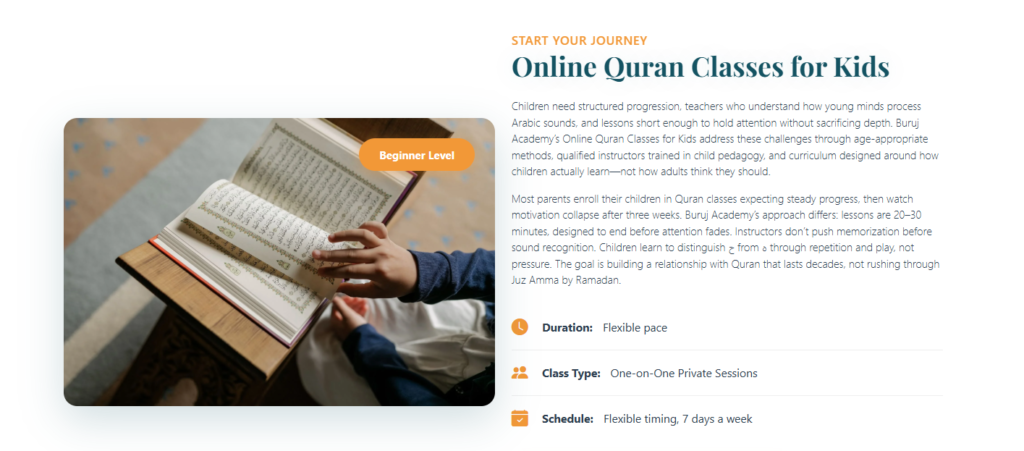
While home activities build connection, Buruj Academy’s Online Quran Classes for Kids provide the structured foundation that turns these moments into lasting skills, taught by Al-Azhar graduates with 12+ years teaching young non-Arabic speakers.
Help your child start reading the Quran with a Free trial
2. Quran Listening Stations Give Kids Repeated Exposure Without Pressure
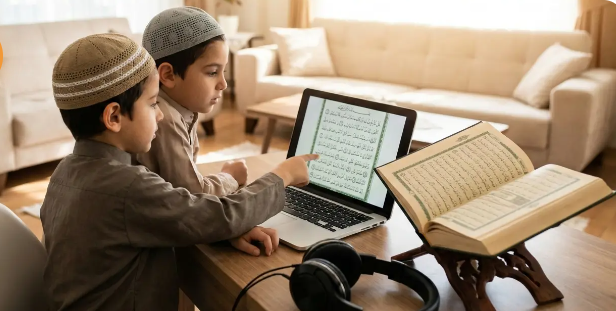
Repetition is how children absorb language naturally. Setting up a dedicated “Quran listening corner” — a comfortable spot with a tablet or speaker playing clear recitation — gives kids passive exposure that supports active memorization later.
Choose a single reciter and stick with them for consistency. Sheikh Mishary Rashid Al-Afasy’s slow, clear recitation works well for children because the pronunciation is distinct and the rhythm is easy to follow along with.
| Age Group | Recommended Daily Listening Time | Suggested Approach |
| Ages 4-6 | 10-15 minutes | During play or drawing |
| Ages 7-10 | 15-20 minutes | Before or after school |
| Ages 11-15 | 20-30 minutes | Independent listening with text |
Children who hear a surah repeatedly before formally studying it memorize it significantly faster. Start with Juz Amma — the short surahs children will use in Salah make the most practical starting point for daily listening.
3. Quran Memorization Games Turn Repetition into Fun for Kids of All Ages
Repetition without variety quickly becomes tedious for children. Simple games built around Quran verses make the required repetition feel like play, keeping kids motivated through the process naturally.
“Finish the Ayah” Game for Kids Ages 5 and Up
Parents recite the beginning of a verse, and children shout out the ending. Start with surahs the child partially knows already. This works brilliantly for سورة الفاتحة (Surah Al-Fatiha) and short surahs from Juz Amma.
“Ayah Jenga” Activity for Kids Ages 7 and Up
Write individual words from a memorized surah on Jenga blocks. Children must recite the word correctly before placing or removing their block. The game reinforces word recognition alongside memorization.
“Quran Rotating Ball” for Group Activity with Kids
Children pass a soft ball while recitation plays. When it stops, whoever holds the ball recites the next ayah. This works especially well for siblings or small Quran study groups on weekends.
At Buruj Academy, our Online Hifz Classe for Kids use this kind of gamification — interactive games, stories, and activities that make repetition enjoyable rather than exhausting, designed by instructors trained specifically in child pedagogy.
Start your child’s Hifz classes for free
4. Quran Sticker Charts Motivate Kids to Build Consistent Daily Habits
Children respond powerfully to visible progress. A simple sticker chart tracking daily Quran practice gives kids something tangible to celebrate, making consistency feel rewarding rather than obligatory throughout the week.
Create a weekly grid with each day labeled. Every time your child completes their Quran activity — even five minutes of listening or one verse review — they place a sticker. After five stickers, a small reward follows. Keep rewards simple: extra playtime, choosing dinner, or a special outing.
This approach teaches children that consistent small efforts build toward meaningful achievement — a lesson that extends far beyond Quran learning into their entire Islamic education and daily life habits, Alhamdulillah.
5. Quran Storytelling Activities Help Kids Understand the Context Behind Verses
Children connect with stories long before they connect with rules. Reading the stories behind Quranic verses — the stories of Prophets Ibrahim, Musa, and Yunus — gives children emotional context that makes the verses themselves feel alive and meaningful.
After telling the story of Prophet Yunus (peace be upon him), introduce:
لَّآ إِلَٰهَ إِلَّآ أَنتَ سُبْحَٰنَكَ إِنِّى كُنتُ مِنَ ٱلظَّٰلِمِينَ
La ilaha illa anta subhanaka inni kuntu mina-dhalimeen
“There is no god but You, glory be to You. Indeed, I was among the wrongdoers.”
Children who know Prophet Yunus’s story memorize this dua with genuine feeling, not just repetition
Ages 4-7: Storytelling Approach
Keep stories under five minutes with simple language. Use soft toys or drawings to act out the story. Let children retell it back to you in their own words before connecting the verse.
Ages 8-12: Story Plus Context Approach
Share the full story with some detail. Ask questions: “Why do you think Prophet Yunus made that dua?” Discussion deepens comprehension and emotional connection with the words.
Ages 13-15: Independent Research Approach
Encourage teens to read the story themselves from a trusted tafsir source, then discuss their reflections. This builds independent relationship with the Quran that Insha’Allah lasts into adulthood.
Discover the Buruj Academy Difference
Step into our virtual classrooms and see how our expert instructors make learning Quran and Arabic intuitive and clear. We focus on overcoming the specific hurdles non-native speakers face, building your confidence and connection with the Quran.
6. Quran Flashcard Games Build Arabic Word Recognition Skills in Kids
Many children memorize Quranic verses phonetically without recognizing individual words. Flashcard games that match Arabic words to simple meanings build Quranic vocabulary that deepens children’s understanding of what they recite.
| Flashcard Word | Simple Meaning |
| ٱللَّهُ | Allah |
| رَبِّ | Lord |
| ٱلرَّحْمَٰنِ | The Most Merciful |
| أَحَدٌ | One |
| قُلْ | Say |
Start with ten words from surahs your child already memorizes. Children who understand even basic vocabulary recite with more focus and emotional connection. This is also excellent preparation for formal Quranic Arabic study later.
Buruj Academy’s Quranic Arabic Course for Kids takes this further, building genuine comprehension of Quranic words through age-appropriate vocabulary games and structured lessons designed for children aged 4-15.
Try Buruj’s Quranic Arabic Course for Kids for free now

7. Quran Recitation Videos Engage Kids Who Are Visual Learners
Not every child learns best through reading or repetition alone. Children who respond to music and visual stimulation often connect with Quran most powerfully through carefully selected recitation videos and Islamic nasheeds based on Quranic themes.
Look for slow, clearly articulated recitation videos with highlighted text — children’s eyes follow along naturally when words light up as the reciter progresses. This simultaneously builds listening skills and Arabic text recognition without additional effort.
Keep video sessions purposeful: 10-15 minutes maximum for under-10s. Always sit with your child initially, pointing to the text and occasionally pausing to repeat lines together. Passive screen time differs significantly from active, guided Quran video engagement.
8. Quran Role-Play Activities Teach Kids Proper Salah Recitation in Context
Children memorize surahs most meaningfully when they understand where those surahs belong. Role-playing Salah — letting children “lead” a prayer while parents follow — gives Quranic recitation immediate, practical purpose that motivates memorization naturally.
This activity works especially well for ages 6-10. Set up a small prayer area, let your child call the adhan, and then “lead” Salah using surahs they’ve memorized. The responsibility of leading motivates careful, correct recitation.
For younger children aged 4-5, simply practicing standing, saying
بِسْمِ ٱللَّهِ ٱلرَّحْمَٰنِ ٱلرَّحِيمِ (Bismillah ir-Rahman ir-Raheem)
clearly, and reciting Al-Fatiha together in prayer position makes the connection between Quran and worship beautifully concrete and memorable.
Read Also: Quran Stories for Kids
9. Quran Activity Journals Give Older Kids a Personal Space for Their Learning Journey
Children aged 10 and above benefit enormously from ownership of their learning. A dedicated Quran journal — where they write verses they’re memorizing, draw illustrations, record reflections, and track their progress — builds independent relationship with the Quran.
| Journal Section | What Kids Include | Learning Benefit |
| My Verse This Week | Arabic text + meaning | Writing reinforces memory |
| What This Means to Me | Personal reflection | Builds emotional connection |
| My Progress Tracker | Surahs memorized | Motivates continued effort |
| Questions I Have | Anything unclear | Encourages critical thinking |
Journals work best when parents show genuine interest — asking “What did you write this week?” rather than checking it as a task. Teens especially respond to being taken seriously as independent Quran learners, Alhamdulillah.
Read Also: Quran Steps for Kids
10. Quran Buddy System Activities Help Kids Learn Together Through Friendly Accountability
Children motivate each other in ways parents and teachers sometimes cannot. Pairing siblings, cousins, or friends as “Quran buddies” — where they memorize the same surah and quiz each other — adds social energy that makes the process genuinely enjoyable.
Set a shared weekly goal: both buddies memorize سورة الناس (Surah An-Nas) by Friday. They check in daily, recite to each other over video call if needed, and celebrate together when both achieve the goal. Shared success builds lasting motivation.
For families with only one child, parents can be the Quran buddy. Memorizing alongside your child — even pretending to “need help” sometimes — creates warmth around Quran learning that children carry into adulthood long after the activity itself is forgotten, Insha’Allah.
Excel in Your Quranic Studies
Join Buruj Academy and master the Quran with our structured, professional curriculum.
Book Your Free TrialRead Also: Quran Learning Apps for Kids
Give Your Child Structured Quran Learning with Buruj Academy’s Expert Instructors
Home activities lay a beautiful foundation, but structured expert guidance builds the skills that truly last. Children thrive when engaging methods meet qualified, child-focused instruction.
- Instructors are Al-Azhar graduates trained in both Islamic education and child pedagogy
- Age-appropriate curriculum designed for kids aged 4-15
- Gamification, stories, and interactive activities — never dry lectures
- Short 20-30 minute sessions matching children’s natural attention spans
- Patient, encouraging approach that builds confidence, not pressure
- Flexible scheduling to fit your family’s routine
Book your child’s free trial lesson with Buruj Academy today and see the difference child-focused Quran instruction makes.
Find your child’s perfect match among Buruj’s top courses for kids:
- Arabic Classes for Kids
- Alphabet course
- Noorani Qaida Course for Kids
- Quranic Arabic Course
- Islamic Studies for Kids
- Hifz Classes for Kids
- Quran Classes for Kids
- Tajweed for Kids
Get a free trial for your child today.

Conclusion
Quran activities work best when they match how children naturally learn — through play, stories, movement, and meaningful repetition. Even ten minutes of purposeful daily engagement builds stronger foundations than infrequent longer sessions throughout the week.
Consistency matters more than perfection. Children who experience Quran as enjoyable and connected to real worship develop intrinsic motivation that parents cannot manufacture through pressure or obligation alone, Alhamdulillah.
Start with one or two activities from this list that fit your child’s personality and your family’s rhythm. Add more gradually as habits form. Every child’s Quran journey is unique — the goal is progress, connection, and love for Allah’s words, Insha’Allah.






Leave a Reply