 Quran
Quran

Most children aged 5 to 12 spend several hours weekly on tablets and smartphones, yet many Muslim parents struggle to find quality digital tools that genuinely strengthen their child’s connection with the Quran. The right quran learning apps for kids transform screen time into meaningful Islamic education without boring young learners.
Effective quran learning apps for kids combine proper Tajweed audio, age-appropriate visuals, and interactive features that hold children’s attention naturally. This guide reviews nine verified apps for children aged 4 to 15, covering memorization tools, Arabic alphabet instruction, and foundational reading skills with practical guidance for parents choosing the best fit.
Table of Contents:
1. Quran Era Is One of the Most Engaging Quran Learning Apps for Kids
Quran Era was developed specifically to solve the problem many Muslim children face — learning Quran feels disconnected from how they naturally learn through play and storytelling. The app uses animal characters in the shape of Arabic letters to help children remember both letter forms and sounds simultaneously.
The curriculum spans five progressive levels. Levels 1 and 2 introduce the Arabic alphabet through animated stories featuring memorable animal characters. Levels 3 and 4 move into vowel markings (harakat), elongation sounds (mudood), sukoon, and tanween — all taught through games and interactive activities rather than drills.
What makes Quran Era particularly effective for young children is its story-based approach. Rather than presenting abstract letter shapes, each Arabic letter connects to an animal character with a name and story. This concrete method helps children aged 4 to 7 cement sounds to letter shapes through memorable associations.
At Buruj Academy, our Online Quran Classes for Kids follow similar child-friendly principles — gamification, visual storytelling, and short sessions matching children’s natural attention spans make Quran learning genuinely enjoyable rather than overwhelming for ages 4 to 15.
Help your child start reading the Quran with a Free trial
2. My Quran Journey Gives Kids Interactive Quran Learning in Seven Languages
My Quran Journey stands out among quran learning apps for kids through its comprehensive multi-language support. The app provides full content in seven languages: English, Arabic, Urdu, Malay, Indonesian, Turkish, and French. This makes it accessible for Muslim families worldwide raising children in non-Arabic environments.
The app combines interactive Quranic lessons, prophet stories, and educational games into one platform. Children explore Quranic stories through vivid animations that bring narratives to life.
The lessons cover foundational Islamic knowledge in age-appropriate formats designed specifically for young learners who need context alongside recitation practice.
Interactive quizzes and games reinforce what children learn throughout their lessons. This built-in assessment helps parents track comprehension without requiring separate testing materials.
The Tajweed-guided audio recitations paired with animations ensure children hear proper pronunciation while watching visual representations that aid memory retention.
3. Quran Companion Turns Quran Memorization Into a Gamified Experience for Kids
Quran Companion approaches memorization through gamification, progress tracking, and daily challenges that keep children motivated. The app uses a “swipe to reveal” feature during memorization testing — children recite from memory while words gradually appear on screen, providing immediate visual feedback on accuracy.
The guided lesson plan feature creates personalized daily assignments based on each child’s memorization goals and timeline.
Parents select which Surahs their child should memorize and by when, and Quran Companion produces a structured plan that breaks large memorization tasks into manageable daily portions.
Buruj Academy’s Hifz for Kids program uses similar age-appropriate techniques — short daily sessions, gamified review systems, and positive reinforcement — to build lifelong memorization habits without overwhelming young learners, guided by Hifz specialists experienced in child psychology.
Discover the Buruj Academy Difference
Step into our virtual classrooms and see how our expert instructors make learning Quran and Arabic intuitive and clear. We focus on overcoming the specific hurdles non-native speakers face, building your confidence and connection with the Quran.
Start your child’s Hifz classes for free
4. Tarteel AI Uses Voice Recognition Technology to Help Kids Practice Quran Recitation Independently
Tarteel AI represents a significant advancement among quran learning apps for kids through its artificial intelligence-powered voice recognition. The app listens to children recite and follows along on screen word-by-word, highlighting text in real time as the child speaks. This immediate visual feedback helps children stay on track during recitation practice.
The memorization mistake detection feature — available through Tarteel Premium — flags word-level errors, skipped words, or incorrect tashkeel (vowel markings) instantly during recitation.
Children can tap any highlighted mistake to see exactly what they recited versus the correct Ayah, allowing them to self-correct before their next practice session.
The app includes memorization mode where verses hide on the Mushaf, requiring children to recite from memory. As they recite correctly, words gradually reveal on screen. This active recall practice strengthens long-term retention far better than passive reading or listening alone.

5. Learns Quran with Marbel Teaches Young Kids Arabic Letters Through Activities
Learns Quran with Marbel focuses specifically on introducing young children to the Arabic alphabet and basic Quranic reading fundamentals. The app uses bright animations, sounds, and voice-overs that appeal to children in early elementary school who respond well to colorful, interactive learning environments.
The app teaches Arabic letter recognition, pronunciation of each letter, harakat (vowel markings), and basic Tajweed rules through games designed for short attention spans. Each letter gets dedicated activities including tracing exercises, matching games, and sound identification challenges that reinforce letter-sound connections.
Parents particularly appreciate the app’s focus on fundamentals without overwhelming children with advanced content too quickly.
For ages 4 to 6, mastering letter shapes and sounds provides the essential foundation for all future Quran reading. Marbel’s game-based approach makes this repetitive practice feel enjoyable rather than tedious.

6. Muslim Kids TV Combines Quran Learning With Islamic Cartoons and Educational Games
Muslim Kids TV takes a multimedia approach among quran learning apps for kids, combining Quranic lessons with Islamic cartoons, educational games, and interactive books. The platform provides an all-in-one Islamic learning environment that keeps children engaged through variety rather than single-format instruction.
Children learn about the Quran, Prophet Muhammad’s life (peace be upon him), and the five pillars of Islam through animated shows designed specifically for young Muslim audiences.
These cartoons present Islamic concepts in age-appropriate narratives that children aged 3 to 8 naturally connect with and remember.
The app includes interactive quizzes that test comprehension after children watch educational content. This built-in assessment helps parents gauge what their child absorbed without requiring separate testing. Songs with Islamic themes aid memorization through melody — children often remember lyrics far longer than spoken content alone.
7. Teaching Quran Juz Amma App Help Kids Memorize the Most Common Surahs for Salah
Teaching Quran apps focusing specifically on Juz Amma (the 30th chapter of the Quran) serve a practical purpose for young Muslim children. Juz Amma contains the short Surahs children need most urgently for performing their daily prayers correctly — Surahs like Al-Ikhlas, Al-Falaq, An-Nas, and Al-Fatiha.
These apps typically use a “listen and repeat” teaching method where a teacher voice recites each verse, followed by a student voice repeating it. This call-and-response format mirrors how children naturally learn language — through imitation after hearing correct models multiple times.
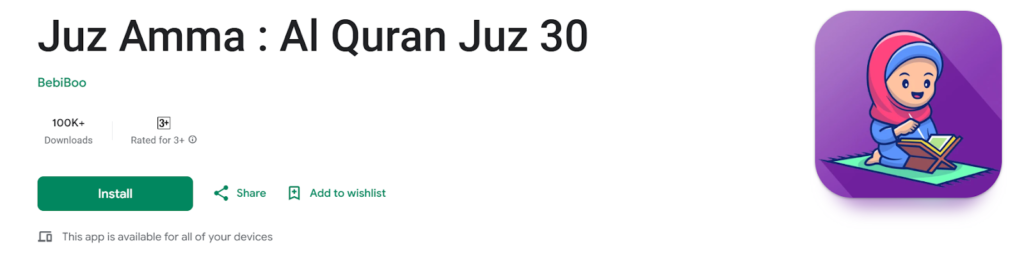
The focus on Juz Amma makes these apps particularly suitable for children aged 5 to 9 who are just beginning structured Quran memorization. Starting with short, manageable Surahs builds confidence and momentum. Children feel accomplished memorizing complete Surahs quickly rather than struggling through longer passages that take weeks to master.
Many Juz Amma apps include cartoon characters or animated guides who interact with children throughout lessons. This personalization makes the learning experience feel more like playing with a friend than sitting through formal instruction, increasing engagement especially for ages 4 to 7.
Through Buruj Academy’s Juz 30 Memorization Course, children focus on building this exact momentum with quick wins — memorizing commonly recited Surahs first so children feel accomplished and motivated to continue their Hifz journey with proper guidance.
Book Your Kid’s First Session in Buruj’s Juz 30 Memorization Course

Read Also: Quran Activities for Kids
8. Ayat Provides Authentic Quran Learning App for Kids Without Distractions
Ayat app, developed by King Saud University, prioritizes authenticity and clarity over flashy gamification. For families seeking distraction-free quran learning apps for kids that focus purely on proper recitation and memorization, Ayat provides exactly that — a clean interface mimicking the physical Madani Mushaf without cartoons or game elements.
The app’s most valuable feature for memorization is its robust looping function. Parents can set specific Ayahs or Ayah ranges to repeat multiple times continuously. This repetition forms the core of effective Hifz — children hear correct pronunciation repeatedly until it becomes automatic through consistent exposure.
Audio recitations from Sheikh Mahmoud Khalil Al-Hussary and other renowned Qaris provide impeccable Tajweed models.
Al-Hussary’s deliberate pacing makes him particularly suitable for children learning pronunciation — he articulates each letter clearly at a speed children can follow and imitate accurately without rushing.

Read Also: Quran Steps for Kids
Start Learning the Quran Today
Join our qualified teachers and begin your journey in Quran recitation, Tajweed, and understanding — from the comfort of your home.
Book Your Free TrialRead Also: Quran Learning Tools for Kids
Help Your Child Build a Lifelong Connection With the Quran Through Buruj Academy’s Expert Instructors
While quran learning apps for kids provide valuable practice tools, consistent expert guidance helps children progress faster and develop proper Tajweed from the beginning.
- Al-Azhar graduate instructors with 12+ years teaching children from non-Arabic families
- Age-appropriate curriculum designed specifically for kids aged 4–15
- Gamification, songs, and interactive activities instead of boring drills
- Short 20–30 minute lessons matching children’s natural attention spans
- Patient, encouraging approach building confidence rather than pressure
- Flexible scheduling fitting busy family routines
Book a free trial lesson for your child at Buruj Academy through our Online Quran Classes for Kids today.
Find your child’s perfect match among Buruj’s top courses for kids:
- Arabic Classes for Kids
- Alphabet course
- Noorani Qaida Course for Kids
- Quranic Arabic Course
- Islamic Studies for Kids
- Hifz Classes for Kids
- Quran Classes for Kids
- Tajweed for Kids
Get a free trial for your child today.

Conclusion
The best quran learning apps for kids combine proper Tajweed audio, age-appropriate visuals, and interactive features that genuinely hold children’s attention. Apps like Quran Era and Marbel suit younger children aged 4 to 8, while Tarteel AI and Quran Companion serve older children aged 10 to 15 developing independent study skills.
Combining app-based practice with live instruction from qualified teachers produces stronger results than using apps alone. Children benefit from technology’s convenience and engagement while still receiving the personalized correction and encouragement only human instructors provide during their Quran learning journey.
Short, consistent daily sessions of 10 to 20 minutes using quality apps build momentum naturally. Insha’Allah, pairing the right digital tools with genuine parental involvement creates the foundation for children developing a lifelong connection with the Quran that strengthens their faith.






Leave a Reply