 Islamic
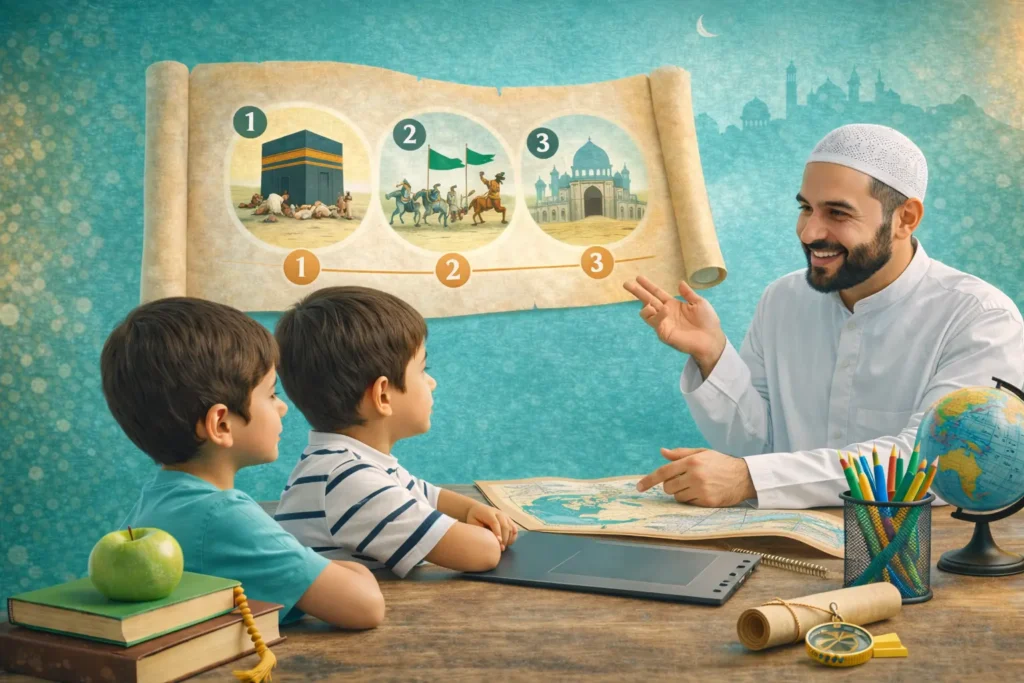
Children absorb stories with remarkable ease—a well-told tale about a brave prophet or a remarkable civilization stays with them for years. Many Muslim parents wonder where to begin when introducing Islamic history to their children in ways that genuinely stick.
Teaching the history of Islam for kids doesn’t have to feel like a school lesson. This guide gives parents age-specific storytelling strategies, simple timelines, and practical activities that make Islamic history come alive for children aged 4 through 15, building both knowledge and love for their faith.
Table of Contents:
History of Islam for Kids
Children who understand where Islam came from are far more likely to feel connected to their faith as they grow older. Islamic history gives them heroes, role models, and a sense of belonging to something meaningful and enduring.
Without this foundation, many children see Islam as simply a set of rules rather than a living, breathing tradition with an extraordinary story behind it. History answers the question every child eventually asks: why does this matter to me?
When children hear how the Prophet Muhammad ﷺ and his companions built an entire community from scratch, they begin to see Islam not as inherited obligation but as a living legacy they are part of. That shift is enormously powerful.
Buruj Academy’s Islamic Studies Classes for Kids address this exact need, weaving Islamic history into lessons that help children feel proud of their heritage, using storytelling and age-appropriate narratives rather than dry dates and memorization.
The first session is free in Buruj’s Islamic Studies Classes for Kids
How to Explain the Beginning of Islamic History to Young Kids in Simple Terms?
The history of Islam begins with one man, one mountain, and one message. The Prophet Muhammad ﷺ was born in Makkah around 570 CE, in a society filled with idol worship, injustice, and inequality. He was known as Al-Amin—the trustworthy one—even before prophethood.
At age 40, in the Cave of Hira, he received the first revelation from Angel Jibreel (AS). That single moment changed the course of human history. For young children, framing this as “the night Allah spoke to the Prophet” makes it immediately understandable and emotionally resonant.
Here is a simple age-based breakdown of how to introduce this beginning:
| Age Group | How to Introduce the Story | Key Focus |
| Ages 4–7 | “Allah chose a very special man to share His message with the world” | Prophet’s kindness and trustworthiness |
| Ages 8–12 | Story of the cave, first revelation, early believers like Khadijah (RA) | Courage under pressure, importance of faith |
| Ages 13–15 | Historical and social context of pre-Islamic Arabia, theological significance | Critical thinking, deeper meaning of prophethood |
The most important takeaway for parents is this: start with feelings before facts. Children aged 4–7 don’t need dates—they need to feel that the Prophet ﷺ was someone worth loving.
Discover the Buruj Academy Difference
Step into our virtual classrooms and see how our expert instructors make learning Quran and Arabic intuitive and clear. We focus on overcoming the specific hurdles non-native speakers face, building your confidence and connection with the Quran.
The Story of the Hijra Is One of the Most Exciting Parts of Islamic History for Kids
Few events in Islamic history match the drama, courage, and faith of the Hijra—the migration of the Prophet ﷺ and his companions from Makkah to Madinah in 622 CE. It marks Year One of the Islamic calendar, and it makes a genuinely gripping story for children of all ages.
The Prophet ﷺ and Abu Bakr (RA) hid in a cave while enemies searched for them. A spider spun a web across the entrance, and a dove laid eggs nearby—signs that made the pursuers turn away. Children find this story genuinely thrilling when told well.
1. Telling the Hijra Story to Children Ages 4 to 7
Use simple picture-book language: “The Prophet had to leave his home because bad people wanted to hurt him. Allah protected him in a special way.” Let children focus on Allah’s protection as the central message. Keep it to five minutes.
2. Telling the Hijra Story to Children Ages 8 to 12
Include more detail: the sacrifice of Ali (RA) sleeping in the Prophet’s bed, the planning, the journey through the desert. Ask children, “What would you have done if you were Abu Bakr?” This encourages empathy and connection to the companions.
3. Discussing the Hijra with Teenagers Ages 13 to 15
Explore the political and social significance: Why was Madinah chosen? What was the Constitution of Madinah? How did this migration establish the first Muslim community? Teenagers can handle complexity and appreciate being treated as capable thinkers.
Teaching Kids the History of Islam Through the Lives of the Prophet’s Companions
The Sahaba—the companions of the Prophet ﷺ—are among the most inspiring figures in Islamic history, and children connect with their stories immediately. These were real people who faced real challenges, making them relatable role models for young Muslims today.
Bilal ibn Rabah (RA) was an enslaved man who chose faith over comfort and became the first muezzin in Islam. Khadijah (RA) was a businesswoman who became the first Muslim and supported her husband completely. These are stories children remember.
Here are four companion stories particularly effective with children:
| Companion | Age Group Best Suited | Core Lesson |
| Bilal (RA) | Ages 6+ | Patience, courage, and standing firm in faith |
| Khadijah (RA) | Ages 8+ | Strength, loyalty, and supporting those we love |
| Ali ibn Abi Talib (RA) | Ages 8+ | Bravery and sacrifice for what matters |
| Umar ibn Al-Khattab (RA) | Ages 10+ | How people change, justice, and leadership |
Each companion story can be told in ten minutes before bed or during a car journey. Consistency matters far more than length—one story per week builds a rich library of Islamic role models in your child’s mind.
Buruj Academy’s Online Islamic Studies Classes introduce children to companion stories through narratives designed specifically for young learners, helping children find personal role models from within Islamic history rather than only looking outside their faith for inspiration.
The first session is free in Buruj’s Islamic Studies Classes for Kids

Simple Islamic History Timelines Help Kids Understand How Our Faith Grew Over Centuries
Children think in stories, not spreadsheets—but a simple visual timeline gives them a framework to hang those stories on. When a child understands that the Prophet ﷺ came, then the four caliphs led, then the great Islamic civilization flourished, history starts to feel like a coherent narrative rather than disconnected facts.
Parents don’t need special skills to create this. A piece of paper on the wall with five or six key moments, illustrated with simple drawings, is genuinely effective for children aged 7 and above.
Here is a simplified timeline parents can use as a starting point:
| Period | Approximate Years | Key Events for Kids |
| Birth of the Prophet ﷺ | 570 CE | “The most important person in history was born in Makkah” |
| First Revelation | 610 CE | “Allah’s message began in a mountain cave” |
| Hijra to Madinah | 622 CE | “Year One of the Islamic calendar—the great migration” |
| Conquest of Makkah | 630 CE | “Makkah returned to Islam peacefully” |
| The Four Caliphs | 632–661 CE | “Four great leaders continued the Prophet’s mission” |
| Golden Age of Islam | 750–1258 CE | “Muslim scholars led the world in science, medicine, and learning” |
For children aged 4–7, focus only on the first three rows. For ages 8–12, introduce all six. For teenagers, each row becomes a doorway into deeper conversation about Islamic civilization and its global contributions.
Read Also: Prophets in Islam for Kids
The Golden Age of Islamic Civilization Shows Kids That Muslims Changed the World
One of the most empowering parts of the history of Islam for kids is learning that Muslim scholars once led the world in science, mathematics, medicine, and astronomy.
This knowledge builds healthy pride and counters any narrative that positions Islam as backward or irrelevant to modern life.
Ibn Sina wrote medical encyclopedias that shaped European medicine for centuries. Al-Khwarizmi invented algebra—yes, the algebra children learn in school today.
Al-Biruni calculated the Earth’s circumference with remarkable accuracy. These were Muslim men driven by their faith to seek knowledge.
For children aged 8 and above, connecting school subjects to Islamic history is particularly effective. When a child realizes that the word “algorithm” comes from Al-Khwarizmi’s name, mathematics class takes on a new dimension of meaning.
Read Also: Angels in Islam for Kids
Teaching Kids the History of Islam at Home Takes Only a Few Minutes Each Day
Many parents assume that teaching Islamic history requires long lessons, special books, or extensive preparation. The reality is far simpler. Consistent five to ten minute conversations, stories at bedtime, or discussions during car journeys accumulate into a rich foundation over months and years.
The key is making history conversational rather than instructional. Children respond to “Did you know that…” far better than “Today we’re going to learn about…”
Here are realistic daily approaches by age:
| Age Group | Daily Time | Suggested Format |
| Ages 4–7 | 5–7 minutes | Bedtime story format, one companion or prophet story |
| Ages 8–12 | 10–15 minutes | Discussion-based, ask questions, use simple timeline |
| Ages 13–15 | 15–20 minutes | Independent reading + brief discussion, deeper context |
Small, consistent efforts work far better than occasional long sessions. Even one Islamic history story per week, told with warmth and curiosity, makes a meaningful difference in a child’s connection to their faith.
Deepen Your Islamic Knowledge
Study Aqeedah, Fiqh, Seerah, and essential Islamic teachings with experienced instructors in a structured online program.
Try Islamic StudiesRead Also: Stories Of The Prophets For Kids
Help Your Child Connect With Islamic History Through Buruj Academy’s Expert Instructors
Children who feel their faith’s history is exciting are children who grow up proud to be Muslim. Structured, expert guidance makes that possible far more efficiently than parents navigating it alone.
- Instructors are Al-Azhar graduates with 12+ years teaching children from non-Arabic backgrounds
- Age-appropriate curriculum specifically designed for children aged 4–15
- Stories, games, and interactive activities that make Islamic history genuinely engaging
- Short 20–30 minute sessions matched to children’s natural attention spans
- Flexible scheduling that fits your family’s routine
- Personalized pacing based on each child’s learning level
Book a free trial lesson for your child with Buruj Academy’s Islamic Studies Classes for Kids today.
Find your child’s perfect match among Buruj’s top courses for kids:
- Arabic Classes for Kids
- Alphabet course
- Noorani Qaida Course for Kids
- Quranic Arabic Course
- Islamic Studies for Kids
- Hifz Classes for Kids
- Quran Classes for Kids
- Tajweed for Kids
Get a free trial for your child today.

Conclusion
Islamic history gives children something no textbook subject can: a sense of identity, belonging, and pride rooted in faith. Teaching it through stories and conversation—not memorization—is what makes it truly meaningful for young minds.
The companions, the Prophet’s ﷺ journey, and the Golden Age of Islamic civilization are not just history lessons. They are role models, proof of faith under pressure, and reminders that Muslims have always contributed meaningfully to the world.
Starting small and staying consistent matters most. Five minutes of an Islamic story before bed, one companion discussed per week, a simple timeline on the wall—these habits, built over years, shape children who know and love their Islamic heritage deeply, Insha’Allah.





Leave a Reply