 Arabic
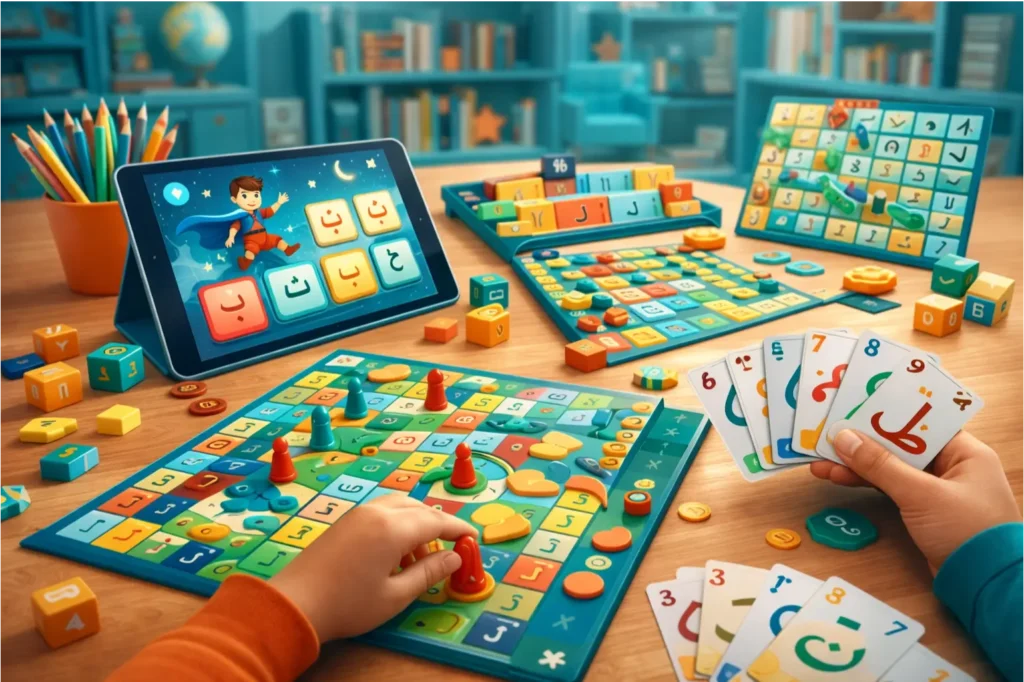
Children absorb the Arabic language fastest when they’re laughing, competing, and moving. Yet many parents assume Arabic requires textbooks and drills, leaving kids bored before they even begin.
Arabic games for kids flip that assumption entirely. The right games build vocabulary, letter recognition, and even basic grammar through play, making daily practice something children actually request rather than resist.
Table of Contents:
1. Arabic Alphabet Bingo Is One of the Best Arabic Games for Kids to Learn Letters Fast
Create bingo cards using Arabic letters instead of numbers. Call out letter names, and children mark them on their cards. This game works brilliantly for ages 4-10 because the competitive element keeps attention sharp.
Play for just 10-15 minutes. Even one round covers all 28 Arabic letters repeatedly without children realizing they’re studying. Parents can download free printable Arabic letter bingo cards online or draw simple grids by hand.
At Buruj Academy, our Online Arabic Classes for Kids use similar letter-recognition games to build alphabet fluency before moving children into word-level reading, guided by instructors trained specifically in child pedagogy.
Book your child’s free Arabic trial now!

2. Arabic Flashcard Memory Match Helps Kids Learn Arabic While Strengthening Vocabulary
Lay pairs of cards face-down — one card showing an Arabic letter, its match showing a picture of a word beginning with that letter. Children flip two cards per turn, trying to find matching pairs.
This classic memory game teaches letter-to-sound associations naturally. A card showing ب pairs with a picture of بيت (house). Children internalize connections without memorizing rules because the game makes associations visual and repeatable.
| Card Side | Example | Arabic | Meaning |
| Letter | ب | بيت | House |
| Letter | ت | تفاحة | Apple |
| Letter | س | سمكة | Fish |
| Letter | ك | كتاب | Book |
These pairings give kids vocabulary alongside letter recognition, making each memory match session twice as productive as simple letter drilling.
3. Arabic Word Relay Builds Vocabulary Through Movement
Divide children into two teams. Call out an Arabic word — the first child to run to a picture representing that word wins a point for their team. Movement + competition = excellent retention for ages 6-12.
For home settings with one child, adapt this as a solo speed challenge. Time how quickly they can match 10 Arabic words to pictures, then beat their own record. Children naturally push themselves harder when competing against their personal best.
Discover the Buruj Academy Difference
Step into our virtual classrooms and see how our expert instructors make learning Quran and Arabic intuitive and clear. We focus on overcoming the specific hurdles non-native speakers face, building your confidence and connection with the Quran.
4. Arabic Storytelling Cards Develop Kid’s Speaking Confidence
Create or purchase simple picture cards. Children draw three random cards and must build a short Arabic sentence — or even a mini-story — using vocabulary words associated with each picture. Start with single words for ages 4-7.
For ages 8-12, require full sentences: “The كلب (dog) is near the بيت (house).” This pushes productive language use rather than passive recognition.
Mistakes are celebrated as attempts, not corrected harshly, building genuine speaking confidence over time.
5. Arabic Alphabet Hopscotch Turns an Outdoor Arabic Game for Kids Into a Full-Body Learning Experience
Draw a hopscotch grid outdoors, writing one Arabic letter in each box instead of numbers. As children hop to each box, they call out that letter’s name and a word beginning with it.
This works especially well for ages 4-8 who learn most effectively through physical movement. Even 10 minutes of Arabic hopscotch covers letter recognition and basic vocabulary in a format that feels like pure outdoor play rather than structured learning.
6. Arabic Freeze Dance Makes Listening Comprehension a Playful Arabic Game Kids of All Ages Love
Play Arabic children’s songs or call out Arabic words while children move. When the music pauses, call a vocabulary word — children must freeze in a pose representing that word’s meaning before the count of five.
“قطة” (cat) means freeze like a stretching cat. “شجرة” (tree) means freeze with arms spread like branches. Comprehension becomes physical and memorable. Even young children aged 4-6 participate successfully without needing to read a single letter.
Buruj Academy’s Online Arabic Classes for Kids incorporate songs, movement activities, and visual storytelling into structured lessons, making our Al-Azhar graduates with 12+ years’ experience teaching children genuinely enjoyable instructors for young learners.
Book your child’s free Arabic trial now!

7. Arabic Scrabble Variants Deepens Spelling Skills
Standard Scrabble tiles don’t include Arabic letters, but parents can create simple handmade Arabic tile sets using index cards.
Older children aged 10-15 build words from random letter tiles, scoring points for longer or more complex words.
This game develops spelling awareness, letter combination understanding, and vocabulary simultaneously. It also creates natural opportunities for parents to discuss letter forms — initial, medial, and final — without making the lesson feel formal or pressured.
| Age Group | Adaptation | Skill Focus |
| Ages 8-10 | 3-letter words only | Basic spelling |
| Ages 11-13 | Any word length | Expanded vocabulary |
| Ages 14-15 | Quran vocabulary only | Quranic Arabic |
Adjusting the rules by age ensures every child plays at their appropriate challenge level, maintaining motivation without frustration.
8. Arabic Pictionary Helps Kids Connecting Words to Visual Meaning
One child draws a picture while others guess the Arabic word being illustrated. No speaking — only drawing. This forces children to think visually about word meaning, strengthening semantic memory in ways that pure repetition cannot achieve.
For ages 4-7, use only concrete nouns — animals, foods, household objects. For ages 8-12, include action words like يجري (runs) or يأكل (eats), requiring children to draw actions rather than objects. This progression builds vocabulary systematically across categories.
Read Also: Arabic Stories for Kids
9. Arabic Yes-or-No Quiz Is a Simple Arabic Game for Kids That Parents Can Play Anywhere
Ask Arabic vocabulary questions requiring only a thumbs-up or thumbs-down response. “Is قمر the moon?” “Is كلب a cat?” Children respond physically without needing to produce Arabic language themselves.
This game requires zero preparation, works during car rides, and takes only 5 minutes.
For beginners especially, removing the pressure of producing language while still requiring comprehension builds confidence quickly. Progress naturally toward asking children to provide the Arabic word themselves.
Read Also: Learning Arabic Words for Kids
10. Arabic Letter Sand Tracing Makes Writing Intuitive
Fill a shallow tray with fine sand or salt. Call out an Arabic letter — children trace it with their finger directly in the sand. Wrong? Simply smooth it over and try again. No pressure, no wasted paper, completely reusable.
This tactile approach benefits ages 4-7 most, particularly children who struggle with pencil control.
The sensory experience of tracing through sand engages motor memory alongside visual memory, making letter formation genuinely stick faster than worksheet practice alone.
Master the Arabic Language
Develop reading, writing, speaking, and comprehension skills through interactive Arabic lessons for all levels.
Start Arabic ClassesRead Also: How to Learn Arabic for Kids?
Start Your Child’s Arabic Mastery at Buruj Academy
Games build enthusiasm, but structured guidance ensures real progress. Buruj Academy’s Online Arabic Classes for Kids pair proven engagement methods with qualified instruction:
- Al-Azhar graduates with 12+ years teaching non-Arabic-speaking children
- Age-appropriate curriculum for children aged 4-15
- Gamification, storytelling, and songs — never dry repetition
- Short 20-30 minute sessions matching children’s attention spans
- Patient, encouraging instructors who build confidence, not pressure
- Flexible scheduling fitting busy family routines
Book your child’s free trial Arabic lesson with Buruj Academy today.
Find your child’s perfect match among Buruj’s top courses for kids:
- Arabic Classes for Kids
- Alphabet course
- Noorani Qaida Course for Kids
- Quranic Arabic Course
- Islamic Studies for Kids
- Hifz Classes for Kids
- Quran Classes for Kids
- Tajweed for Kids
Get a free trial for your child today.
Conclusion
Playful Arabic games work because children’s brains associate language with emotion and movement. When a word connects to laughter or excitement, memory holds it far more reliably than forced repetition ever achieves.
Different games serve different learning needs — alphabet recognition, vocabulary building, listening comprehension, and writing each require slightly different approaches matched to your child’s age and current level.
Starting with just one or two games weekly builds momentum naturally. Insha’Allah, consistency with even simple activities creates real Arabic foundations children carry confidently into structured learning and beyond.





Leave a Reply