The Illuminated Path: Discovering the Prophet Muhammad’s Enduring Story
The Prophet Muhammad story is one of the most transformative narratives in human history. Born into the harsh, tribal landscape of 6th-century Arabia, his life journey fundamentally altered the course of civilization, giving rise to one of the world’s largest religions, Islam. Far more than a historical account, his story is a profound blueprint for moral and ethical living, inspiring billions across continents and centuries. To truly grasp the essence of Islam, one must first explore the extraordinary life of the man who received its divine message. This account, spanning his humble beginnings, his divine calling, the relentless challenges he faced, and his ultimate victory, provides invaluable lessons in faith, perseverance, and justice.
Free Trial Session Contact Us
The Early Years OF Prophet Muhammad story: Humility and Integrity in Mecca
The early chapter of the Prophet Muhammad story begins around 570 CE in the bustling trading city of Mecca, located in modern-day Saudi Arabia. He was born into the noble Quraysh tribe, but tragically, he was orphaned early. His father, Abdullah, passed away before his birth, and his mother, Aminah, died when he was just six. This early exposure to loss and reliance shaped his character.
He was initially raised by his grandfather, Abdul Muttalib, and later by his uncle, Abu Talib. Mecca at the time was a hub of idol worship and tribal strife, yet young Muhammad distinguished himself through his impeccable character. He earned the moniker Al-Amin (The Trustworthy) due to his honesty and integrity in business dealings and begin another chapter of the Prophet Muhammad story.
As a young man, he managed the trade caravans of Khadijah bint Khuwaylid, a successful and respected businesswoman. Impressed by his virtues, Khadijah offered him marriage, and they married. Their union was marked by profound love, respect, and mutual support, with Khadijah playing an indispensable role throughout the most challenging periods of the Prophet Muhammad story.
The Dawn of Revelation: The Call to Prophethood
The pre-Islamic Arabian society was plagued by practices like female infanticide, social injustice, and widespread polytheism. Troubled by the moral decay around him, Muhammad often sought solitude for reflection. He habitually retreated to a cave called Hira, located on the mountain of Jabal an-Nour (The Mountain of Light), outside Mecca.
It was in this solitude, around the year 610 CE, at the age of 40, that the most pivotal moment in the Prophet Muhammad story occurred. While meditating, the Angel Gabriel (Jibreel) appeared to him and commanded him to ‘Read’ (or ‘Recite’). Overwhelmed, Muhammad initially protested that he could not read. The angel repeated the command, and the first verses of the Qur’an were revealed:
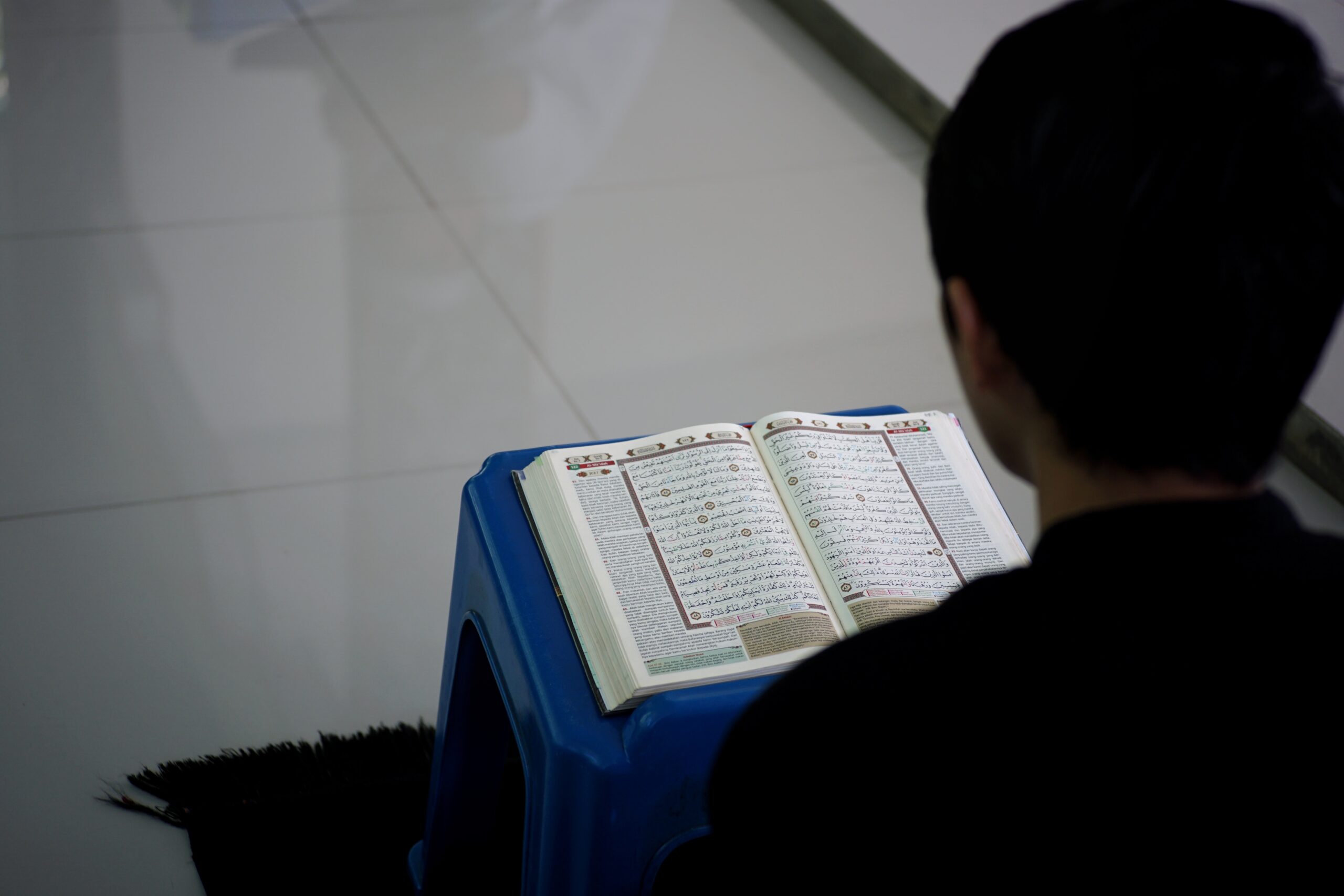
“Read! In the Name of your Lord Who created, created man from a clinging substance. Read! And your Lord is the Most Generous, Who taught by the pen, taught man that which he knew not.” (Quran, 96:1-5)
اقْرَأْ بِاسْمِ رَبِّكَ الَّذِي خَلَقَ ,خَلَقَ الْإِنْسَانَ مِنْ عَلَقٍ, اقْرَأْ وَرَبُّكَ الْأَكْرَمُ ,الَّذِي عَلَّمَ بِالْقَلَمِ ,عَلَّمَ الْإِنْسَانَ مَا لَمْ يَعْلَمْ
This was the beginning of his Prophethood. He returned home trembling, comforted by Khadijah, who immediately believed in his message. Muhammad became the final messenger in a line of prophets, tasked with restoring the original monotheistic message of Adam, Noah, Abraham, Moses, and Jesus. The message was simple yet revolutionary: Lā ʾilāha ʾillā-llāh (There is no god but God).
Check out Buruj Academy’s Islamic courses today!
The Struggle in Mecca: Persecution and Perseverance
The initial years of sharing the message of Islam were fraught with difficulty. The powerful leaders of the Quraysh, whose authority and lucrative idol-worship economy were threatened by pure monotheism, fiercely opposed the Prophet.
The early Muslims, who were often poor, slaves, or from less-powerful clans, faced brutal persecution. Stories of resilience, such as that of Bilal ibn Rabah, an Abyssinian slave who endured torture but refused to renounce Islam, illustrate the incredible faith of the early community.
Throughout this decade of intense opposition, the Prophet himself was subjected to ridicule, boycotts, and attempts on his life. However, he remained steadfast, embodying patience and mercy. He constantly sought peaceful means to convey the message, offering profound lessons in leadership under duress. The Qur’an continued to be revealed during this period, offering solace, guidance, and principles of morality to the small, beleaguered community. This part of the Prophet Muhammad story highlights the foundational importance of unwavering belief against all odds.
The Hijra: A New Dawn in Medina (Yathrib)
As the persecution escalated, the situation became untenable. In 622 CE, following divine instruction, the Prophet and his followers secretly undertook a monumental journey from Mecca to the city of Yathrib, about 320 kilometers to the north. This event, known as the Hijra (Migration), is so significant that it marks the beginning of the Islamic calendar.
Yathrib welcomed the Muslims and subsequently renamed Al-Madinah Al-Munawwarah (The Illuminated City), or simply Medina. The Hijra was not merely a change of location; it was the birth of the first truly Islamic society.
In Medina, the Prophet established a diverse, harmonious community. He drafted the Constitution of Medina, an extraordinary document that guaranteed religious freedom and political rights to all inhabitants—Muslims, Jews, and pagans—establishing a model of pluralistic governance for its time. He transformed a warring collection of tribes into a single Ummah (community), uniting them under the banner of justice and faith.
The Battles and Victories: Defending the Faith
Even in Medina, the Prophet not left in peace. The Meccan polytheists launched several military campaigns to crush the nascent Muslim community. The major confrontations—the Battle of Badr (624 CE) second year of hijrah, the Battle of Uhud (625 CE) third year of hijrah, and the Battle of the Trench or the battle of Khandaq (627 CE) fifth year of hijrah—were pivotal moments that tested the resolve and military strategy of the Muslims.
Despite being frequently outnumbered, the Muslims, guided by the Prophet’s leadership and commitment to defensive warfare, successfully protected their community. Crucially, the Prophet always emphasized ethical conduct even in war, forbidding the killing of non-combatants, the destruction of crops, and the mutilation of bodies—rules that were revolutionary for the brutal warfare of the era. The Prophet Muhammad story here transitions into one of successful political and military stewardship.
The Conquest of Mecca and The Farewell Pilgrimage
The climax of the Prophet Muhammad story arrived in 630 CE (8 AH). With a large, peaceful army, the Prophet returned to Mecca. Instead of exacting revenge for years of persecution, he offered a general amnesty to almost all his former enemies, demonstrating an unparalleled act of forgiveness and mercy. He entered the Kaaba, the holy sanctuary, and personally oversaw the destruction of the 360 idols (Asnam) , restoring the house of worship to the pure monotheism of Abraham.
Two years later, in 632 CE, the Prophet performed his final pilgrimage, known as the Farewell Pilgrimage. On the plains of Mount Arafat, he delivered his final sermon, a comprehensive summation of Islamic principles and human rights. It stands as a timeless charter, proclaiming:
- The sanctity of life and property.
- The prohibition of usury.
- The equality of all human beings, stating that no Arab is superior to a non-Arab, nor is a white person superior to a black person, except by piety and good action.
- The just treatment of women.
- The importance of adhering to the Qur’an and his Sunnah (practice).
Shortly after returning to Medina from this pilgrimage, the Prophet Muhammad passed away on the 12th of Rabi’ al-Awwal, 11 AH (June 8, 632 CE).
The Enduring Legacy of the Prophet Muhammad Story
The death of the Prophet Muhammad was a devastating loss, but the foundation he laid was unshakeable. The Prophet Muhammad story is a testament to the power of a single life dedicated to a divine purpose. His legacy carried in three major ways:
-
The Qur’an:
The divinely revealed book, preserved exactly as he received it.
-
The Sunnah (Practice):
His words, actions, and approvals, which provide a practical demonstration of how to live according to the Qur’an.
-
The Global Muslim Community:
The Ummah that continues to adhere to his teachings and strives to emulate his compassion, justice, and devotion.
In conclusion, the Prophet Muhammad story offers a timeless model for humanity. It is a narrative of an orphan who became a prophet. A businessman who became a statesman, and through patience and trust in God. He transformed a fragmented desert land into a civilization defined by knowledge, ethics, and unity.
What Chapter of the Prophet Muhammad Story Resonates Most with You?
We encourage you to delve deeper into the life and teachings of the Prophet. Understanding the context of his revelations and the profound wisdom behind his actions can illuminate your own path.