 Arabic
Millions of people want to learn Arabic but struggle to find consistent, flexible practice time. Podcasts solve that problem by turning dead time — commutes, chores, morning routines — into productive Arabic exposure that builds real comprehension over months.
Yes, you can learn Arabic using podcasts — and they genuinely work. The most effective approach pairs audio immersion with structured grammar work, since listening builds natural comprehension while explicit instruction speeds up the process of understanding what you hear.
Table of Contents:
What Are The Best Podcasts to Learn Arabic?
The following verified, currently active podcasts span every level and dialect focus. Each link connects to a confirmed listening page.
| Podcast | Best For | Dialect |
| ArabicPod101 | Beginners, structured lessons | MSA (primarily) |
| Arabic with Sam | Quranic Arabic, Quranic grammar | MSA / Quranic |
| Simple & Easy Arabic | Intermediate listening practice | Levantine |
| Talk in Arabic | Multi-dialect immersion | 8 dialects |
| The Arabic We Speak | MSA-to-dialect bridging | Levantine |
If you are also working toward understanding the Quran, our Arabic for Beginners course is designed to connect classroom grammar directly with real Quranic vocabulary from lesson one.
Begin learning Arabic at Buruj with a FREE trial lesson
1. ArabicPod101 Podcast Structured Lessons for Absolute Beginners
ArabicPod101 is one of the most established beginner resources available, with episodes running approximately ten minutes each.
The format follows a consistent structure: a short native-speaker dialogue, vocabulary extraction, and grammatical explanation — all delivered in English. Beginner episodes are free, with advanced content behind a paid membership.
The limitation is dialect consistency: the platform mixes Modern Standard Arabic with some Egyptian and Moroccan content, and this is not always labelled clearly.
For learners who specifically want Quranic Arabic or MSA, stick to the beginner series and treat the dialect variation as a later-stage bonus.
2. Arabic with Sam — Quranic Focus for Muslim Learners
Arabic with Sam is hosted by an English convert to Islam who studied Arabic in Egypt and Palestine. Sam specialises in breaking down Arabic grammar — including Quranic text analysis — with over 248 episodes available.
Episodes range from five to thirty minutes, making them genuinely commute-friendly. For learners motivated by Quran comprehension, this is among the most relevant free options available.

3. Simple & Easy Arabic Podcast
The Simple & Easy Arabic podcast uses short stories told in slow, clearly articulated Levantine Arabic to build listening comprehension organically. Each episode opens with vocabulary, then delivers a story, then closes with comprehension questions — a format that mimics classroom structure without the classroom.
Transcripts are available through Patreon. This podcast is particularly effective for intermediate learners who have studied some grammar but want their ears to catch up with their textbook knowledge.
4. Talk in Arabic Podcast
Talk in Arabic is the broadest dialect resource available in podcast format, covering Egyptian, Levantine, Moroccan, Algerian, Tunisian, Saudi, Iraqi, and Sudanese Arabic. The lesson structure targets grammar, vocabulary, and listening at all difficulty levels.
This is a membership platform rather than a fully free podcast, but it fills a genuine gap for learners who need a specific dialect not covered elsewhere. Egyptian Arabic learners, in particular, benefit from its substantial Egyptian library.
Read also: Arabic Video Tutorials to Learn Arabic
5. The Arabic We Speak — Bridging MSA and Spoken Arabic
Created by two Jordanian teachers, The Arabic We Speak explicitly addresses the gap between textbook Arabic and real spoken conversation.
Episodes discuss culture and everyday topics in Levantine Arabic, making them useful for learners who have studied MSA formally and are now ready to understand what real speakers actually say.
Updated weekly, this podcast suits adult learners who want to eventually hold real conversations rather than pass written exams.
Can Arabic Be Self-Taught Through Podcasts Alone?
Arabic can be partially self-taught through podcasts, but audio immersion alone has clear limits that most learners discover within two to three months. Podcasts build listening fluency and vocabulary recognition effectively, yet they rarely explain why a sentence is grammatically structured as it is — and Arabic grammar is precise enough that this gap eventually creates a ceiling.
In our Arabic online classes at Buruj Academy, students who arrive having learned only through audio resources can often understand a great deal of spoken Arabic but struggle to produce grammatically correct sentences themselves.
They have strong ears but limited ability to write, read script, or apply the case-ending system (i’rab) that governs formal Arabic and Quranic Arabic. The reason is structural: podcasts provide input, not explanation.
Self-teaching through podcasts works best as one layer of a multi-tool approach. Pair audio content with a grammar resource, flashcard vocabulary review, and ideally some live speaking practice, and the podcast becomes a powerful reinforcement tool rather than the entire curriculum.
Book your FREE Arabic trial online Arabic class at Buruj

What Is the Importance of Listening When Learning Arabic?
Listening is the gateway skill in Arabic acquisition — and it is far more important than most self-study learners initially credit it. Regular, structured listening builds what linguists call “comprehensible input”: exposure to real language that the brain gradually maps onto grammar rules and vocabulary without conscious effort.
For Arabic specifically, listening carries additional weight because of tajweed — the precise phonological system governing how Arabic letters sound in different positions.
Non-native speakers who skip listening practice tend to develop mispronunciation habits that later resist correction.
Students who train their ear early, by contrast, internalize correct vowel sounds, the ghunnah nasal resonance, and the difference between emphatic and non-emphatic consonants long before they consciously study those rules.
Master the Arabic Language
Join our expert-led courses and build a strong foundation in Classical and Modern Arabic.
Get Your Free TrialA. Listening Builds Vocabulary Faster Than Flashcards Alone
Hearing a word in context — embedded in a sentence, carrying emotion and rhythm — encodes it more durably than reading it on a flashcard. Podcasts provide hundreds of these contextual encounters per episode, creating multiple reinforcement pathways in memory simultaneously. Over six to eight weeks of consistent listening, most students notice passive vocabulary expanding noticeably even before their active speaking improves.
Read also: Best Arabic Video Tutorials for Learning Arabic
B. Arabic Pronunciation Requires Ear Training First
Arabic contains sounds absent from English: the guttural ‘ayn (ع), the fricative kha (خ), the emphatic consonants sad (ص) and dad (ض).
These sounds must be heard repeatedly from native speakers before the mouth can attempt to reproduce them accurately.
Podcasts with native-speaker audio provide exactly this training — far more efficiently than reading transliterations or watching grammar videos without authentic audio modeling.
In our Arabic speaking classes we explain the specific phonetic challenges English speakers face and how to correct them systematically.
Book your free trial to start speaking Arabic fluently

How to Use an Arabic Podcast Effectively at Every Level?
Listening passively while multitasking produces minimal retention. The learners who make real progress through podcasts share a specific set of active listening habits that distinguish genuine acquisition from background noise.
| Level | Podcast Strategy | Goal |
| Beginner | Repeat each episode 3× before moving on | Sound recognition and phoneme accuracy |
| Intermediate | Listen once, then shadow line-by-line | Rhythm, intonation, and pronunciation |
| Advanced | First listen blind, then check transcript | Comprehension testing and vocabulary logging |
A. Shadow the Audio — Don’t Just Listen
Shadowing means playing a sentence, pausing, and immediately repeating it at the same speed and intonation. This technique, well-established in language pedagogy, trains the muscles of Arabic pronunciation alongside the ear. We recommend starting with just two to three minutes of shadowing per session and building up gradually.
Our students who shadow consistently show measurably faster improvement in speaking confidence than those who only listen passively.
You can read more about developing speaking fluency in our guide on how to improve Arabic speaking skills.
B. Log Arabic Vocabulary From Every Episode
After each listening session, write down five to ten new words encountered in the episode and review them within 24 hours. This turns passive input into active vocabulary.
Combining this with our guide on mastering Arabic vocabulary provides a retention system that keeps new words from slipping away between sessions.
Read also: Learn Modern Standard Arabic
Choosing the Right Learn Arabic Podcast Based on Your Goal
Not all Arabic learners share the same destination. The best podcast to learn Arabic is always the one aligned with your specific target — and the three most common targets require meaningfully different podcast choices.
| Goal | Recommended Podcast | Why It Fits |
| Quranic Arabic comprehension | Arabic with Sam | Focuses on classical grammar and Quranic text analysis |
| MSA reading and formal communication | ArabicPod101 (beginner series) | Structured MSA with grammar breakdowns |
| Spoken Egyptian dialect | Talk in Arabic | Largest Egyptian dialect audio library available |
| Spoken Levantine dialect | Simple & Easy Arabic | Story-based Levantine with transcripts |
| Bridging MSA to spoken Arabic | The Arabic We Speak | Explicitly targets MSA-dialect gap |
Muslim learners pursuing Quranic understanding benefit from pairing any of the above podcasts with dedicated Quranic Arabic grammar instruction.
Our Quranic Arabic Classes are designed by Al-Azhar graduates to connect classical grammar rules with real Quranic passages — a pairing that dramatically accelerates comprehension for learners already using audio resources independently.
For learners who want to understand Arabic grammar more deeply alongside their podcast listening, our article on how to learn Arabic grammar easily provides a structured roadmap that complements audio practice with explicit grammatical explanation.
Begin Understanding Quranic Arabic with a FREE Lesson
Discover the Buruj Academy Difference
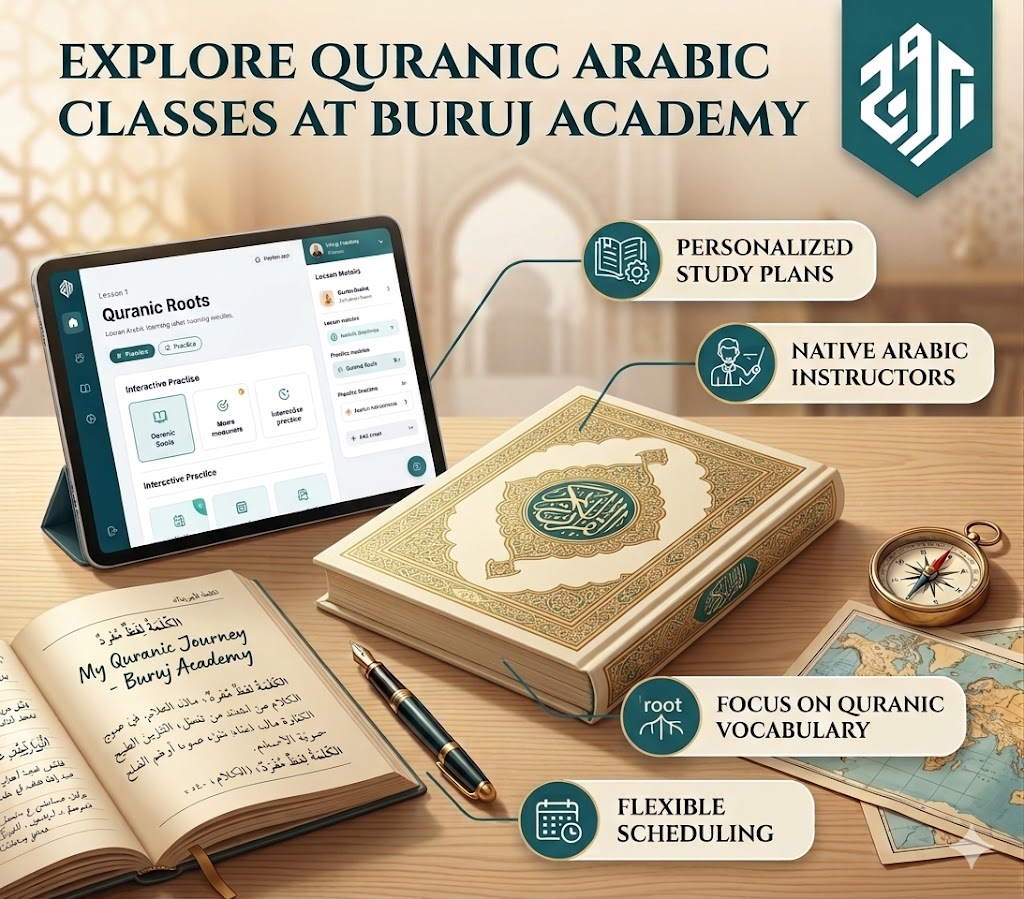
Step into our virtual classrooms and see how our expert instructors make learning Quran and Arabic intuitive and clear. We focus on overcoming the specific hurdles non-native speakers face, building your confidence and connection with the Quran.
Start Your Arabic Journey With Buruj Academy’s Expert Instructors
Podcasts are a powerful supplement — but they work best when anchored by structured, expert-led instruction. At Buruj Academy, our Online Arabic Classes are taught by Al-Azhar University graduates with 12+ years of experience helping non-native speakers move from zero to confident, functional Arabic.
What makes the Buruj Method different:
- Context-before-abstraction: You hear and understand Arabic in real contexts before rules are formally introduced
- Personalized 1-on-1 sessions with flexible 24/7 scheduling for busy adults
- Rigorous instructor selection: every teacher holds verified qualifications and undergoes ongoing training
- Real-time correction of pronunciation and grammar errors that podcasts cannot provide
Book your free trial lesson today and discover how structured instruction makes every podcast session you do outside of class ten times more effective.
Alhamdulillah, thousands of students globally have used this combination to build lasting Arabic fluency.
Begin your transformation today by choosing the path that fits your goals:
- Online Arabic Classes (General & Comprehensive)
- Arabic Course for Beginners
- Arabic Alphabet Learning Course
- Online Arabic Classes for Kids
- Arabic Classes for Adults
- Arabic Grammar Course (Nahw & Sarf)
- Intermediate Arabic Course (B1/B2)
- Arabic Speaking Course (Conversational Fluency)
- Arabic Reading Course (Literary Excellence)
- Learn Arabic Writing Course (Calligraphy & Composition)
Ready to speak with confidence? Join the global community at Buruj Academy and book your free placement interview today!
Master the Arabic Language
Join our expert-led courses and build a strong foundation in Classical and Modern Arabic.
Get Your Free TrialConclusion
Podcasts are among the most accessible and flexible tools available for learning Arabic — but their real power emerges when they are used actively, consistently, and in combination with structured learning.
Whether your goal is Quranic comprehension, MSA fluency, or spoken dialect confidence, there is a verified podcast built for exactly that purpose. Start with one resource, commit to active listening habits, and pair audio practice with grammar instruction for results that compound over time.
Frequently Asked Questions About Arabic Learning Podcasts
Can you learn Arabic by listening to podcasts alone?
Podcasts build strong listening comprehension and passive vocabulary, but they do not teach Arabic script, grammar rules, or productive speaking skills in isolation. Most learners reach a plateau within three months of audio-only study. Combining podcasts with structured grammar instruction and speaking practice produces far faster, more complete results.
Is Modern Standard Arabic or a spoken dialect better to learn through podcasts?
MSA provides the most transferable foundation — it is understood across all Arabic-speaking regions and is the basis of Quranic Arabic. Spoken dialects are more useful for casual conversation with specific regional communities. Most educators recommend MSA first, then layering in a dialect once the grammatical foundation is established.
How long does it take to learn Arabic using podcasts?
Consistent podcast use — 20 to 30 minutes of active listening daily — paired with grammar study typically produces noticeable comprehension improvements within 8 to 12 weeks. Reaching conversational competency in MSA generally takes 18 to 24 months of combined effort. Raw listening time matters far less than the quality and consistency of each session.
Related Articles
Arabic