 Quran
Quran
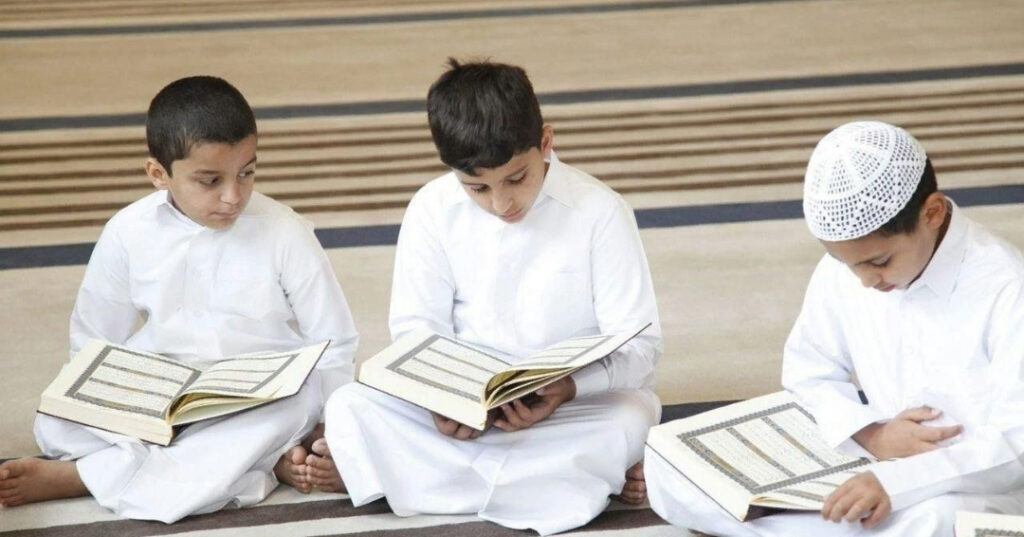
| Key Takeaways |
| Children aged 4–7 begin Quran learning through Arabic letter recognition using Noorani Qaida before attempting full recitation. |
| Non-Arabic speaking kids require phonetic training before Tajweed rules — sound accuracy must precede rule memorization entirely. |
| Short daily sessions of 15–20 minutes outperform longer weekly lessons for building retention in young learners. |
| Qualified native Arab instructors with child pedagogy training dramatically reduce pronunciation errors formed in early learning stages. |
| Starting memorization with short surahs from Juz 30 builds confidence and establishes sustainable Hifz habits in children. |
Children raised in English-speaking homes carry a beautiful ambition — connecting to the Quran — without the phonetic foundation Arabic-speaking children inherit naturally. That gap is real, but it is not permanent.
The right sequence closes it completely. When kids follow a structured path starting from letter sounds through basic recitation and into memorization, non-Arabic speakers consistently achieve fluency and retention that surprises their own parents. This guide walks through that exact path, step by step.
Table of Contents:
1. Begin with Arabic Letter Recognition Before Attempting Any Quranic Text
The very first step for any non-Arabic speaking child is building familiarity with the Arabic alphabet as a visual and phonetic system — completely separate from Quran recitation. Children who skip this stage and jump directly into Quranic text develop misreading habits that take months to correct.
At Buruj Academy, our Quran instructors for kids spend the first two to three weeks solely on letter shapes and their isolated sounds. Children learn to recognize ب، ت، ث in all their forms — initial, medial, and final — before a single word of Quran is introduced.
Why Isolated Letter Learning Prevents Long-Term Errors
Arabic letters change shape based on their position in a word. A child who does not recognize ع in its four forms will misread it every single time it appears.
We have seen this pattern repeatedly: students who skipped letter isolation work spend the first months of recitation guessing rather than reading.
| Letter Form | Position | Example Letter (ع) |
| Isolated | Standalone | ع |
| Initial | Start of word | عَلِيم |
| Medial | Middle of word | مَعَنا |
| Final | End of word | سَمِيع |
This table represents the exact visual recognition challenge every non-Arabic speaking child must overcome before reading a single Quranic ayah.
2. Master Arabic Phonetics Through Noorani Qaida Before Any Recitation Begins
Noorani Qaida is not a beginner shortcut — it is the foundational phonetic curriculum used by qualified teachers across the Arab world for over a century.
For non-Arabic speaking children, it is non-negotiable. It systematically trains the mouth, tongue, and lips to produce sounds that simply do not exist in English.
The sounds ح، خ، ع، غ، ق require specific articulation points — what classical Tajweed science calls Makharij al-Huruf — that no English word activates.
A child cannot learn these sounds by reading transliteration. They must hear them from a qualified instructor and practice under live correction.
Our Noorani Qaida for Kids course at Buruj Academy uses audio modeling, repetition games, and real-time feedback in every session. In our instructors’ experience, most children aged 5–8 need approximately four to six weeks of consistent Qaida work before their phonetics reach a level where Quran reading does not introduce errors.
What Noorani Qaida Covers Before Quran Reading
- Isolated Arabic letters and their sounds
- Letters joined in two-letter and three-letter combinations
- Short vowels (Fathah, Kasrah, Dammah) and long vowels (Madd)
- Tanween and Sukoon markings
- Basic rules for Tajweed
Sign up your son for a free Noorani Qaida lesson

3. Introduce Quran Reading with Short Daily Sessions
Once a child completes Noorani Qaida, they are ready to begin reading actual Quranic text — but the method matters enormously.
For non-Arabic speaking children, we recommend beginning with the last ten surahs of Juz 30. These surahs are short, rhythmically memorable, and contain phonetic patterns the child has already encountered in Qaida practice.
Reading easy surahs of the Quran to memorize at this stage builds reading confidence before longer passages are introduced.
Session length is equally important. In our experience teaching hundreds of non-Arabic speaking children at Buruj Academy, 15–20 minute sessions, five days per week, consistently produce better results than 45-minute sessions twice weekly. Young attention spans require frequency, not duration.
4. Introduce Basic Tajweed Rules Only After Fluent Letter-Level Reading Is Established
One of the most common mistakes parents and teachers make with non-Arabic speaking kids is introducing Tajweed rules before the child reads fluently at the letter level. When a child is still decoding individual letters, adding Ghunnah and Ikhfa rules creates cognitive overload — they collapse under the weight of two simultaneous tasks.
The correct sequence is letter fluency first, then rule introduction. Specifically, children should read a full short surah without decoding pauses before their first Tajweed lesson begins.
The first Tajweed rules appropriate for children are Madd (lengthening), Sukoon (vowel-less letters), and basic Noon Sakinah rules.
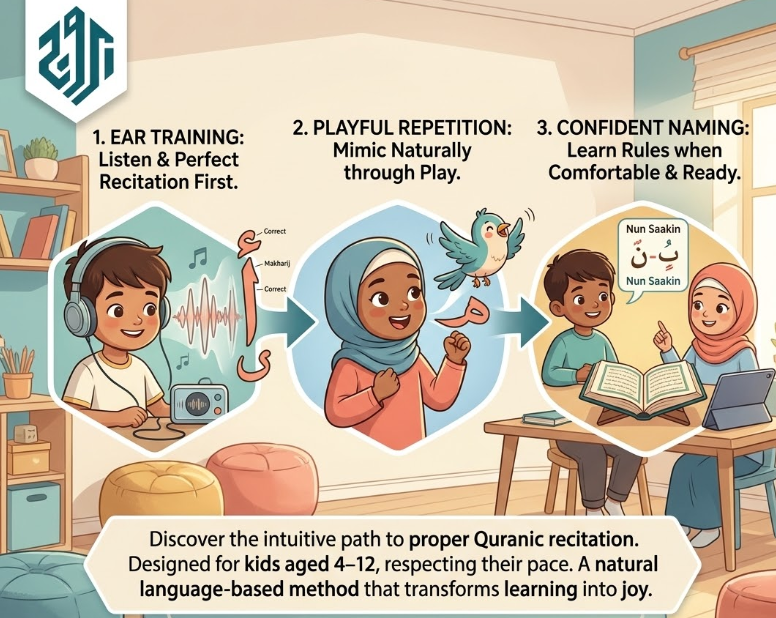
Our Tajweed for Kids course introduces these through listening exercises before explaining the rule name — a core principle of the Buruj Method’s sound-before-rules approach. Children hear the correct sound dozens of times before they ever see the rule label.
For parents wanting to understand what their children are learning, our Tajweed for beginners guide explains foundational rules in accessible English.
| Tajweed Rule | When to Introduce | Child-Friendly Explanation |
| Madd (lengthening) | After fluent letter reading | “Hold this sound for two counts” |
| Ghunnah (nasalization) | After Madd is natural | “Hum through your nose here” |
| Ikhfa (concealment) | After Ghunnah is consistent | “Blend the noon softly into the next letter” |
| Qalqalah (echo) | After Ikhfa is practiced | “Let the letter bounce at the end” |
Book your child’s free Tajweed trial lesson today
5. Begin Surah Memorization Using Repetition and Audio Modeling Together
Memorization — Hifz — works differently for children than for adults. Young children memorize primarily through auditory repetition and emotional association, not through deliberate study.
This is an advantage, not a limitation: it means children can memorize accurately and rapidly when the method respects how their brains work.
The proven approach for non-Arabic speaking kids is audio-first memorization. The child listens to a qualified reciter read three to five ayahs, then repeats aloud immediately.
This cycle continues — listen, repeat, listen, repeat — until the passage is secure. Only then does the child look at the written text.
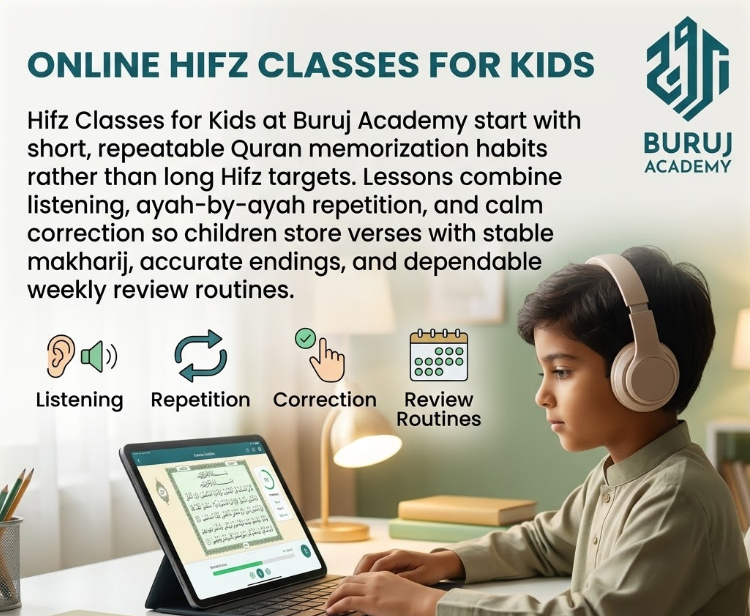
Buruj Academy’s Hifz for Kids course uses this exact method with one important addition: the instructor provides live correction in every repetition cycle, catching mispronunciations before they solidify into habit.
Starting with the shortest surahs to memorize ensures early wins that build the child’s confidence and love for Quran.
Read also: How to Learn the Quran for Kids?
How Much Can a Child Memorize Weekly?
In our instructors’ experience, non-Arabic speaking children aged 6–10 who maintain five sessions weekly typically memorize three to five ayahs per session during the early Hifz stage.
This is not a researched statistic — it is an observational estimate from our teaching team, and it varies significantly by age, session consistency, and the child’s individual learning pattern.
Start your child’s Hifz classes for free session
6. Build a Consistent Home Review Routine to Prevent Forgetting
Memorization without review is not memorization — it is temporary storage. The most common challenge parents of non-Arabic speaking children describe to our instructors is: “My child knew the surah perfectly on Friday. By Monday it was gone.” This is not a failure of the child’s ability. It is a failure of the review system.
New memorization is highly volatile in the first seven days. Review within 24 hours of learning dramatically increases retention — a principle well-established in cognitive science and equally observable in our Hifz classrooms.
A simple home review routine of ten minutes daily, where the parent listens while the child recites, makes a measurable difference.
For parents building structured review into their week, our Quran memorization schedule guide provides practical weekly templates adaptable for children at different stages.
Excel in Your Quranic Studies
Join Buruj Academy and master the Quran with our structured, professional curriculum.
Book Your Free Trial7. Use Age-Appropriate Quran Activities to Sustain Motivation Between Sessions
Children disengage when learning feels exclusively like work. For non-Arabic speaking kids, maintaining motivation through the early stages — when progress is real but slow — requires enrichment beyond formal lessons. This is where intentional activities make a practical difference.
Effective Quran activities for children at this stage include: listening to recitation during car rides, following along with finger-tracing in the Mushaf, coloring Arabic letter worksheets, and simple gamified Quran review with family members.
Our team has compiled specific ideas in our Quran activities for kids resource, which parents frequently use alongside their child’s weekly sessions.
Buruj Academy’s Online Quran Classes for Kids incorporate structured gamification directly into lessons — point systems, milestone celebrations, and teacher encouragement are embedded in every session to sustain the child’s intrinsic motivation throughout the learning process.
8. Enroll in Structured Online Classes with a Qualified Native Arab Instructor
Self-directed learning, apps, and YouTube videos serve a supplementary role — they cannot replace a qualified human instructor for non-Arabic speaking children. Arabic phonetics require live correction. Tajweed rules require real-time feedback. Memorization requires a teacher who hears every recitation and catches every deviation.
The Prophet ﷺ said, as recorded in Sahih al-Bukhari 5027:“The best among you are those who learn the Quran and teach it.” This hadith reflects the Islamic tradition’s emphasis on transmission through qualified human teachers — a chain unbroken since the time of the Companions.
For non-Arabic speaking families outside Muslim-majority countries, structured online learning with qualified instructors is both practical and highly effective.
Buruj Academy’s Online Quran Classes for Kids course connects children with Al-Azhar-trained instructors and Ijazah-certified teachers who specialize in child pedagogy and have extensive experience teaching non-Arabic speaking students globally.
A qualified instructor catches what no app can: the subtle mispronunciation of ح versus ه, the incorrect lengthening of a Madd letter, or the missing Ghunnah in Noon Mushaddadah. These errors, left uncorrected, become embedded habits requiring significant time to undo.
Help your child start learning the Quran with a Free trial

9. Track Progress Through Clear Milestones to Maintain Long-Term Commitment
Long-term Quran learning requires visible progress markers. Without milestones, children and parents alike lose sight of how far the child has traveled — and motivation quietly fades.
Structured milestone tracking transforms an abstract, ongoing commitment into a series of achievable, celebratable goals.
| Milestone | Approximate Stage | Celebration Suggestion |
| Completes Noorani Qaida | 6–10 weeks | Certificate + family recognition |
| Reads first complete surah | 7–12 weeks | Dedicated family recitation session |
| Memorizes Juz 30 | 12–18 months | Special milestone gift or outing |
| Reads full Quran without decoding pauses | 2–3 years | Quran Khatm celebration |
Understanding the best age to memorize Quran helps parents set realistic expectations — children aged 6–12 are in their strongest neurological window for Quran memorization, making consistent effort during these years exceptionally productive.
Read also: Worksheet Arabic Numbers for Kids
Discover the Buruj Academy Difference
Step into our virtual classrooms and see how our expert instructors make learning Quran and Arabic intuitive and clear. We focus on overcoming the specific hurdles non-native speakers face, building your confidence and connection with the Quran.
Start Your Child’s Quran Learning with Buruj Academy’s Expert Instructors
Every child deserves a teacher who understands exactly where they are starting from and knows precisely how to move them forward.
At Buruj Academy, our Ijazah-certified instructors and Al-Azhar University graduates have spent 12+ years refining exactly this: teaching non-Arabic speaking children the Quran with patience, structure, and genuine expertise.
Our Online Quran Classes for Kids course offers:
- Personalized 1-on-1 sessions with Al-Azhar-trained child specialists
- The Buruj Method: sound-before-rules, consistency-before-speed
- Flexible 24/7 scheduling for families in any time zone
- Real-time pronunciation correction in every session
- Clear progression from Qaida through Quran reading and Hifz
Book your child’s free trial lesson today and see the difference expert, structured teaching makes from the very first session.
Enroll your child in one of our specialized, kid-friendly tracks today:
- Online Quran Classes for Kids
- Tajweed Classes for Kids
- Hifz Classes for Kids
- Online Arabic Classes for Kids
- Quranic Arabic Course for Kids
- Noorani Qaida Course for Kids
- Islamic Studies Classes for Kids
Ready to watch your child grow in knowledge and character? Join the Buruj Academy family and book a free trial session for your child today!
Excel in Your Quranic Studies
Join Buruj Academy and master the Quran with our structured, professional curriculum.
Book Your Free TrialConclusion
Teaching a non-Arabic speaking child the Quran is not a single act — it is a layered, sequential process where each stage builds on the one before it. Letter recognition opens the door. Phonetic training establishes the foundation. Structured recitation, proper Tajweed, and consistent memorization build the rest.
The families who see the strongest results share one common factor: they combine a qualified teacher with a consistent home environment.
When both exist, non-Arabic speaking children achieve what once seemed distant — fluent, confident, beautiful Quran recitation. May Allah make every child’s path to His Book easy and full of barakah.
Frequently Asked Questions About How Non-Arabic Speaking Kids Learn Quran
What Age Should a Non-Arabic Speaking Child Begin Quran Learning?
Children can begin Arabic letter recognition as early as age 4 through structured Noorani Qaida sessions. Formal Quran reading typically begins between ages 5–7, when fine motor and attention skills support structured learning. Earlier exposure to Quran listening — without formal instruction — is beneficial at any age and naturally builds phonetic familiarity.
How Long Does It Take a Non-Arabic Speaking Child to Read Quran Fluently?
In our instructors’ experience, children who begin Noorani Qaida at age 5–6 and attend five sessions weekly typically reach fluent Quran reading within 5–16 months. This estimate varies based on session consistency, home review frequency, and the child’s individual learning pace. Consistency matters far more than any single factor.
Can Non-Arabic Speaking Kids Learn Quran Online as Effectively as In-Person?
Yes — provided the instructor is qualified, the session is 1-on-1, and real-time audio correction is available. Online learning actually offers an advantage for non-Arabic speaking families: access to Al-Azhar-trained, Ijazah-certified instructors who may not be locally available. The key variable is teacher quality, not the delivery format.
Is Tajweed Necessary for Young Children Learning Quran?
Basic Tajweed — particularly correct Makharij and essential elongation rules — is necessary from the beginning, as mispronunciation habits formed early are difficult to correct. Advanced Tajweed rules, such as the detailed Noon Sakinah rules or Idgham categories, are introduced progressively as the child’s reading fluency develops.