 Arabic
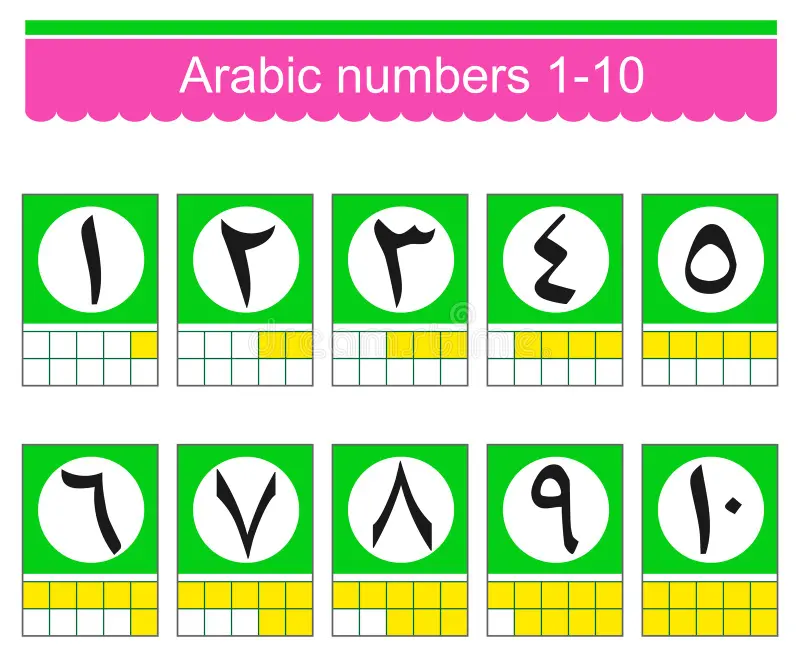
Finding a reliable worksheet for Arabic numbers for kids — one that actually teaches correct numeral formation, not just recognition — is harder than it should be. Most parents and teachers end up wading through generic printables that mix Eastern Arabic numerals (١ ٢ ٣) with Western digits, which creates confusion rather than clarity.
The resources below are real, verified options — free and paid — covering tracing, recognition, counting, matching, and coloring. Whether your child is in preschool or early primary school, this list gives you something printable or interactive for every learning stage.
Table of Contents:
1. Tracing Arabic Numbers 1–10 Worksheets
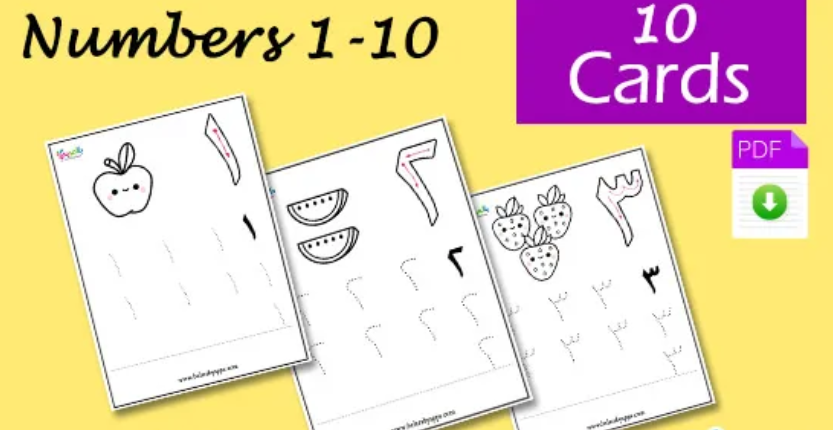
Tracing Arabic Numbers Worksheets for Kids – Free Printable from Belarabyapps is one of the most complete free resources available for early learners. The PDF set covers Eastern Arabic numerals 1 through 10, with dedicated tracing, writing, and coloring pages for each number.
At Buruj Academy, we often recommend this exact set to parents who are beginning their child’s Arabic learning journey for kids. The worksheets develop pencil grip, fine motor control, and number recognition simultaneously — three skills young Arabic learners need before moving to number words and pronunciation.
| Skill Developed | How the Worksheet Addresses It |
| Fine motor control | Guided tracing with dotted numeral outlines |
| Number recognition | Clear, bold Eastern Arabic numerals per page |
| Early writing | Independent write-after-trace practice section |
| Engagement | Coloring component keeps children motivated |
Print on card stock and laminate for reusable dry-erase practice — a tip parents in our Buruj Academy community use regularly to stretch a single download across months of daily revision.
2. Tracing Arabic Numbers 1–20 Worksheets
Tracing Arabic Numbers 1–20 Worksheets PDF from Belarabyapps builds directly on the 1–10 set above, extending number formation and recognition through 20. This range is appropriate for kindergarten and Grade 1 students who have already mastered single-digit Arabic numerals.
The structure mirrors the 1–10 pack: each numeral gets a dedicated page with tracing guides, a coloring element, and a section for independent practice.
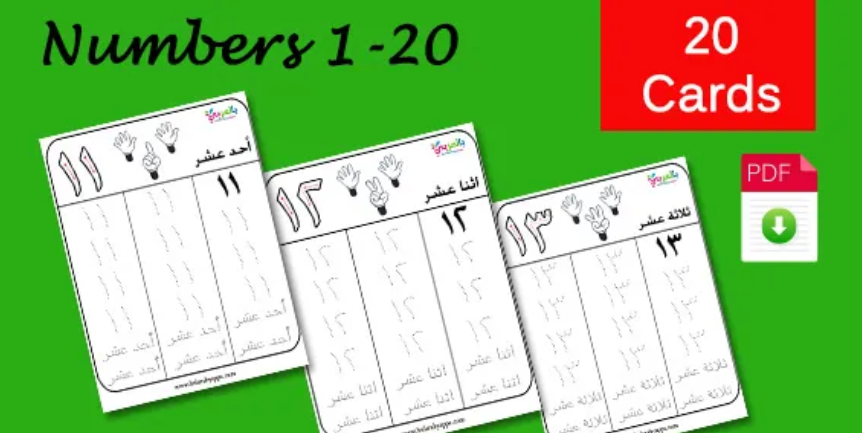
One detail we appreciate from a pedagogy standpoint is the consistent layout across all 20 pages — children in our Online Arabic Classes for Kids respond better to consistent visual formats because it reduces cognitive load and lets them focus on the numeral itself.
This resource is entirely free and downloadable as a PDF, printable as many times as needed.
Book a FREE Arabic trial for your Child

3. Arabic Numbers Sheet Alongside Letter Activities
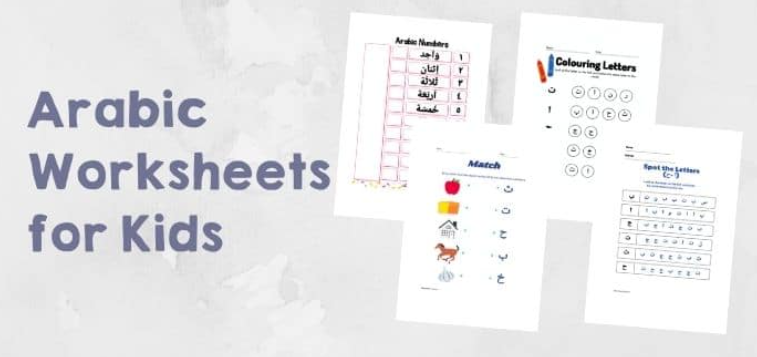
Arabic Worksheets for Kids from IlmBank is a four-worksheet free PDF set that includes an Arabic numbers page alongside letter spotting, letter coloring, and picture-matching activities. This is a useful choice for Islamic homeschool families who want a single download covering both letters and numbers.
The numbers sheet in this set introduces Eastern Arabic numerals in context with other Arabic literacy activities — a small but meaningful design choice.
Children who learn numbers and letters together in the same resource session begin to recognize the Arabic script as one coherent system rather than separate unrelated tasks. The file is free and rated 4/5 stars by reviewers on IlmBank.
4. Arabic Numbers Interactive Exercises
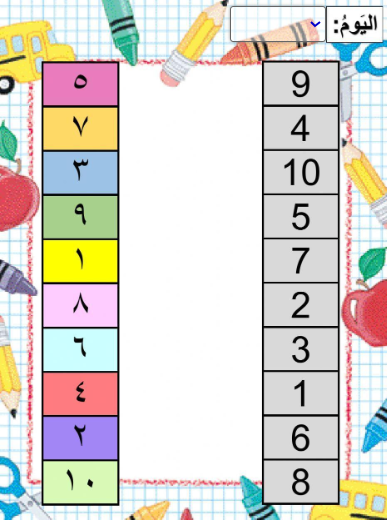
Arabic Numbers 1–10 Interactive Worksheet on Liveworksheets is a browser-based, self-correcting exercise children can complete on a tablet or computer. Unlike printable PDFs, this format provides instant feedback — children know immediately whether their answer is correct.
Digital worksheets on Liveworksheets are particularly useful for children who resist sitting with pencil and paper, or for supplementing printed practice with screen-based reinforcement.
Master the Arabic Language
Join our expert-led courses and build a strong foundation in Classical and Modern Arabic.
Get Your Free TrialThe platform hosts multiple Arabic number worksheets across different formats — matching, fill-in, and identification — all available at no cost.
For parents integrating digital tools alongside structured instruction through our Online Arabic Classes for Kids course, these interactive exercises work well as between-session reinforcement.
Read also: How to Learn Quran for Non-Arabic Speaking Kids?
5. Arabic Worksheet Numbers 1–100
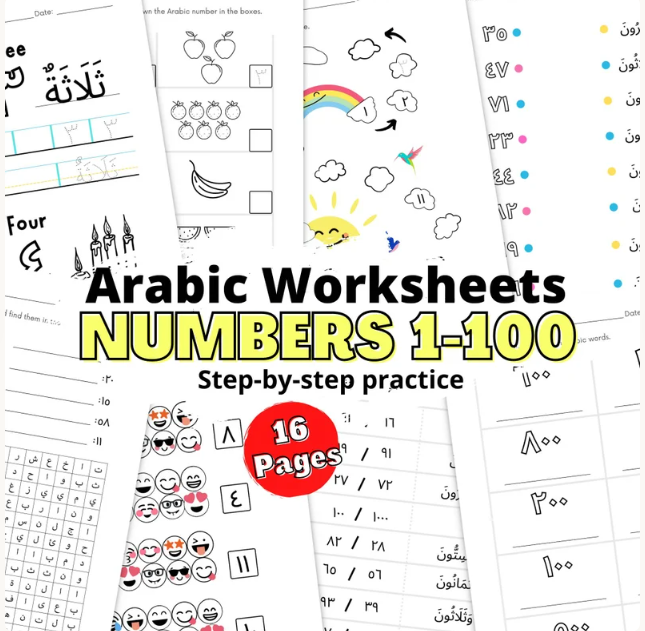
Arabic Worksheet Numbers 1–100 Printable Activity by CoolKidsPractice is a 16-page PDF workbook covering Eastern Arabic numerals 1 through 100. It includes letter tracing, fruit-based counting, emoji coloring, number arrangement, matching exercises, word form writing, and a word game.
This is the most cognitively varied paid option on this list — it covers multiple learning styles and skill levels within a single download.
For children in Grade 1 and above who have mastered 1–10 tracing and are ready for extended number literacy, this set provides genuine challenge and breadth. It is available as an instant PDF download directly from Etsy.
If you are looking to build your child’s full Arabic language foundation beyond numbers, our learning Arabic alphabet for kids guide is the natural next step.
Discover the Buruj Academy Difference
Step into our virtual classrooms and see how our expert instructors make learning Quran and Arabic intuitive and clear. We focus on overcoming the specific hurdles non-native speakers face, building your confidence and connection with the Quran.
Start Your Child’s Arabic Language Foundation with Buruj Academy’s Expert-Led Kids Course
Arabic numbers are just one piece of a much larger literacy picture. Mastering Eastern Arabic numerals (١–١٠٠) alongside the Arabic alphabet, basic vocabulary, and sentence structure gives children a foundation that connects directly to Quranic comprehension as they grow.
Buruj Academy’s Online Arabic Classes for Kids course is designed specifically for non-Arabic-speaking children, taught by Al-Azhar University graduates with 12+ years of experience making Arabic accessible and genuinely enjoyable for young learners.
Every session is 1-on-1, personalized to your child’s pace, and scheduled flexibly around your family’s routine.
What sets the Buruj Method apart for kids:
- Sound recognition before script — children hear and say numbers before writing them
- Patient, child-experienced Ijazah-certified and Al-Azhar-trained instructors
- Clear milestone progression from letters and numbers to full reading confidence
- Flexible 24/7 scheduling for families across all time zones
Book your child’s free trial lesson today and see the difference structured, expert instruction makes.
Enroll your child in one of our specialized, kid-friendly tracks today:
- Online Quran Classes for Kids
- Tajweed Classes for Kids
- Hifz Classes for Kids
- Online Arabic Classes for Kids
- Quranic Arabic Course for Kids
- Noorani Qaida Course for Kids
- Islamic Studies Classes for Kids
Ready to watch your child grow in knowledge and character? Join the Buruj Academy family and book a free trial session for your child today!
Master the Arabic Language
Join our expert-led courses and build a strong foundation in Classical and Modern Arabic.
Get Your Free TrialConclusion
Worksheets for Arabic numbers are most effective when they match your child’s current skill level — starting with coloring and tracing for preschoolers, progressing to counting, sequencing, and word-form exercises for early primary students.
Consistent short daily sessions — even ten minutes of tracing or flashcard review — produce far stronger results than occasional longer practice sessions. Pair any worksheet set with spoken Arabic number practice and, Insha’Allah, your child’s number recognition will strengthen quickly.
When you’re ready to move beyond numbers into full Arabic literacy, structured online instruction is the most reliable next step.
Read also: How to Learn the Quran for Kids?
Frequently Asked Questions About Worksheet Arabic Numbers for Kids
What Is the Difference Between Arabic Numerals and Eastern Arabic Numerals on Worksheets?
Western countries use Arabic-origin numerals (1, 2, 3) derived from the Eastern Arabic system. Eastern Arabic numerals — written as ١، ٢، ٣ — are the standard numerals used in the Arab world and in Quranic text contexts. Worksheets teaching Arabic numbers for kids should use the Eastern Arabic numeral forms, not Western digits.
What Age Should Children Start Using Arabic Number Worksheets?
Children aged 3–4 can begin with coloring-based numeral pages that build shape awareness without demanding fine motor precision. Tracing worksheets suit ages 4–6, and counting, sequencing, and word-form exercises are appropriate from age 5–6 onward. Match the worksheet type to your child’s current fine motor and cognitive development stage.
How Many Arabic Numbers Should Children Learn First on Worksheets?
Start with 1–10. Eastern Arabic numerals 1–10 (١–١٠) are the foundational set that unlocks all subsequent number literacy. Once children can recognize, trace, and write 1–10 fluently, extending to 1–20 and beyond follows naturally. Rushing to larger numbers before 1–10 are solid creates recognition gaps that persist.
Can Children Use Arabic Number Worksheets Without an Arabic-Speaking Parent at Home?
Yes. Tracing and coloring worksheets require no spoken Arabic input from parents — the visual activity is self-contained. For pronunciation of number names (واحد، اثنان، ثلاثة), parents can use audio resources or enroll their child in structured lessons like Buruj Academy’s Online Arabic Classes for Kids course, where instructors model correct pronunciation in every session.