 Quran
Quran
| Key Takeaways |
| Learning Quranic Arabic for Complete Beginners by Ikram Hawramani is the top self-teaching option for absolute beginners with zero Arabic background. |
| Access to Qur’anic Arabic by Abdul Wahid Hamid uses exclusively Quranic vocabulary throughout, making every grammar lesson directly applicable to the Quran. |
| Essentials of Quranic Arabic by Masood Ranginwala is used at the university level and covers morphology (sarf) alongside grammar, a rare combination in English-language resources. |
| The Madinah Arabic Reader series by Dr. V. Abdur Rahim was developed at the Islamic University of Madinah and bridges Quranic, classical, and modern Arabic systematically. |
| No book alone replaces a qualified teacher — consistent guided practice accelerates comprehension far beyond self-study alone. |
Choosing the right book to learn Quranic Arabic is one of the most consequential decisions a non-Arabic speaker can make in their Islamic education journey.
The wrong starting point — a book pitched at the wrong level, or one focused on colloquial Arabic instead of classical — can waste months of effort.
The best book to learn Quranic Arabic depends on your current level, your learning goal (grammar comprehension vs. vocabulary acquisition vs. reading fluency), and whether you are self-studying or working with a teacher.
Table of Contents:
1. Learning Quranic Arabic for Complete Beginners by Ikram Hawramani
Learning Quranic Arabic for Complete Beginners by Ikram Hawramani is the most accessible entry point for students who have never studied Arabic at all. The book begins with the first verse of the Quran and builds outward, teaching grammar structures through real Quranic examples from page one.
It was specifically designed for self-teaching, with each concept explained in plain English before any Arabic terminology is introduced.
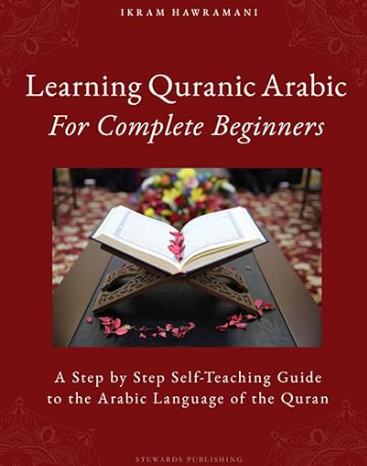
What distinguishes Hawramani’s approach is its focus on structural understanding over memorization. Rather than drilling vocabulary lists, the book trains readers to recognize Arabic’s root-pattern system — the foundation that makes all further Quranic Arabic study possible.
The book draws on classical Tafsir and I’rab sources, including works by al-Tabari and al-Qurtubi, giving learners confidence that the linguistic explanations are rooted in authentic scholarship.
For anyone reading the Quran for the first time and wanting to move from recitation toward comprehension, this is the book we recommend first.
| Feature | Detail |
| Author | Ikram Hawramani |
| Best For | Absolute beginners, self-study |
| Focus | Grammar structure, root patterns |
| Language of Instruction | English throughout |
| Key Strength | Uses Quranic verses from lesson one |
2. Access to Qur’anic Arabic by Abdul Wahid Hamid
Access to Qur’anic Arabic by Abdul Wahid Hamid is a three-part set — Textbook, Workbook, and Quranic Selections — that covers foundational Arabic grammar using exclusively Quranic vocabulary. No invented example sentences, no colloquial Arabic. Every exercise, every grammar illustration, every vocabulary item comes directly from the Quran itself.
This design makes the book exceptionally efficient for learners whose goal is Quran comprehension rather than conversational Arabic.
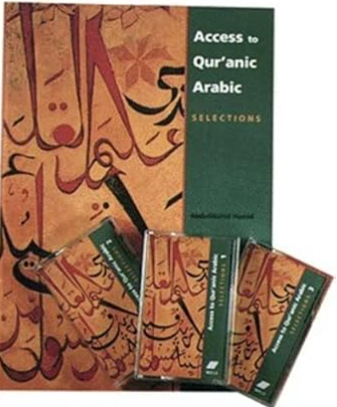
The textbook’s format — grammar lesson on the left page, Quranic verses demonstrating that rule on the right — is one of the clearest visual learning structures we have seen in any Quranic Arabic resource.
The Selections volume introduces unvowelled Arabic text at an early stage, which is an important and often-neglected bridge to real Mushaf reading.
In our experience at Buruj Academy, students who use this book alongside a live teacher make noticeably faster progress than those who rely on it for self-study alone — the grammatical jumps between chapters benefit from real-time explanation.
Buruj Academy’s Quranic Arabic for Beginners course pairs structured text-based grammar instruction with qualified teacher guidance, giving students the best of both approaches.
Begin Understanding Quranic Arabic with a FREE Lesson
3. Essentials of Quranic Arabic by Masood Ranginwala
Essentials of Quranic Arabic (Volume 1) and
Volume 2 by Masood Ranginwala stand apart from most English-language Quranic Arabic books because they address both Nahw (Arabic grammar/syntax) and Sarf (morphology/word forms) — the twin pillars of classical Arabic linguistic science.
Volume 1 lays the grammatical foundation through carefully sequenced Quranic examples.
Volume 2 extends into irregular verbs, intermediate morphology, and an introduction to Balagha (Quranic eloquence).
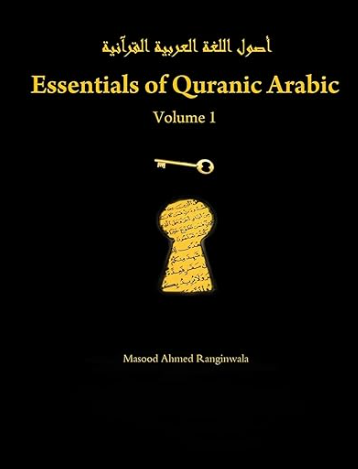
Notably, the Islamic Online University adopted Volume 1 for its introductory Quranic Arabic course, which speaks to its scholarly credibility.
The review questions at the end of each chapter make it one of the few books that functions well for structured classroom use as well as independent study.
We recommend this series for students who have already completed a beginner resource and want to consolidate their grammatical knowledge before advancing to Tafsir study or to one of our Quranic Arabic courses.
Begin Understanding Quranic Arabic with a FREE Lesson
4. Arabic Through the Qur’an by Alan Jones
Arabic Through the Qur’an by Alan Jones, published by the Islamic Texts Society, offers a systematic grammar curriculum where every rule — verb conjugations, noun cases, sentence structures — is illustrated with direct Quranic examples.
Jones also provides a comprehensive glossary of Quranic terminology, making this resource valuable both as a grammar course and as a reference tool for ongoing Quran study.
The book covers key grammatical elements that are often skimmed in lighter resources: the three i’rab (case) endings, verb patterns derived from the triliteral root system, and the distinction between definite and indefinite constructions — all of which are essential for accurate Quran comprehension.
Excel in Your Quranic Studies
Join Buruj Academy and master the Quran with our structured, professional curriculum.
Book Your Free Trial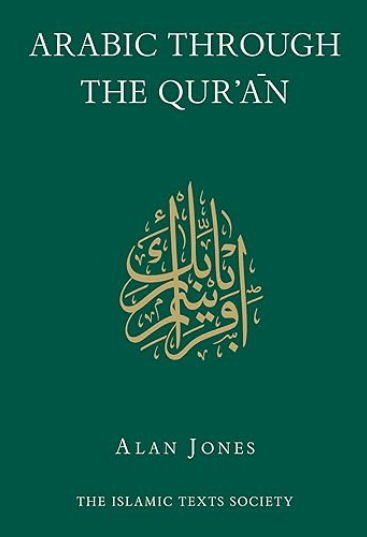
Read also: Best App to Learn Quranic Arabic
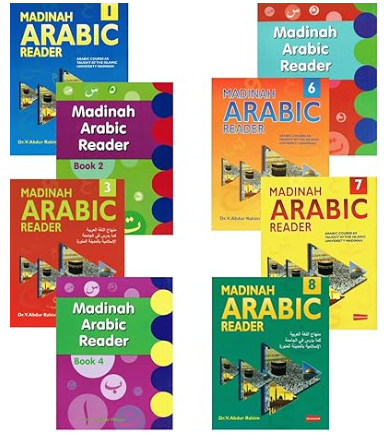
5. Madinah Arabic Reader Series by Dr. Abdur Rahim
The Madinah Arabic Reader series by Dr. Abdur Rahim is an eight-volume curriculum originally developed at the Islamic University of Madinah for non-Arabic speaking Muslim students.
Each volume builds on the last through conversation-based lessons that teach applied grammar through distinctive language patterns. The series is used in UK GCE O-Level and A-Level preparation, indicating a standardized level of linguistic rigor.
The vocabulary deliberately spans classical, Quranic, and modern Arabic, giving learners a flexible linguistic foundation that serves Quran study and broader classical Islamic scholarship.
This series requires commitment — all eight volumes represent a multi-year study program. But for parents enrolling children in a structured Arabic curriculum, or for adults serious about deep Quranic comprehension, it is one of the most thorough printed resources in English.
Discover the Buruj Academy Difference
Step into our virtual classrooms and see how our expert instructors make learning Quran and Arabic intuitive and clear. We focus on overcoming the specific hurdles non-native speakers face, building your confidence and connection with the Quran.
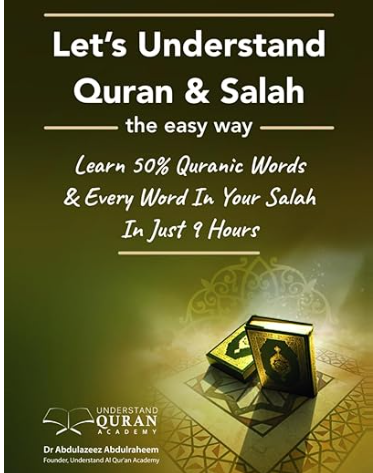
6. Understand Quran: 50% Words by Dr. Abdulazeez Abdulraheem
Understand Quran: 50% Words by Dr. Abdulazeez Abdulraheem takes a fundamentally different approach from grammar-first books. Its method is frequency-based vocabulary acquisition: by mastering the words that appear most often in the Quran, learners achieve reading comprehension at a faster rate than through grammar study alone.
The book lists Quranic vocabulary in order of frequency, covering nouns and verbs with their conjugated forms. It also ensures learners understand every word in their daily Salah, making it immediately spiritually actionable for any Muslim.
This approach aligns with what researchers in second-language acquisition call the “high-frequency word” method — and for Quranic Arabic specifically, it works because the Quran’s vocabulary is finite and internally repetitive.
We typically recommend this book as a complement to a grammar-focused resource rather than a standalone course.
Students in our Quranic Arabic Grammar course who supplement their grammar study with active vocabulary building from frequency-based resources consistently outperform those who rely on grammar alone.
Get Your Free Trial Quranic Arabic Grammar Lesson
Start Learning Quranic Arabic with Buruj Academy’s Expert-Led Online Course
Every book on this list is a valuable tool — but tools need skilled hands. The fastest gains in Quranic Arabic come when a structured text is paired with a qualified teacher who corrects errors in real time, answers questions no book anticipates, and adapts the pace to your specific needs.
Buruj Academy’s Quranic Arabic Classes are taught by Al-Azhar University graduates with 12+ years of experience teaching non-Arabic speakers globally.
Our Buruj Method prioritizes context before abstraction — students understand meaning before memorizing rules.
Sessions are 1-on-1, fully flexible in scheduling, and available at beginner, intermediate, and grammar-specialist levels.
Book your free trial lesson and start understanding the Quran in the language Allah revealed it.
Begin your journey of understanding by enrolling in a specialized track today:
- Quranic Arabic Classes (General & Immersive)
- Quranic Arabic Course for Kids (Interactive & Engaging)
- Quranic Arabic Course for Beginners (Foundation Building)
- Quranic Arabic Grammar Course (Syntax & Morphology)
Are you ready to understand what you recite? Join Buruj Academy today and book your free introductory session to begin your journey of discovery!
Excel in Your Quranic Studies
Join Buruj Academy and master the Quran with our structured, professional curriculum.
Book Your Free TrialRead also: How Long Does It Take to Learn Quranic Arabic?
Conclusion
The best book to learn Quranic Arabic is ultimately the one you use consistently — but choosing the right starting point matters enormously. Absolute beginners benefit most from Hawramani’s self-paced approach or Hamid’s Quran-only grammar system.
Students seeking depth in morphology and rhetorical science will find Ranginwala’s two-volume series indispensable. Those committed to a long-term classical curriculum should consider the Madinah Arabic Reader series in full.
What none of these books can replace is the feedback loop a qualified teacher provides. Combine the best text with expert guidance, and your path from reciting the Quran to truly understanding it becomes dramatically shorter.
Frequently Asked Questions About Learning Quranic Arabic
What Is the Fastest Book to Learn Quranic Arabic?
Understand Quran: 50% Words by Dr. Abdulazeez Abdulraheem offers the fastest path to partial Quran comprehension through high-frequency vocabulary acquisition. However, vocabulary without grammar produces incomplete understanding. For balanced fast-track learning, pair it with a structured grammar resource and, ideally, a qualified teacher for guided practice and error correction.
Is Quranic Arabic Different from Modern Standard Arabic?
Quranic Arabic is a form of classical Arabic with a fixed, precise grammatical structure and vocabulary that differs from Modern Standard Arabic (MSA) in several ways, including verb forms, vocabulary choices, and rhetorical structures. Books like Arabic Through the Qur’an by Alan Jones and the Madinah Arabic Reader series address classical Arabic specifically, making them better suited for Quran comprehension than general MSA textbooks.
At What Age Can Children Start Learning Quranic Arabic?
Children as young as 7–8 can begin structured Quranic Arabic study using age-appropriate resources. Buruj Academy’s Quranic Arabic Course for Kids introduces classical Arabic foundations through methods tailored for young learners, building vocabulary and basic grammar in engaging, age-appropriate sessions with instructors trained in child pedagogy.
Do I Need to Know How to Read Arabic Before Starting These Books?
Most books on this list — including Hawramani and Hamid — assume the reader can already read Arabic script, even if imperfectly. If you cannot yet read Arabic letters fluently, completing a Noorani Qaida with Tajweed course first will ensure you gain the most from any Quranic Arabic textbook.