 Islamic

| Key Takeaways |
| The Quran contains 604 pages and 30 Juz’; reading 4 pages daily completes it in approximately 151 days. |
| A 20-minute daily session is sufficient for beginners to build consistent Quran reading habits without burnout. |
| Fajr and after-Asr are the two most effective daily windows for Quran recitation based on scholarly guidance and cognitive research. |
| Dividing your daily portion into two sessions — morning and evening — significantly improves retention and consistency over time. |
| Matching your schedule to your Tajweed level prevents rushed, error-prone recitation and builds long-term accuracy. |
Most Muslims want to read Quran daily but struggle to make it stick. The gap between intention and consistency usually comes down to one thing: the absence of a structured, realistic plan matched to their actual schedule and recitation level.
A practical daily Quran reading schedule assigns specific pages, times, and session lengths to your day — making Quran reading a fixed habit rather than an afterthought. Whether your goal is completing a full recitation or building foundational consistency, the right plan transforms aspiration into action.
Table of Contents:
How Many Pages of Quran Should You Read Each Day?
The answer depends entirely on your goal and available time — but there are clear, tested benchmarks that work for most learners. Reading 4 pages per day completes the Quran in approximately 151 days. Reading 2 pages daily completes it in around 302 days. For those aiming to complete one full recitation per month (a widely recommended practice), 20 pages daily — equal to one Juz’ — is required.
Here is a reference table our instructors at Buruj Academy recommend for planning purposes:
| Daily Pages | Approximate Completion Time | Recommended For |
| 1–2 pages | 10–12 months | Absolute beginners building habits |
| 4 pages | ~5 months | Steady intermediate reciters |
| 8 pages | ~75 days | Confident reciters with time available |
| 20 pages (1 Juz’) | 30 days | Advanced reciters pursuing monthly Khatm |
One practical note from our sessions: beginners often overestimate what they can sustain. We consistently advise starting at 2 pages daily — establishing the habit first — before increasing the portion. A habit maintained at 2 pages outperforms an abandoned 10-page target every time.
If you are still building your foundational reading skills, our Quran Reading Course helps students reach the fluency level needed to maintain a consistent daily schedule with correct pronunciation from the start.
Book your Free trial lesson and start reading the Quran

Daily Quran Recitation Schedule According to the Best Time
The best times for daily Quran recitation are after Fajr prayer and after Asr prayer — both supported by Islamic tradition and aligned with periods of mental clarity. The Prophet ﷺ highlighted the blessing of the early morning hours, and recitation at Fajr is specifically referenced in the Quran.
أَقِمِ ٱلصَّلَوٰةَ لِدُلُوكِ ٱلشَّمْسِ إِلَىٰ غَسَقِ ٱلَّيْلِ وَقُرْءَانَ ٱلْفَجْرِ ۖ إِنَّ قُرْءَانَ ٱلْفَجْرِ كَانَ مَشْهُودًا
Aqimi s-salata li-duluki sh-shamsi ila gasaqi l-layli wa-qur’ana l-fajri inna qur’ana l-fajri kana mashhuda
“Establish prayer at the decline of the sun until the darkness of the night and the Quran of dawn. Indeed, the recitation of dawn is ever witnessed.” (Al-Isra 17:78)
This verse establishes Fajr recitation as divinely witnessed — classical scholars of Tafsir understand “witnessed” as attended by the angels of night and day simultaneously.
| Time Window | Why It Works | Best For |
| After Fajr | Maximum focus, blessed hour, angels present | New memorization or primary daily portion |
| After Dhuhr | Mid-day reset, quieter household period | Second review session or working professionals |
| After Asr | Pre-evening alertness, pre-Maghrib preparation | Revision of previously read sections |
| After Isha | Calm environment, minimal distraction | Supplementary reading or longer sessions |
Splitting recitation across two windows — Fajr for new reading, Asr for review — produces stronger retention than one long sitting. We recommend this dual-session model to virtually all our intermediate and advanced students.
Expand Your Islamic Knowledge
Join our structured online courses led by qualified instructors to deepen your understanding of the Deen.
Join a Free Trial ClassRead also: How to Start Reading Quran Daily?
Daily Quran Reading Plan for Beginners (1–2 Pages Per Day)
A beginner’s daily Quran reading plan should prioritize accuracy over quantity, establishing correct letter pronunciation before increasing page targets. For students still developing fluency, 1–2 pages daily with focused attention produces better long-term results than rushing through larger portions with errors.
Recommended Daily Schedule for Beginners
| Time | Activity | Duration |
| After Fajr | Read 1 page slowly with full attention to letters | 15–20 minutes |
| After Asr | Listen to recitation of the same page | 10 minutes |
| After Isha | Review 5–10 lines from today’s page | 5–10 minutes |
Total daily time: 30–40 minutes
This plan focuses on quality recitation over page count. In our experience teaching non-Arabic speakers at Buruj Academy, students who spend 15–20 focused minutes on one page — attending carefully to each letter — develop stronger long-term fluency than those rushing through 4–5 pages with Tajweed errors uncorrected.
If you are beginning from zero, our Quran Classes for Beginners pairs this reading schedule with live instructor feedback so errors are identified immediately rather than becoming embedded habits.
Begin Learning Quran With a FREE Trial Lesson
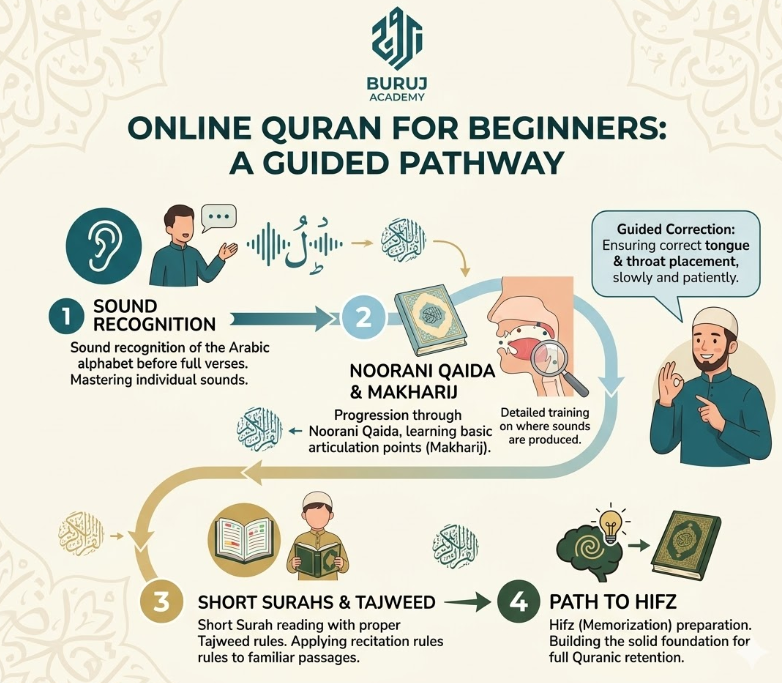
For a full introduction to the reading process, our guide on reading the Quran for the first time walks through exactly what to expect in your earliest sessions.
Daily Quran Reading Schedule for Intermediate Reciters (4–8 Pages Per Day)
An intermediate reciter’s daily Quran reading schedule should balance consistent page progress with Tajweed accuracy, aiming for 4–8 pages daily across two focused sessions. This range allows completion of the full Quran within 75–151 days while maintaining recitation quality.
4-Page Daily Schedule (Two-Session Model)
| Session | Time | Pages | Duration |
| Morning Session | After Fajr | 2 pages | 20–25 minutes |
| Evening Session | After Asr/Maghrib | 2 pages | 20–25 minutes |
| Daily Total | 4 pages | 40–50 minutes |
8-Page Daily Schedule (Two-Session Model)
| Session | Time | Pages | Duration |
| Morning Session | After Fajr | 4 pages | 35–40 minutes |
| Evening Session | After Asr | 4 pages | 35–40 minutes |
| Daily Total | 8 pages | 70–80 minutes |
A common mistake we see from intermediate students is reading too quickly to hit their page target. If your Tajweed rules are still developing, 4 pages at measured pace with correct application of rules like Ghunnah and Ikhfa is far superior to 8 pages read carelessly.
For students working on Tajweed alongside their reading schedule, our article on Tajweed for beginners explains how to integrate rule application into daily recitation without disrupting your flow.
Discover the Buruj Academy Difference
Step into our virtual classrooms and see how our expert instructors make learning Quran and Arabic intuitive and clear. We focus on overcoming the specific hurdles non-native speakers face, building your confidence and connection with the Quran.
Daily Quran Recitation Schedule for Advanced Reciters (1 Juz’ Per Day)
Advanced reciters aiming for a monthly Khatm (full completion) need to recite one complete Juz’ — approximately 20 pages — every day. This requires a structured multi-session approach, strong Tajweed foundation, and deliberate time allocation across the day’s prayer windows.
1 Juz’ Daily Schedule Across Five Prayer Windows
| Prayer Window | Pages | Approximate Duration |
| After Fajr | 4–5 pages | 30–35 minutes |
| After Dhuhr | 4–5 pages | 30–35 minutes |
| After Asr | 4–5 pages | 30–35 minutes |
| After Maghrib | 3–4 pages | 20–25 minutes |
| After Isha | 3–4 pages | 20–25 minutes |
| Daily Total | ~20 pages | ~2.5–3 hours |
This model — distributing recitation across all five prayer windows — is the classical practice of the Companions and early Muslim scholars. It prevents mental fatigue, maintains consistent focus across each sitting, and naturally anchors Quran reading to the daily prayer rhythm.
Buruj Academy’s Online Quran Recitation Course supports advanced reciters in maintaining Tajweed accuracy even at high-speed daily recitation, with Ijazah-certified instructors providing regular assessment sessions.
Book your first FREE recitation lesson

How to Build a Weekly Quran Reading Planner That Actually Sticks?
A weekly Quran reading planner requires three elements to sustain consistency: a realistic daily target, a designated makeup day, and a tracking system. Without all three, most schedules collapse within two to three weeks.
Sample Weekly Quran Reading Planner (4 Pages/Day Model)
| Day | Morning Session | Evening Session | Weekly Pages |
| Saturday | 2 pages after Fajr | 2 pages after Asr | 4 |
| Sunday | 2 pages after Fajr | 2 pages after Asr | 4 |
| Monday | 2 pages after Fajr | 2 pages after Asr | 4 |
| Tuesday | 2 pages after Fajr | 2 pages after Asr | 4 |
| Wednesday | 2 pages after Fajr | 2 pages after Asr | 4 |
| Thursday | 2 pages after Fajr | 2 pages after Asr | 4 |
| Friday | Catch-up or extended recitation | Review week’s pages | 4+ |
| Weekly Total | 28 pages |
Friday functions as a flexible buffer day — used for catch-up if any session was missed during the week, or for extended recitation given Friday’s special status in Islamic practice.
We recommend keeping a simple physical tracker — a printed page grid where you mark each page completed. Digital apps work well for some students, but in our instructors’ experience, the physical act of marking a completed page creates stronger accountability than passive app notifications.
Read also: How to Get Better at Reading Quran?
How to Adjust Your Daily Quran Reading Schedule Around a Busy Life?
A daily Quran reading schedule for working adults and parents must account for schedule unpredictability by building minimum viable sessions — short enough to complete even on difficult days. The goal is protecting the streak, not hitting the maximum target every day.
Minimum Viable vs. Full Session Planning
| Life Situation | Full Session Target | Minimum Viable Session |
| Working professional | 4 pages / 40 minutes | 1 page / 10 minutes after Fajr |
| Parent with young children | 3 pages / 30 minutes | Half page / 5–7 minutes |
| Student during exam period | 4 pages / 40 minutes | 1 page / 10–12 minutes |
| Traveler / irregular schedule | 2 pages / 20 minutes | 5–10 lines / 5 minutes |
The minimum viable session concept is critical. Missing one day often leads to missing a week. But reciting even 5 lines after Fajr on a difficult day preserves the habit’s neurological groove — making tomorrow’s full session easier to re-enter.
Our Hifz for Adults program applies this same principle to memorization schedules, designing realistic plans around adult life constraints rather than idealized daily availability.
Book Your Free Trial Lesson with Burruj’s Hifz Course for Adults

How Tajweed Level Affects Your Daily Quran Reading Schedule?
Your current Tajweed proficiency directly determines how many pages you can read accurately per session — and ignoring this leads to one of the most common scheduling errors we see. A student with developing Tajweed who commits to 8 pages daily will either rush and accumulate errors, or feel constantly behind and abandon the schedule entirely.
Tajweed Level and Recommended Daily Page Range
| Tajweed Level | Description | Recommended Daily Pages |
| Foundational | Still learning basic rules (Ikhfa, Idgham) | 1–2 pages |
| Developing | Rules known, application inconsistent | 2–4 pages |
| Established | Rules applied accurately under normal pace | 4–8 pages |
| Fluent | Full Tajweed with natural, confident pace | 8–20 pages |
Students at the foundational level often ask us whether they should wait until their Tajweed is strong before establishing a daily reading schedule. The answer is no — begin the schedule now at an appropriate page count, while simultaneously working on Tajweed rules. The two efforts reinforce each other when paced correctly.
Our articles on Ikhfa rules and Idgham rules in Tajweed explain the specific rules most commonly affecting recitation pace — understanding these helps you set a realistic daily target.
Expand Your Islamic Knowledge
Join our structured online courses led by qualified instructors to deepen your understanding of the Deen.
Join a Free Trial ClassStart Your Consistent Quran Reading Practice with Buruj Academy
A well-designed daily Quran reading schedule is only as effective as the recitation quality behind it. Reading more pages with errors embedded is not progress — it is reinforcing mistakes.
Buruj Academy’s Online Quran Recitation Course provides the structured foundation every consistent reader needs:
- Ijazah-certified instructors and Al-Azhar University graduates with 12+ years teaching non-Arabic speakers
- The Buruj Method: Sound-before-rules approach ensuring correct pronunciation from session one
- Personalized 1-on-1 sessions with flexible 24/7 scheduling across all time zones
- Real-time Tajweed correction integrated directly into your daily reading sessions
- Customized progression plans matching your current level and target schedule
Join a global community of learners and find the path that best supports your spiritual and intellectual growth:
- Online Studies Islamic Classes (General & Flexible)
- Islamic Studies Course for Beginners (Foundational Knowledge)
- Islamic Studies Classes for Kids (Engaging & Values-Based)
- Islamic Studies Classes for Adults (In-Depth Theological Discussion)
- Islamic Studies Classes for Ladies (Sisterhood & Specialized Learning)
- Islamic Studies Classes for New Muslims (Guided Support & Essentials)
- Tafseer Al Quran Course (Unlocking Divine Meanings)
- Quranic Sciences (Uloom Al Quran) Course (Advanced Linguistic & Historical Context)
Book your free trial lesson today and let our instructors help you design and sustain a daily Quran reading schedule built for your life.
Frequently Asked Questions About Daily Quran Reading Schedules
How long does it take to read the Quran once if I read 20 minutes a day?
Reading 20 minutes daily at an average beginner pace typically covers 1–2 pages per session, completing the Quran in approximately 10–12 months. At an intermediate pace of 2–3 pages per 20 minutes, completion takes 6–8 months. Consistent daily sessions matter more than session length for reaching completion.
What is the best daily Quran reading schedule for someone who has never read before?
Absolute beginners should start with one page after Fajr daily, spending 15–20 focused minutes on accurate letter pronunciation before worrying about page targets. Pair this with 10 minutes of listening to the same page after Asr. Build the habit for four weeks before increasing your daily portion.
Can I split my daily Quran reading across multiple short sessions?
Yes — splitting recitation across multiple short sessions is not only permissible but often more effective than one long sitting. Distributing your daily portion across Fajr, Dhuhr, and Asr windows maintains focus, prevents fatigue, and anchors Quran reading naturally to your existing prayer routine throughout the day.
How do I stay consistent with my Quran reading schedule during Ramadan?
During Ramadan, restructure your schedule around Tarawih and Suhoor windows. Many reciters add a dedicated post-Tarawih session for extended recitation. Setting a specific Ramadan target — such as completing the full Quran once — provides concrete motivation. Track daily progress visually to maintain momentum through the final ten nights.
Does reading Quran without understanding count as worship?
Yes. According to the scholarly consensus of mainstream Islamic jurisprudence, reciting the Quran in Arabic with correct pronunciation is an act of worship rewarded per letter, regardless of comprehension level. The Prophet ﷺ confirmed this in an authentic hadith recorded by Al-Tirmidhi. Seeking understanding alongside recitation is encouraged but not a precondition for reward.