 Islamic

| Key Takeaways |
| Starting with just 5–10 minutes of daily Quran reading builds a sustainable habit more effectively than occasional long sessions. |
| Choosing a fixed time — such as after Fajr — anchors your daily Quran reading to an existing prayer routine, increasing consistency. |
| Non-Arabic speakers must prioritize correct pronunciation from day one; reading with Tajweed errors without correction reinforces mistakes. |
| Tracking daily reading in a simple log increases accountability and helps identify the realistic amount of Quran to read each day. |
| A structured online course with a qualified instructor accelerates progress and eliminates the guesswork of self-directed Quran reading. |
Many Muslims genuinely want to read the Quran every day but struggle to move from intention to consistent habit. The challenge is rarely motivation — it is the absence of a clear, realistic starting structure.
Starting daily Quran reading requires three things: a manageable time commitment, a fixed routine anchor, and correct foundational reading skills. Even five focused minutes daily, consistently maintained, produces measurable progress within weeks.
Table of Contents:
1. Assess Your Current Quran Reading Level Before Setting Any Daily Goal
To start reading Quran daily, first identify exactly where your reading currently stands — this single step determines everything that follows.
Jumping into a daily reading goal without this assessment leads to either frustration from unrealistic targets or stagnation from goals that are too easy.
There are three practical reading levels to identify yourself within:
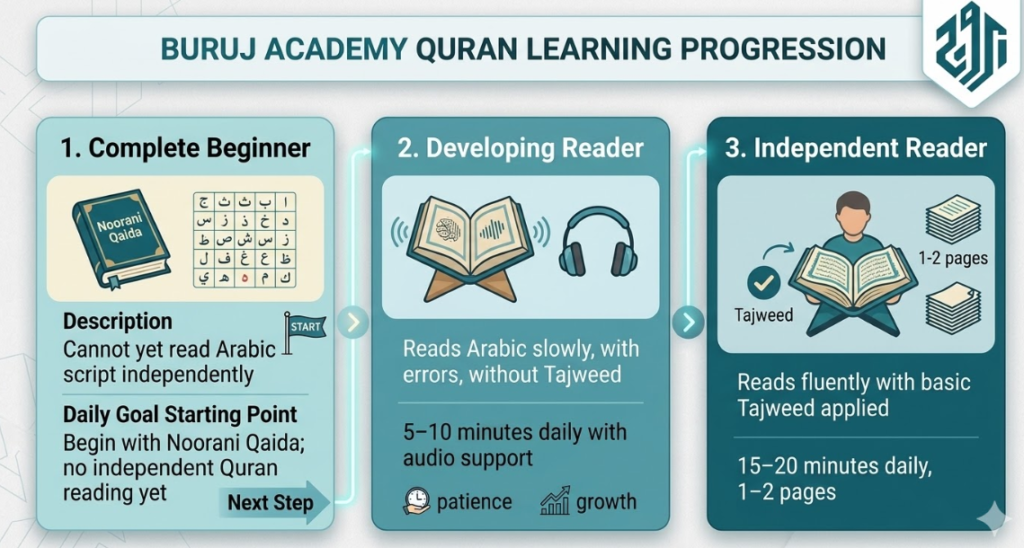
We consistently observe at Buruj Academy that adult students who skip this assessment tend to set goals based on what they wish they could read, rather than what their current skills support. This leads to discouragement within two weeks.
If you are a complete beginner, the most important first step is not opening the Mushaf — it is learning to read Arabic letters accurately.
Our Quran Reading Course builds this foundation systematically, taught by Al-Azhar-trained instructors with 12+ years of experience guiding non-Arabic speakers from zero to confident daily reading.
Book your Free trial lesson and start reading the Quran

Read also: How to Get Better at Reading Quran?
2. Start With a Daily Quran Reading Amount That You Can Realistically Sustain
The most common reason daily Quran reading habits collapse is beginning with an amount that is too ambitious for the current schedule and skill level. Sustainability must take priority over quantity in the early weeks.
How Much Quran Should I Read a Day as a Beginner?
For beginners, a daily target of half a page to one page of the Mushaf (approximately 5–10 minutes) is realistic and sustainable. The Quran contains 604 pages; reading half a page daily means completing the entire Quran in roughly three years and four months — which is far more valuable than reading two pages daily for two weeks before stopping entirely.
How Many Pages of the Quran Should I Read a Day to Complete It in One Year?
To complete the Quran in one year, you need to read approximately 1.65 pages per day — practically speaking, between one and two pages daily. The Quran has 604 pages divided across 30 Juz’, with each Juz’ averaging approximately 20 pages. Reading two pages daily completes the Quran in just over 10 months.
| Completion Goal | Daily Pages Required | Daily Time Estimate |
| 6 months | ~3.3 pages | 20–30 minutes |
| 1 year | ~1.65 pages (≈ 2 pages) | 10–15 minutes |
| 2 years | ~0.83 pages (≈ 1 page) | 5–10 minutes |
| 3 years | ~0.55 pages (≈ half page) | 4–6 minutes |
These estimates assume a developing reader’s pace. Fluent readers will cover the same pages faster.
Expand Your Islamic Knowledge
Join our structured online courses led by qualified instructors to deepen your understanding of the Deen.
Join a Free Trial Class3. Choose a Fixed Daily Time That Anchors Your Quran Reading to an Existing Habit
Choosing when to read Quran daily matters as much as deciding how much to read. Habits attach most successfully to existing anchors — actions you already perform daily without thinking.
The time immediately after Fajr prayer is the most effective anchor for daily Quran reading, and this recommendation has both spiritual and practical dimensions. The Prophet ﷺ said:
“Allah made the early morning hours blessed for my Ummah.” (Sunan Abi Dawud 2606)
After Fajr, the mind is rested, distractions are minimal, and the spiritual momentum of prayer is already present.
What If Fajr Is Not Realistic for My Schedule?
If Fajr reading is genuinely not sustainable — for parents of young children, shift workers, or new converts still building prayer habits — the following alternatives work well as anchors:
- After Maghrib: Family households often have a natural pause before dinner
- After Asr: Mid-afternoon for those working from home
- Immediately before sleep: Consistent nightly reading before any screen use
The critical rule is consistency of timing, not perfection of timing. A slightly imperfect time you maintain for six months is infinitely more valuable than the ideal time you abandon after two weeks.
Discover the Buruj Academy Difference
Step into our virtual classrooms and see how our expert instructors make learning Quran and Arabic intuitive and clear. We focus on overcoming the specific hurdles non-native speakers face, building your confidence and connection with the Quran.
Read also: Benefits of Reading Quran in the Morning and at Fajr
4. Learn Basic Tajweed Rules Before Reading Independently Every Day
Daily Quran reading only produces spiritual and academic benefit when the recitation is correct. Reading with systematic Tajweed errors daily does not build good habits — it reinforces incorrect ones, making them progressively harder to correct later.
The Quran itself specifies the manner of its recitation:
وَرَتِّلِ ٱلْقُرْءَانَ تَرْتِيلًا
Wa rattilil-Qur’āna tartīlā
“And recite the Quran with measured recitation.” (Al-Muzzammil 73:4)
Classical scholars of Tajweed interpret tartil as recitation with proper articulation, measured pace, and correct application of rules — not simply reading the words.
Which Tajweed Rules Are Essential for Daily Reading?
For beginners beginning daily reading, these foundational rules must be learned first:
| Rule | Why It Matters for Daily Reading |
| Madd (elongation) | Affects meaning — incorrect madd can change a word’s meaning entirely |
| Noon and Meem Mushaddad (Ghunnah) | Present in almost every page of the Quran |
| Waqf (stopping rules) | Stopping incorrectly mid-verse distorts meaning |
| Qalqalah | Applies to five letters appearing throughout the Quran |
Our detailed guide on Tajweed for beginners covers each of these rules with clear examples for non-Arabic speakers.
Buruj Academy’s Online Tajweed Classes for Beginners teach these rules through the Buruj Method’s sound-before-rules approach — students develop ear recognition of correct sounds before any abstract rule memorization.
Our Ijazah-certified instructors identify and correct pronunciation errors in real time, preventing the exact habit-reinforcement problem that daily self-study without guidance creates.
Book Your FREE Trial Lesson to Begin Your Tajweed Journey

Expand Your Islamic Knowledge
Join our structured online courses led by qualified instructors to deepen your understanding of the Deen.
Join a Free Trial Class5. Build a Simple Daily Quran Reading Tracker to Sustain Accountability
Intention alone does not sustain a daily Quran reading habit across weeks and months. External accountability systems — even simple ones — dramatically increase the probability of maintaining consistency.
In our experience with students at Buruj Academy, those who track their daily reading in any format — a phone note, a printed calendar, or a basic habit app — maintain their habit approximately three times longer than those who rely on intention alone.
The tracking itself is not the point; the visual record of unbroken consistency creates a psychological commitment to not break the chain.
What Should a Daily Quran Reading Log Include?
A useful daily reading tracker needs only four data points:
- Date
- Surah and verse where you began
- Surah and verse where you stopped
- Duration in minutes
This log serves a second purpose: it reveals your realistic reading pace over time, allowing you to adjust your daily page target to something genuinely achievable. After two weeks of tracking, you will know exactly how many pages you read in ten minutes — and can set goals accordingly.
Read also: How to Complete Quran in 7 Days, 5 Days, or 3 Days?
6. Use Audio Recitation to Support Your Daily Reading From the Beginning
Listening to a qualified reciter while following along in the Mushaf is one of the most effective tools for non-Arabic speakers beginning daily Quran reading. This technique simultaneously trains the ear, corrects pronunciation, and builds reading fluency in a way that silent reading alone cannot achieve.
The recitation of Sheikh Mahmoud Khalil Al-Hussary (رحمه الله) in Muallim (teaching) style is particularly effective for beginners — the slow, clearly articulated pace allows the reader to follow along comfortably and notice pronunciation discrepancies in their own reading.
How to Use Audio Recitation Effectively During Daily Reading
Follow this sequence for maximum benefit:
- Listen first — play the verse or short passage without looking at the text
- Follow along — replay while tracking each word in the Mushaf
- Repeat independently — attempt the same passage without audio
- Compare — play the audio once more and identify any differences
This technique is not memorization (Hifz) — it is active reading reinforcement. Students who use our Quran Recitation Course develop this skill systematically, with instructors providing the live comparison and correction that audio alone cannot offer.
Book your first FREE recitation lesson

7. Dedicate Time Daily to Read Quran by Removing One Specific Obstacle
The most common reason people fail to dedicate time daily to read Quran is not a lack of time — it is the presence of a specific, unaddressed obstacle. Identifying and removing that obstacle is more effective than adding more motivation.
| Common Obstacle | Practical Solution |
| “I don’t have a Mushaf accessible” | Keep a pocket Mushaf or install a verified Quran app |
| “I can’t read Arabic yet” | Enroll in a reading course before setting a Mushaf-reading goal |
| “I read but don’t understand anything” | Pair daily reading with a brief English translation review |
| “I miss days and lose momentum” | Use a makeup rule: if you miss one day, double the next |
| “Family interruptions break my reading” | Read immediately after any obligatory prayer already prayed alone |
The “immediately after prayer” solution deserves particular attention. Every obligatory prayer represents a moment already protected from most interruptions — adding five minutes of Quran reading directly after the tasleem requires no extra schedule management, only the decision to remain seated.
Our guide on reading the Quran for the first time addresses the specific fears and obstacles that beginners face when approaching the Mushaf — it is worth reading alongside this practical framework.
8. Gradually Increase Your Daily Quran Reading as the Habit Solidifies
A sustainable increase in daily reading quantity follows a predictable pattern: maintain the initial target without exception for a minimum of three weeks, then increase by no more than half a page at a time.
Rapid increases — jumping from half a page to three pages within a week — are the second most common cause of habit collapse after beginning with too much.
The schedule cannot absorb a sudden increase when life disruptions occur, and missed days from an inflated target feel more defeating than missed days from a modest one.
When Is the Right Time to Increase How Much Quran I Read Per Day?
Increase your daily reading target only when all three conditions are met:
- You have maintained your current target for at least 21 consecutive days
- You have completed your daily reading before your scheduled anchor time on most days (indicating the current amount feels comfortable)
- Your reading pace has improved — you are completing the same pages faster than when you began
The goal of daily Quran reading is lifelong consistency, not maximum quantity in the shortest possible time. As Allah ﷻ’s Messenger ﷺ said:
“The most beloved deeds to Allah are those done consistently, even if they are small.” (Sahih al-Bukhari 6464)
This hadith is the single most important principle governing sustainable daily Quran reading. Consistent small deeds outweigh occasional large ones — in both divine reward and practical habit formation.
For those whose goal is not just daily reading but memorization, our Quran memorization schedule provides a structured framework for combining new memorization with consistent daily review.
Expand Your Islamic Knowledge
Join our structured online courses led by qualified instructors to deepen your understanding of the Deen.
Join a Free Trial ClassBegin Your Daily Quran Reading with Buruj Academy’s Expert Instructors
Daily Quran reading delivers its full benefit when the recitation is correct, the habit is structured, and progress is guided. At Buruj Academy, our Online Quran Classes for Beginners provide exactly this — personalized 1-on-1 sessions with Ijazah-certified, Al-Azhar-trained instructors who build your reading skills from the foundation upward.
Our instructors apply the Buruj Method — consistency-before-speed, sound-before-rules — ensuring that every student develops correct habits from day one. Flexible 24/7 scheduling means your sessions fit around your life, not the other way around.
Join a global community of learners and find the path that best supports your spiritual and intellectual growth:
- Online Studies Islamic Classes (General & Flexible)
- Islamic Studies Course for Beginners (Foundational Knowledge)
- Islamic Studies Classes for Kids (Engaging & Values-Based)
- Islamic Studies Classes for Adults (In-Depth Theological Discussion)
- Islamic Studies Classes for Ladies (Sisterhood & Specialized Learning)
- Islamic Studies Classes for New Muslims (Guided Support & Essentials)
- Tafseer Al Quran Course (Unlocking Divine Meanings)
- Quranic Sciences (Uloom Al Quran) Course (Advanced Linguistic & Historical Context)
Book your free trial lesson today at Buruj Academy and establish a daily Quran reading habit that lasts a lifetime, insha’Allah.
Frequently Asked Questions About How to Start Reading Quran Daily
How Much Quran Should I Read a Day as a Busy Adult?
Busy adults should begin with a minimum of five to ten minutes of daily Quran reading — equivalent to roughly half a page to one page. Consistency across weeks matters far more than quantity in any single session. A fixed post-prayer reading slot of five minutes daily is more sustainable and spiritually rewarding than irregular longer sessions.
How Many Pages of the Quran Should I Read a Day to Finish in One Year?
To complete the Quran in one year, read approximately two pages daily — more precisely, 1.65 pages per day across 604 total pages. At this pace, the Quran is completed in approximately 365 days. A developing reader typically requires 10 to 15 minutes to cover two pages comfortably.
Can I Start Reading Quran Daily If I Don’t Know Arabic?
Yes — but with an important qualification. Non-Arabic speakers must learn to read Arabic script correctly before beginning independent daily Quran reading. Starting with a foundational Quran Reading Course or Noorani Qaida course with a qualified teacher ensures that daily reading builds correct habits rather than reinforcing pronunciation errors.
What Is the Best Time to Read Quran Daily for Maximum Spiritual Benefit?
The time immediately after Fajr prayer is widely regarded by scholars as the most blessed time for Quran reading, supported by the hadith in Sunan Abi Dawud affirming the blessing of early morning hours. Practically, Fajr reading also benefits from minimal distractions, mental freshness after sleep, and the spiritual momentum of having just completed prayer.
How Do I Maintain My Daily Quran Reading Habit When Life Gets Busy?
Maintain your habit during busy periods by temporarily reducing your daily target — not abandoning it. Reading a single page instead of three during a difficult week preserves the habit’s continuity. Use a simple daily log to track consistency, and apply a makeup rule: if you miss one day, add that portion to the following day rather than abandoning the week entirely.