 Islamic

| Key Takeaways |
| Daily Quran recitation is wajib (obligatory) for every Muslim through Salah, making it fard in practice. |
| Reading Quran outside of Salah is classified as a confirmed Sunnah (Sunnah Mu’akkadah) by the majority of scholars. |
| Scholars unanimously agree that Muslims must maintain a living relationship with the Quran through regular reading and reflection. |
Every Muslim has felt it — that quiet pull toward the Quran, and the accompanying guilt when days pass without opening it. But what does Islamic law actually say about reading the Quran? Is it obligatory, or does missing it leave no sin?
Reading the Quran is mandatory within Salah as a condition of valid prayer, making it functionally fard for every practicing Muslim. Outside of Salah, the majority of scholars classify regular Quran recitation as Sunnah Mu’akkadah — a confirmed Sunnah whose consistent abandonment is sinful and spiritually damaging.
Table of Contents:
Is Reading Quran Fard or Sunnah?
Reading Quran outside of Salah is classified as Sunnah Mu’akkadah — a strongly confirmed Sunnah. This means it is not fard in the same absolute sense as prayer itself, but its regular abandonment without valid excuse is considered Makruh.
The distinction matters. Fard (obligatory) acts, when abandoned, make a Muslim sinful without question. Sunnah Mu’akkadah acts, when consistently neglected, also Makruh — the Prophet ﷺ maintained these so consistently that abandoning them signals a serious disconnect from prophetic practice.
Importantly, scholars do not treat this as a light matter. Imam Ibn al-Jazari, one of the greatest authorities in Quranic sciences, wrote that a Muslim who has learned to read the Quran and then abandons it entirely bears a real religious responsibility.
The scholarly consensus frames regular Quran reading not as optional enrichment but as a living obligation of the Muslim heart.
Read also: How Many Good Deeds for Reading the Whole Quran?
Is Reading Quran Mandatory Through Salah?
Yes — reciting the Quran is fard through Salah, and no Muslim can avoid it. Reciting Surah Al-Fatiha in every rak’ah is a pillar of prayer, as established in the authenticated hadith from Sahih al-Bukhari:
لَا صَلَاةَ لِمَنْ لَمْ يَقْرَأْ بِفَاتِحَةِ الْكِتَابِ
“Laa salaata liman lam yaqra’ bi faatihatil-kitaab”
“There is no prayer for the one who does not recite the opening chapter of the Book.” (Sahih al-Bukhari 756)
This hadith establishes that Quran recitation is a condition of valid Salah — not an enhancement of it. Every Muslim who performs their five daily prayers recites Quran a minimum of seventeen rak’ahs per day.
In this sense, reading Quran is not merely sunnah for any Muslim who prays — it is fard, embedded within the prayer itself.
The practical implication is significant: a Muslim who claims they “don’t read Quran” but performs Salah is already reciting it seventeen times daily. The real question is whether they are reading beyond Salah with presence, understanding, and consistency.
Expand Your Islamic Knowledge
Join our structured online courses led by qualified instructors to deepen your understanding of the Deen.
Join a Free Trial ClassWhat Does the Quran Itself Say About Reading It?
Allah ﷻ commands regular engagement with the Quran in multiple verses. One of the most direct is from Surah Al-Muzzammil:
فَاقْرَءُوا مَا تَيَسَّرَ مِنَ الْقُرْآنِ
“Faqra’oo maa tayassara minal-Qur’an”
“so recite what is easy [for you] of the Qur’an.” (Al-Muzzammil 73:20)
Scholars of Tafsir note that this verse came as a merciful easing of an earlier command to stand in night prayer — yet Allah ﷻ retained the command to recite. Even when easing the burden, the recitation was kept. This tells us something profound: Quran reading is not a bonus act but a baseline expectation for the believer.
The verse uses the word “maa tayassara” — what is easy — which scholars interpret as Allah accommodating varying capacities while maintaining the principle that recitation must not be abandoned entirely.
| Quranic Ruling | Category | Scholarly Classification |
| Al-Fatiha in Salah | Fard (Obligatory) | Agreed upon by all four madhabs |
| Additional Surah in prayer | Wajib/Sunnah (varies by madhab) | Hanafi: Wajib; others: Sunnah |
| Daily Quran recitation outside Salah | Sunnah Mu’akkadah | Majority position |
| Abandoning Quran entirely | Sinful | Agreed upon by scholars |
Discover the Buruj Academy Difference
Step into our virtual classrooms and see how our expert instructors make learning Quran and Arabic intuitive and clear. We focus on overcoming the specific hurdles non-native speakers face, building your confidence and connection with the Quran.
What Happens If You Don’t Read Quran?
Allah ﷻ gives us a direct answer in the Quran itself. On the Day of Judgment, the Prophet ﷺ will complain to Allah about those who abandoned the Quran:
وَقَالَ الرَّسُولُ يَٰرَبِّ إِنَّ قَوْمِى اتَّخَذُوا۟ هَٰذَا الْقُرْءَانَ مَهْجُورًا
“Wa qaaalar-rasoolu yaa Rabbi inna qawmit-takhazoo haadhal-Qur’aana mahjooraa”
“And the Messenger will say: ‘My Lord, indeed my people have taken this Quran as a thing abandoned.'” (Al-Furqan 25:30)
Imam Ibn Kathir explains in his Tafsir that “mahjoor” (abandoned) includes multiple forms of abandonment — not reciting it, not listening to it, not reflecting on it, and not acting by its guidance.
This verse serves as a serious warning: the Quran’s complaint against its own people is one of the gravest images in the entire Quran.
From a jurisprudential standpoint, scholars identify several consequences of abandoning Quran recitation:
| Level of Abandonment | Islamic Ruling | Scholarly Evidence |
| Missing individual days | Not sinful if generally consistent | Principle of mercy in Islamic law |
| Neglecting for weeks/months without excuse | Sinful (Sunnah Mu’akkadah abandoned) | Majority scholarly position |
| Never reading outside Salah for years | Serious sin | Based on Al-Furqan 25:30 |
| Abandoning Salah itself (which contains Quran) | Major sin | Agreed upon unanimously |
In our experience teaching at Buruj Academy, students who come to us after long breaks from the Quran often carry a heavy spiritual weight — they sense something is missing but aren’t sure what.
We consistently see that returning to the Quran, even with basic reading, produces an almost immediate shift in their sense of connection to Allah ﷻ.
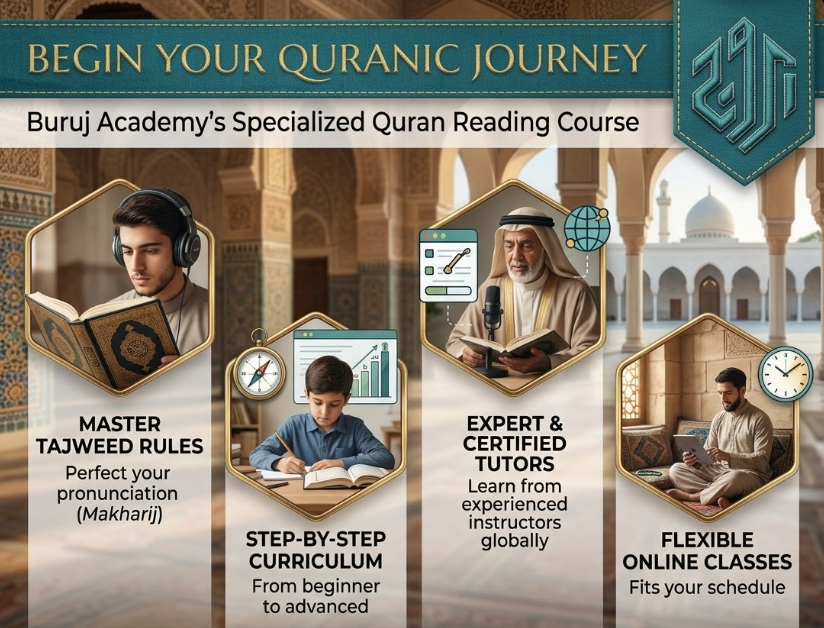
If you’re returning to the Quran after time away, our Quran Reading Course provides a structured, judgment-free path back — taught by Al-Azhar-trained instructors who understand exactly where you are.
Book your Free trial lesson and start reading the Quran
Is Reading Quran Fard for Every Muslim Individually?
The principle of fard al-‘ayn (individual obligation) versus fard al-kifayah (collective obligation) is relevant here. Scholars have distinguished between different aspects of Quran engagement:
Fard al-‘Ayn aspects (individually obligatory for every Muslim):
- Reciting Al-Fatiha in every rak’ah of Salah
- Knowing enough Quran to perform valid prayer
- Not abandoning the Quran entirely
Fard al-Kifayah aspects (obligatory on the Muslim community collectively):
- Preserving, memorizing, and teaching the full Quran
- Producing qualified scholars who master Tajweed and Quranic sciences
This distinction clarifies why not every Muslim must become a hafiz or a Tajweed scholar — but every Muslim must maintain a personal, living relationship with the Quran through recitation.
At Buruj Academy, our Online Quran Classes for Beginners are built around exactly this principle — helping every Muslim fulfill their individual obligation to read and connect with the Quran, regardless of starting level. Our Ijazah-certified instructors have guided thousands of non-Arabic speaking adults to confident Quran reading through the Buruj Method.
Begin Learning Quran With a FREE Trial Lesson
How Much Quran Should a Muslim Read Daily?
Classical scholars recommended a daily portion (known as a wird) of Quran recitation as a structured habit. The Prophet ﷺ guided companions on pacing their complete recitation, with authentic narrations suggesting completing the Quran in seven days for those with strong capacity, and longer periods for those with less time.
The key principle from classical scholarship is consistency over quantity. A small, consistent daily portion — even a single page — is more spiritually valuable than reading large amounts infrequently.
| Daily Reading Level | Approximate Quran Completion | Recommended For |
| 1 page per day | ~1.7 years | Absolute beginners, very busy schedules |
| 4 pages per day | ~5 months | Average adult learners |
| 1 Juz per day | 30 days (one month) | Advanced readers during Ramadan |
| 2 pages per day | ~10 months | Beginners building consistency |
Scholars from the Hanbali and Shafi’i schools specifically advised against completing the Quran in less than three days, citing a hadith in Sunan Abu Dawud where the Prophet ﷺ said: “Whoever recites the Quran in less than three days does not understand it.” This shows that reading with reflection was always prioritized over speed alone.
Our article on reading the Quran for the first time provides practical guidance for Muslims building this habit from scratch.
Read also: Virtues and Rewards for Reading Quran
Does the Ruling Change for Someone Who Cannot Read Arabic?
For a Muslim who has not yet learned to read Arabic, the obligation shifts to acquiring that ability. Scholars classify learning enough Arabic to recite Al-Fatiha correctly as fard al-‘ayn — individually obligatory — because Salah itself cannot be valid without it.
A Muslim who is actively learning is not sinful for their current inability. But the intention and effort to learn must be genuine and ongoing. Indefinitely delaying learning to read the Quran — particularly when resources are available — is not an acceptable position in Islamic law.
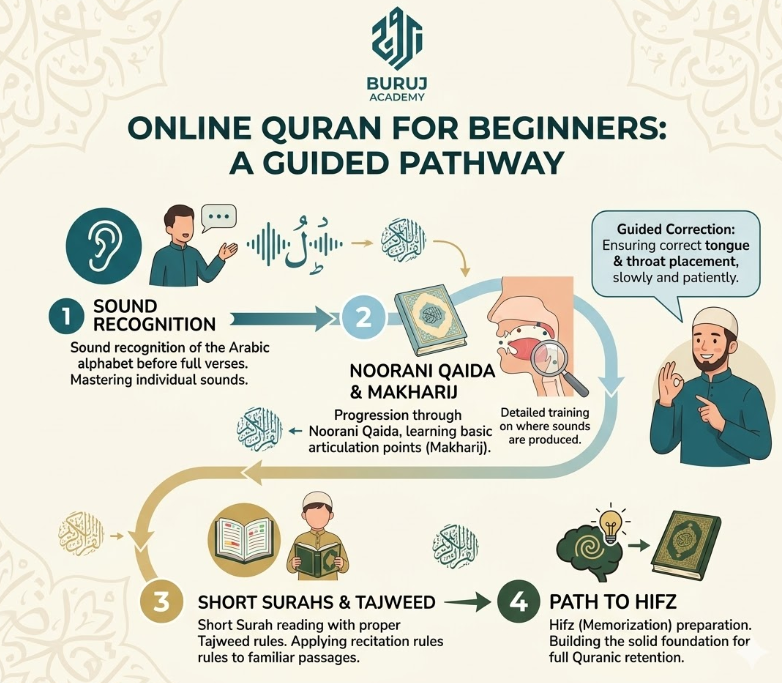
This is precisely why beginning Quran reading is not optional for any Muslim, regardless of age or background. Buruj Academy’s Online Quran Recitation Course was designed for exactly this situation — adults and beginners who need structured, patient guidance from qualified teachers who have helped non-Arabic speakers successfully for over 12 years.
Book your first FREE recitation lesson
For Muslims beginning at the very foundation — learning Arabic letters and basic reading rules — our guide on Tajweed for beginners walks through where to start and how to progress systematically.
Expand Your Islamic Knowledge
Join our structured online courses led by qualified instructors to deepen your understanding of the Deen.
Join a Free Trial ClassStart Reading Quran with Confidence at Buruj Academy
Every Muslim deserves to fulfill their relationship with the Quran — not just through Salah, but through daily, confident, meaningful recitation. Buruj Academy’s Online Quran Classes connect you with Ijazah-certified, Al-Azhar-trained instructors who have guided non-Arabic speakers globally for 12+ years.
What sets Buruj Academy apart:
- Al-Azhar University graduates with deep Quran and Islamic sciences training
- The Buruj Method: sound-before-rules, consistency-before-speed
- Personalized 1-on-1 sessions with flexible 24/7 scheduling
- Real-time feedback and individualized recitation correction
- Proven progression from complete beginner to confident daily reader
Join a global community of learners and find the path that best supports your spiritual and intellectual growth:
- Online Studies Islamic Classes (General & Flexible)
- Islamic Studies Course for Beginners (Foundational Knowledge)
- Islamic Studies Classes for Kids (Engaging & Values-Based)
- Islamic Studies Classes for Adults (In-Depth Theological Discussion)
- Islamic Studies Classes for Ladies (Sisterhood & Specialized Learning)
- Islamic Studies Classes for New Muslims (Guided Support & Essentials)
- Tafseer Al Quran Course (Unlocking Divine Meanings)
- Quranic Sciences (Uloom Al Quran) Course (Advanced Linguistic & Historical Context)
Book your free trial lesson today and take the first step toward fulfilling one of the most rewarding acts in your Muslim life — Insha’Allah.
Frequently Asked Questions About Reading Quran in Islam
Is reading Quran fard or sunnah outside of Salah?
Reading Quran outside of Salah is Sunnah Mu’akkadah — a strongly confirmed Sunnah — according to the majority of scholars. Its consistent abandonment without excuse is sinful. Within Salah, however, reciting Al-Fatiha in every rak’ah is fard al-‘ayn, making Quran recitation obligatory for every praying Muslim on a daily basis.
Is it mandatory to read the Quran in Arabic?
Yes — Quran recitation in Salah must be in Arabic. Reading translations does not substitute for reciting the original Arabic text in prayer. Every Muslim is obligated to learn enough Arabic to recite Al-Fatiha correctly, as Salah without it is invalid according to all four major madhabs.
How much Quran should I read every day?
Classical scholars recommended a consistent daily wird (portion). Even one page daily maintains the living connection the Quran demands. The Prophet ﷺ guided companions to complete recitation in more than seven days, not less than that. Consistency matters more than volume — a small amount read daily is superior to large amounts read infrequently.
Can I fulfill my Quran reading obligation through listening only?
Listening to Quran recitation (istima’) carries great reward and is encouraged, but it does not replace the obligation to personally recite in Salah. Scholars differ on whether listening fully substitutes for personal recitation outside Salah, but the agreed position is that a Muslim capable of reading should personally recite, not rely solely on listening.