 Islamic

| Key Takeaways |
| Reciting Quran from memory without wudu is permitted for minor ritual impurity (hadath asghar), according to the majority of scholars. |
| Physically touching a printed mushaf without wudu is prohibited according to the four major madhabs, based on established scholarly evidence. |
| Reading Quran from a smartphone or app does not carry the same ruling as a printed mushaf — wudu is not required to touch the device. |
| A person in a state of major ritual impurity (janabah) may not recite Quran at all — from memory, mushaf, or phone — until they perform ghusl. |
| A menstruating woman may recite Quran from memory or from her phone without wudu, as her condition differs fundamentally from janabah. |
Most Muslims have asked this question at some point — sitting on a bus, waking up before Fajr, or reaching for their phone during a busy afternoon. The question of wudu and Quran recitation touches daily worship in a very real, practical way.
The short answer is this: you may recite Quran from memory without wudu if you are in a state of minor impurity — but you may not touch a printed mushaf without wudu, and you may not recite at all if you are in a state of major impurity (janabah). The ruling changes depending on your state, your method of reading, and what you are holding.
Table of Contents:
Do You Need Wudu to Recite Quran from Memory?
Reciting Quran from memory without wudu is permitted for a person in a state of minor ritual impurity (hadath asghar). The majority of classical scholars, including those of the Maliki, Shafi’i, and Hanbali schools, held that wudu is a condition for touching the mushaf — not for recitation itself.
The Prophet ﷺ is reported in a hadith recorded by Imam Ahmad to have regularly made dhikr and engaged in speech in various states, with the specific exception of janabah (major impurity). This supports the position that minor impurity does not prevent the tongue from reciting.
That said, reciting with wudu is always superior. We consistently remind students at Buruj Academy that approaching Quran in a state of purity — even when it is not obligatory — reflects the reverence this Book deserves.
| State | Recite from Memory | Touch Mushaf | Read from Phone |
| With wudu | ✅ Yes | ✅ Yes | ✅ Yes |
| Minor impurity (no wudu) | ✅ Yes | ❌ No | ✅ Yes |
| Major impurity (janabah) | ❌ No | ❌ No | ❌ No |
| Menstruation / Nifas | ✅ Yes (memory/phone) | ❌ No | ✅ Yes |
The table above summarizes the core rulings that govern daily Quran engagement across different states of purity.
Read also: Can You Read the Quran Without Hijab?
Is It Haram to Touch the Quran Without Wudu?
Yes, touching a printed mushaf without wudu is prohibited according to the four major madhabs. The evidence most commonly cited is the letter the Prophet ﷺ sent to the people of Yemen, in which it was written: “None should touch the Quran except one who is pure (tahir).” Scholars of hadith — including Ibn Abd al-Barr — have accepted this narration as supported by corroborating chains.
The word tahir (pure) in this context refers to freedom from both major and minor ritual impurity. This means a person who has not performed wudu after nullifying it — through sleep, using the restroom, or similar — may not directly handle the pages of a printed mushaf.
What Counts as “Touching” the Mushaf?
Direct skin contact with the pages or cover of the mushaf is what scholars address when they speak of this ruling. Carrying a mushaf wrapped in cloth, placed inside a bag, or held with a barrier does not fall under the same prohibition according to most scholars.
This distinction is practical: a student who is not in wudu but needs to move a mushaf from one place to another may do so using a cloth or sleeve without violating the ruling.
Expand Your Islamic Knowledge
Join our structured online courses led by qualified instructors to deepen your understanding of the Deen.
Join a Free Trial ClassCan You Read Quran Without Wudu on Your Phone?
Reading Quran from a phone app without wudu is permitted. Scholars at institutions including Al-Azhar have clarified that a smartphone displaying Quranic text is not considered a mushaf in the legal sense — the letters on a screen are digital signals, not inscribed text on a physical surface designated exclusively for the Quran.
This means the ruling that prohibits touching the mushaf without wudu does not apply to a phone, tablet, or computer screen. A person in a state of minor impurity may unlock their phone, open a Quran app, and recite freely.
Entering the Bathroom While Quran Is Open on Your Phone
If you need to enter the bathroom with your phone, scholars recommend closing the Quran app or locking the screen before entering. Displaying Quranic verses in a place of impurity carries its own ruling of disrespect (ihanah), even if the phone itself is not a mushaf. Closing the app removes any concern.
Buruj Academy’s students — many of whom use Quran apps for daily review and recitation practice — are always advised to treat digital Quran displays with the same general reverence they would a physical text, even where the strict legal rulings differ.
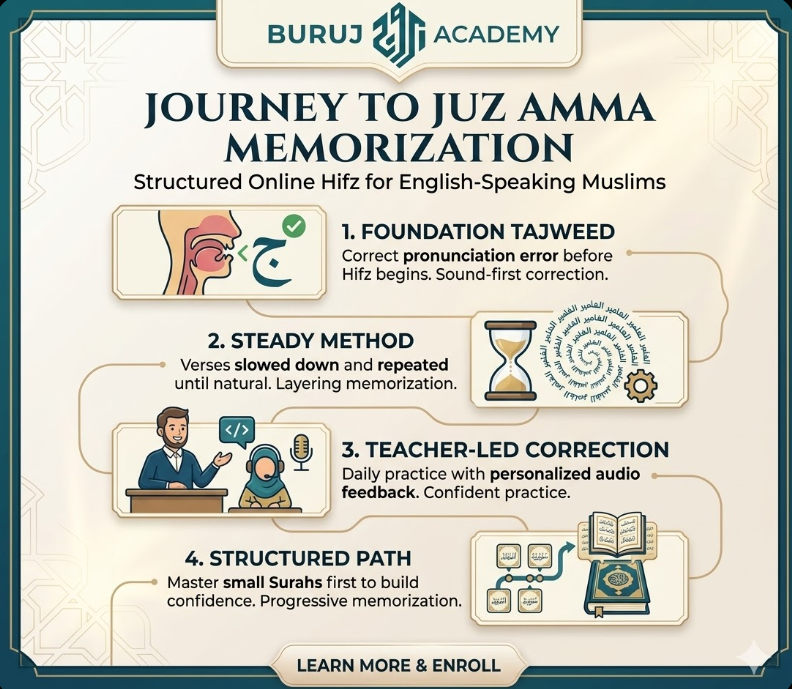
If building your memorized repertoire for prayer is a goal, Buruj Academy’s Juz 30 Memorization course systematically covers the most recited surahs with proper Tajweed, taught by Ijazah-certified instructors who ensure both accuracy and retention.
Book Your Kid’s First Session in Buruj’s Juz 30 Memorization Course
Can You Recite Quran Without Wudu If You Are in a State of Janabah?
No. A person in a state of major ritual impurity (janabah) — which occurs after sexual intercourse or emission — may not recite Quran at all until they perform ghusl (full ritual bath). This prohibition covers recitation from memory, from a physical mushaf, and from a digital screen.
The evidence for this ruling is recorded by Imam Ahmad and Abu Dawud on the authority of ‘Ali ibn Abi Talib (may Allah be pleased with him): “Nothing prevented the Prophet ﷺ from reciting Quran except janabah.” This hadith establishes that janabah specifically — and not minor impurity — is the barrier to recitation itself.
Some scholars have made a narrow exception for a person in a state of janabah who recites a brief supplication that happens to be Quranic — such as Bismillah or Alhamdulillah — with the intention of dhikr (remembrance) rather than Quran recitation. This is a minority position and should not be taken as a general license.
The rule is clear and consistent: ghusl must be performed before any Quranic recitation resumes.
Read also: Can You Read Quran on Your Period?
Can You Read Quran Translation Without Wudu?
Reading a Quran translation without wudu is permitted. A book containing only the translation of Quranic meanings — without the original Arabic text — does not carry the ruling of a mushaf. It may be handled and read freely regardless of ritual state.
For books that contain both Arabic Quranic text and translation side-by-side, scholars differ. The dominant view is that the presence of the Arabic text gives the volume the ruling of a mushaf, and wudu is therefore required to touch it.
Some scholars permit touching the translation portion with the non-dominant hand, though this is a fine distinction that varies by school.
If you are reading the Quran for the first time and relying on a bilingual edition, the safest practice is to maintain wudu when handling it — or to use a digital version where the ruling is more flexible.
Discover the Buruj Academy Difference
Step into our virtual classrooms and see how our expert instructors make learning Quran and Arabic intuitive and clear. We focus on overcoming the specific hurdles non-native speakers face, building your confidence and connection with the Quran.
Can a Menstruating Woman Read Quran Without Wudu?
A menstruating woman (ha’id) may recite Quran from memory or from her phone without wudu. The stronger scholarly position — held by Ibn Taymiyyah, Ibn al-Qayyim, and supported by evidence from the Sunnah — is that menstruation does not carry the same ruling as janabah regarding Quran recitation.
The Prophet ﷺ told ‘A’ishah (may Allah be pleased with her) during her menstruation in Hajj: “Do what a person on Hajj does, except do not perform tawaf around the Ka’bah until you are pure.” He specified tawaf as the exception — not Quran recitation. This omission is itself evidence that recitation remains permitted.
The reasoning that distinguishes menstruation from janabah is practical: a person in janabah can perform ghusl immediately and remove their impurity. A menstruating woman cannot — her state may last seven to ten days. Preventing her from all Quran recitation for that extended period has no explicit textual basis.
She may not, however, touch a physical mushaf during menstruation. The prohibition on touching the mushaf without purity applies here as it does in all other states. Recitation from memory or a phone app remains fully open to her.
If she is working through a memorization program, we encourage sisters to maintain their daily revision through their phone during this time — consistency in Quran memorization is one of the most important factors in long-term retention.
Buruj Academy’s Hifz Classes for Ladies is taught by qualified women instructors who provide personalized guidance and understand the specific practical needs of female students, including how to maintain momentum through all phases of their schedule.
Book Your Free Trial Lesson with Burruj’s Hifz Course for Ladies

Expand Your Islamic Knowledge
Join our structured online courses led by qualified instructors to deepen your understanding of the Deen.
Join a Free Trial ClassStrengthen Your Recitation with Buruj Academy’s Expert Instructors
Knowing the rulings around wudu and Quran recitation helps you protect your worship and maintain it across all circumstances. The next step is ensuring that your recitation itself is correct — with proper Tajweed, accurate pronunciation, and confident fluency.
Buruj Academy’s Online Tajweed Classes are taught by Ijazah-certified instructors and Al-Azhar University graduates with 12+ years of experience teaching non-Arabic speakers worldwide.
Through the Buruj Method — sound before rules, consistency before speed — students build accurate recitation habits from the foundation up.
We offer personalized 1-on-1 sessions with flexible scheduling across all time zones. Whether you are a complete beginner or refining advanced recitation, book your free trial lesson today and begin with a qualified instructor who will meet you exactly where you are.
Join a global community of learners and find the path that best supports your spiritual and intellectual growth:
- Online Studies Islamic Classes (General & Flexible)
- Islamic Studies Course for Beginners (Foundational Knowledge)
- Islamic Studies Classes for Kids (Engaging & Values-Based)
- Islamic Studies Classes for Adults (In-Depth Theological Discussion)
- Islamic Studies Classes for Ladies (Sisterhood & Specialized Learning)
- Islamic Studies Classes for New Muslims (Guided Support & Essentials)
- Tafseer Al Quran Course (Unlocking Divine Meanings)
- Quranic Sciences (Uloom Al Quran) Course (Advanced Linguistic & Historical Context)
Ready to enrich your life with sacred knowledge? Connect with Buruj Academy today and book your free introductory session to begin your journey!
Frequently Asked Questions About Reading Quran Without Wudu
Can You Recite Quran Without Wudu if You Are a Beginner Learning to Read?
Yes. A beginner learning to read Quran — whether from a phone app, a teacher’s screen, or from memory — may do so in a state of minor impurity without wudu. The ruling against touching a mushaf without wudu applies to the physical printed text, not to the act of learning or reciting itself. Pursue Tajweed for beginners with confidence regardless of your ritual state.
Does Wudu Break During Quran Recitation?
No. Wudu is not broken by Quran recitation itself. Wudu is nullified by its known legal nullifiers — using the restroom, passing gas, deep sleep, and similar acts. If any of these occur during recitation, you would need to renew wudu before touching the mushaf again, though you may continue reciting from memory until you do.
Can You Read Quran Without Wudu on a Phone During Pregnancy?
Yes. Pregnancy does not affect the ruling on wudu or Quran recitation. A pregnant woman carries no state of ritual impurity related to her pregnancy. She may recite from memory, from her phone, or touch the mushaf — all according to the standard rulings based on whether she has wudu or not.
Is It Disrespectful to Read Quran Without Wudu?
It is not disrespectful in the legal sense when the ruling permits it — such as reciting from memory or reading from a phone in a state of minor impurity. Wudu for recitation, when not obligatory, is an act of recommended etiquette (adab) that earns additional reward. The act itself remains valid and rewarded without it.
Do You Need Wudu to Listen to Quran Recitation?
No. Listening to Quran — whether from a speaker, phone, or another person’s recitation — does not require wudu in any state. Listening is an act of the ear and heart, not the hand. You may listen to Quran at any time, in any state of ritual purity, and the reward for attentive listening is confirmed in Islamic scholarship.